Technical SEO Checklist 2025: Rank on Google & AI
Master technical SEO in 2025 with this checklist covering Core Web Vitals, schema markup, AI search optimization (AEO), and site architecture.
 Maya Krishnan
Great content is invisible without a solid technical foundation. You can write the most insightful industry analysis, but if search engines cannot crawl, index, or render your pages efficiently, your rankings will stagnate.
In 2026, technical SEO has evolved beyond simple meta tags and sitemaps. It now encompasses optimization for AI engines (AEO), strict Core Web Vitals adherence (specifically INP), and structured data that feeds Large Language Models (LLMs) like GPT-5 and Gemini.
This checklist is not just a list of tasks. It is a strategic framework designed to make your website understandable to both Google's bots and the AI agents powering the next generation of search. If you are new to the discipline, start with our guide on what technical SEO is, then use this checklist to put it into practice.
1. Crawlability and Indexing: The Foundation
Before worrying about rankings, you must ensure search engines can access your site. If Google can't see it, you don't exist.
Optimize Your Robots.txt
Your robots.txt file is the gatekeeper. It tells bots where they can and cannot go. A single syntax error here can de-index your entire site.
Checklist:
- Ensure the file is located at
yourdomain.com/robots.txt. - Verify you are not blocking important resources (CSS, JS, images).
- Check that
Disallow: /is NOT present (unless the site is in development). - Include the location of your XML sitemap at the bottom of the file.
User-agent: *
Allow: /
Disallow: /admin/
Disallow: /cart/

Sitemap: https://www.yourdomain.com/sitemap_index.xml
XML Sitemap Configuration
Your sitemap serves as a roadmap for crawlers.
Checklist:
- Include only canonical, indexable URLs (no 404s, 301s, or noindexed pages).
- Keep file size under 50MB and 50,000 URLs. If larger, use a sitemap index file.
- Submit your sitemap to Google Search Console (GSC) and Bing Webmaster Tools.
- Pro Tip: Create separate sitemaps for images, videos, and news if you have distinct content types.
Fix Status Code Errors
Status codes tell you how the server responds to a request. You want to minimize "link rot" to preserve authority.
- 200 (OK): The goal for all live pages.
- 301 (Permanent Redirect): Ensure redirect chains are avoided (e.g., A > B > C). Link directly from A > C.
- 404 (Not Found): Identify these in GSC. If the page had traffic or backlinks, 301 redirect it to the most relevant equivalent. If it was low-value, let it 410 (Gone).
- 5xx (Server Errors): These are urgent. They indicate your server is failing to load the page, causing Google to drop the URL from the index temporarily.
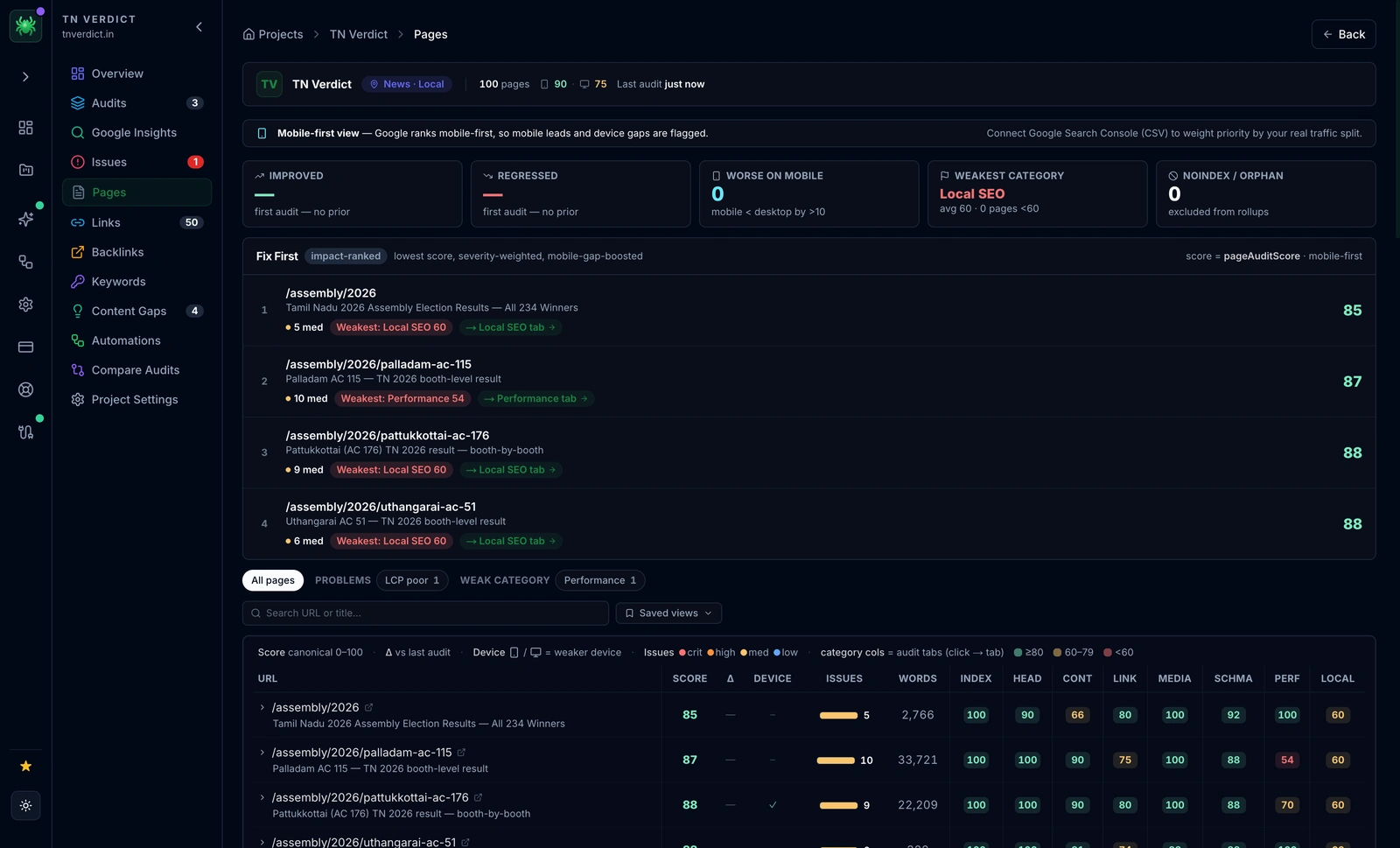
Digispot AI can help you identify and fix these issues automatically with AI-powered audits analyzing 300+ ranking factors, ensuring no broken link goes unnoticed.
2. Site Architecture and URL Structure
A logical structure helps distribute "link juice" (authority) and helps AI models understand the topical relationship between your pages.
Implement SEO-Friendly URLs
URLs should be descriptive yet concise. Avoid parameters and ID numbers when possible.
- Bad:
domain.com/cat?id=452 - Good:
domain.com/technical-seo-checklist
Use hyphens to separate words (not underscores) and keep everything lowercase.
Breadcrumb Navigation
Breadcrumbs provide a secondary navigation scheme. They visualize page hierarchy for users and search engines.
Requirement: Ensure breadcrumbs are marked up with structured data (Schema.org). This allows Google to display the navigation path in search results, improving CTR.
Optimize Internal Linking
Internal links are the nerves of your website. They signal which pages are most important.
Strategy:
- Link from high-authority pages (like your homepage) to priority conversion pages.
- Use descriptive anchor text. Avoid "click here."
- Ensure orphan pages (pages with zero internal links) are eliminated.
Learn more about specific internal linking strategies to maximize your crawl budget and authority distribution.
3. Core Web Vitals and Page Experience
In 2026, user experience is a direct ranking factor. Google's Core Web Vitals metrics are strictly enforced.
Interaction to Next Paint (INP)
Replaced FID in 2024, INP measures responsiveness. It tracks how much time elapses between a user's click/tap and the browser's visual response.
Fixes:
- Break up long tasks in JavaScript.
- Optimize event callbacks.
- Use a web worker to run heavy logic off the main thread.
Largest Contentful Paint (LCP)
Measures loading performance. Ideally, the main content should load within 2.5 seconds.
Fixes:
- Upgrade server hosting response time.
- Compress images (WebP format).
- Implement lazy loading for below-the-fold images.
- Preload the LCP image.
Cumulative Layout Shift (CLS)
Measures visual stability. Elements shouldn't jump around as the page loads.
Fixes:
- Set explicit width and height attributes for all images and video elements.
- Reserve space for ad slots.
- Avoid inserting new content above existing content.
For a deeper dive into these metrics, read our Core Web Vitals guide.
4. HTTPS and Security Protocol
Security is non-negotiable. Browsers label non-HTTPS sites as "Not Secure," killing trust and conversion rates immediately.
Checklist:
- Force HTTPS on all pages.
- Ensure your SSL certificate is valid and not expiring soon.
- Check for "Mixed Content" errors (loading HTTP images on an HTTPS page).
- Implement HSTS (HTTP Strict Transport Security) to force browsers to use secure connections.
5. Mobile-First Indexing
Google predominantly uses the mobile version of the content for indexing and ranking. If your desktop site is perfect but your mobile site is broken, you will not rank.
Audit Steps:
- Responsive Design: Ensure content adjusts seamlessly to screen size.
- Tap Targets: Buttons and links must be spaced far enough apart for fingers.
- Parity: Verify that the mobile version contains the same primary content, structured data, and meta tags as the desktop version.
- Speed: Mobile networks can be slower; optimize payload sizes.
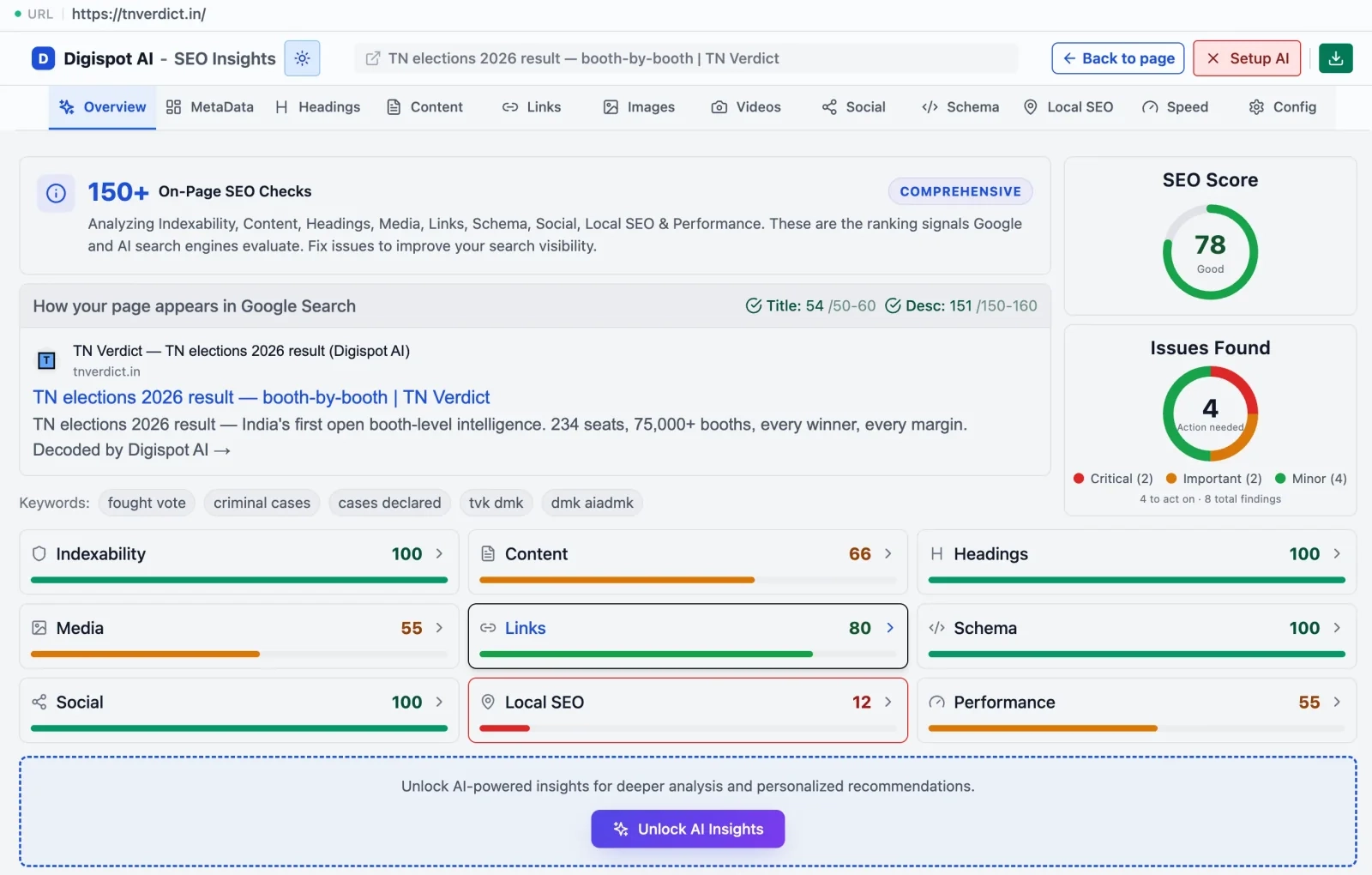
Get instant SEO insights on any page, including mobile view checks, with our free Chrome extension.
6. Structured Data and Schema Markup
Structured data is the language of AI. It translates your content into a format that machines (Google, ChatGPT, Claude) can process instantly. This is vital for winning Rich Snippets and appearing in AI Overviews.
Essential Schema Types
- Organization: Helps with Knowledge Graph panels.
- Article/BlogPosting: Essential for news and blog content.
- Product: Critical for e-commerce (Price, Availability, Ratings).
- FAQPage: Helps gain extra real estate in SERPs.
- BreadcrumbList: Clarifies site hierarchy.
Validation: Always test your code. One missing bracket can invalidate the entire markup. Use the free Schema Markup Generator to create valid structured data in minutes without coding.
7. JavaScript SEO
Modern websites rely heavily on JavaScript frameworks (React, Angular, Vue). However, search engines parse HTML much faster than they render JavaScript.
Client-Side vs. Server-Side Rendering (SSR)
If your content relies entirely on the client's browser to render (Client-Side Rendering), bots may see a blank page.
Recommendation: Use Server-Side Rendering (SSR) or Static Site Generation (SSG). This delivers fully rendered HTML to the bot immediately.
Dynamic Rendering
If SSR isn't possible, use dynamic rendering. This serves a pre-rendered static HTML version to bots while serving the normal JS version to users.
Audit:
- Inspect URLs in GSC using the "Test Live URL" feature.
- View the "Screenshot" tab to see exactly what Google sees. If the content is missing in the screenshot, you have a rendering issue.
8. International and Multilingual SEO
If you target multiple regions or languages, you must explicitly tell Google which version serves which audience.
Hreflang Tags
Hreflang tags prevent duplicate content issues across different regional versions of your site (e.g., US English vs. UK English).
Implementation:
- Place tags in the
<head>or sitemap. - Ensure bi-directional linking (Page A links to B, and B links back to A).
- Include a
x-defaulttag for users who don't match any specific language/region.
<link rel="alternate" hreflang="en-us" href="https://example.com/us" />
<link rel="alternate" hreflang="en-gb" href="https://example.com/uk" />
<link rel="alternate" hreflang="x-default" href="https://example.com/" />
9. Duplicate Content and Canonicalization
Search engines get confused when multiple URLs display the same content. They don't know which one to rank, often leading to all versions ranking poorly.
Canonical Tags
The rel="canonical" tag tells Google, "This is the master version of this page."
Use Cases:
- E-commerce:
product.php?color=redshould canonicalize toproduct.php. - Syndication: If you publish content on Medium or LinkedIn, canonicalize back to your original blog post.
- Trailing Slashes: Ensure
domain.com/page/anddomain.com/pageresolve to a single version.
Unsure if you have duplication issues? Try the free On-Page SEO Analysis tool to audit any URL instantly and check canonical implementations.
10. Optimizing for AI Search (AEO)
Answer Engine Optimization (AEO) is the new frontier. Platforms like Perplexity, ChatGPT, and Google's AI Overviews don't just give links; they give answers.
To appear in these answers, your technical SEO must facilitate easy extraction.
Entity-Based Optimization
Ensure your content clearly defines entities (people, places, concepts). Use distinct H2s and H3s that ask direct questions, followed by concise, factual answers (40-60 words).
Clean Code Structure
AI bots consume vast amounts of data. Bloated HTML, excessive inline CSS, and messy DOM structures make it harder for LLMs to parse your core content. Keep your code semantic and clean.
Common Technical SEO Mistakes to Avoid
Even seasoned pros miss things. Here are quick pitfalls to watch for:
- Leaving 'Noindex' on Production: Often left over from the staging environment.
- Robots.txt Blocking CSS: Google needs to see your layout to judge mobile-friendliness.
- Slow Server Response: Cheap hosting is the most expensive mistake you can make.
- Ignoring Image Alt Text: This hurts accessibility and image search rankings.
Check our guide on common SEO mistakes to ensure you aren't unknowingly sabotaging your efforts.
Start Improving Your Technical SEO Today
Technical SEO is not a "set it and forget it" task. The web changes, your site grows, and search algorithms evolve. A broken redirect or a slow server can silently drain your traffic and revenue.
In 2026, the winning strategy combines rigorous technical hygiene with AI-friendly architecture. By following this checklist, you build a resilient foundation that allows your content to shine on every platform.
Ready to improve your search visibility? Try Digispot AI for comprehensive website audits and actionable recommendations that bridge the gap between traditional SEO and the future of AI search.
Related deep-dives
Continue with these closely related guides:
- to get indexed — How to Get Indexed in Microsoft Copilot: The 2026 AEO Guide
- to rank — How to Rank in ChatGPT Search: The Complete AEO Guide
- google ai overviews optimization — Google AI Overviews Optimization: The Definitive Strategy for 2026
- b2b enterprise seo strategy — B2B Enterprise SEO Strategy: The 2026 Framework for Scale & AI Visibility
References
Audit any page in seconds
300+ SEO checks including Core Web Vitals, schema markup, meta tags, and AI readiness — trusted by 1000+ SEO experts and marketers.
Frequently Asked Questions
Here are some of our most commonly asked questions. If you need more help, feel free to reach out to us.
Written by
Maya Krishnan
Digital growth expert
Maya is a seasoned expert in web development, SEO, and digital strategy, dedicated to helping businesses achieve sustainable growth online. With a blend of technical expertise and strategic insight, she specializes in creating optimized web solutions, enhancing user experiences, and driving data-driven results. A trusted voice in the industry, Maya simplifies complex digital concepts through her writing, empowering readers with actionable strategies to thrive in the ever-evolving digital landscape.