Google Backlinks: Build Authority & Boost Rankings
Build high-quality backlinks that Google values. Learn proven link building strategies, outreach techniques, and authority signals to improve domain rankings.
 Maya Krishnan
Ranking on the first page of search results often comes down to one critical differentiator: backlinks. In the algorithmically driven world of search, these connections act as "votes of confidence" from other websites. They tell Google—and increasingly, AI search engines like ChatGPT and Perplexity—that your site is an authoritative, relevant, and trustworthy resource worth citing.
Understanding the mechanics of backlink SEO requires looking beyond the surface level. It isn't just about accumulating numbers; it is about fostering meaningful digital connections that elevate your domain's reputation. Whether you are launching a new site or auditing an established brand, the quality of your inbound link profile directly correlates with your ability to compete for high-value keywords.
This guide breaks down the science of Google backlinks. We will cover exactly how they function technically, why they remain a top ranking factor, and how to execute a scalable, high-quality link-building campaign. You will learn to identify toxic links, capitalize on competitor gaps, and leverage tools to streamline the process for maximum impact.
Key Takeaways
- Relevance beats volume. A single editorial link from a topically relevant, authoritative site outperforms hundreds of links from generic directories or link farms.
- Diversify your anchor text. Mix branded, partial-match, naked-URL, and generic anchors to avoid triggering over-optimization filters like Google's Penguin system.
- Earn links, don't buy them. Paid links, PBNs, and mass directory submissions invite manual actions; focus on content assets, digital PR, and outreach instead.
- Audit before you build. Fix broken target pages and disavow genuinely toxic links first so incoming equity flows to healthy, indexable content.
- Measure referring domains, not raw links. Track unique referring domains, link velocity, and ranking movement over a four-to-eight-week window to gauge real impact.
What Are Google Backlinks?
A backlink, technically referred to as an "inbound link," is created when one website links to another. If Website A publishes an article and includes a hyperlink to Website B, Website B receives a backlink. In the eyes of search engines, this is comparable to an academic citation. Just as a research paper gains credibility when cited by other respected scholars, your website gains authority when cited by other reputable domains.
For Google, these links serve as fundamental trust signals. They help crawlers discover new pages and understand the relationship between topics across the web. When the algorithm sees that industry-leading sites point to your content, it infers that your material is valuable. This accumulated trust is what allows specific pages—and your domain as a whole—to rank higher for competitive search terms.
The Anatomy of a Hyperlink
To understand how search engines parse these signals, it helps to look at the HTML code behind a standard link:
<a href="https://www.digispot.ai/blog" rel="dofollow">SEO Blog</a>
<a>tag: This defines the start of the link.hrefattribute: This specifies the destination URL (Target Page).- Anchor Text: The visible text ("SEO Blog") that users click.
relattribute: This tells crawlers how to treat the link (e.g., whether to pass authority).
Understanding this structure is crucial because different parts of the link convey different data to Google. The anchor text provides topical context, while the rel attribute dictates the flow of authority.
Key Terms in Backlink SEO
| Term | Definition |
|---|---|
| Backlink | A hyperlink from one website to another, also called an inbound or incoming link. |
| Linking Domain | The external website that hosts a backlink pointing to your site (also called Referring Domain). |
| Target Page | The specific URL on your website where the backlink directs traffic. |
| Anchor Text | The clickable, visible text of a hyperlink that indicates context or relevance to users and bots. |
| Link Equity | Often called "link juice," this is the SEO value or authority passed from one page to another. |
| DoFollow Link | The default state of a link. It passes authority ("link equity") and directly influences rankings. |
| NoFollow Link | A link with rel="nofollow", instructing search engines not to pass authority, though they may still use it for discovery. |
| Internal Link | A hyperlink connecting two pages within the same domain, crucial for site structure. |
| External Link | A hyperlink directing users from your website out to a different domain. |
For a deeper dive into how search engines crawl these elements to index your site, read our guide on how Google Search works.
Why Are Backlinks Critical for SEO?
The significance of backlinks is rooted in Google's original algorithm, PageRank. While the modern algorithm has expanded to include thousands of signals—including Core Web Vitals and user experience metrics—links remain a primary indicator of importance. Without them, even high-quality content can struggle to gain traction because Google lacks the external verification that the content is accurate and authoritative.
Here is why backlinks are indispensable for your strategy:
1. Authority and Trust Transfer
Google views the web as a graph of interconnected nodes. High-authority sites (like major news outlets, government (.gov) sites, or universities (.edu)) possess immense trust. When they link to you, a portion of that trust is transferred to your domain. This concept, known as "Link Equity," is essential for building your site's Domain Authority (DA). A site with high authority can often rank for difficult keywords with less effort than a newer, lower-authority site.
2. Improved Keyword Rankings
There is a direct correlation between the number of unique referring domains and organic traffic. Data consistently shows that pages in position #1 on Google generally have significantly more backlinks than those in position #10. Links signal to the algorithm that your page is the definitive answer to a query.
3. Faster Indexing and Discovery
Search engine spiders (bots) navigate the web by following links. They treat existing authoritative sites as hubs. If your new blog post is linked from a popular industry news site that Google crawls daily, the bot will discover and index your new page almost immediately. Without links, your content relies solely on your sitemap submission, which can take days or weeks to process.
4. Referral Traffic
A major side benefit of link building is direct traffic. SEO is not the only goal; business growth is. A strategic mention in a high-traffic publication can send hundreds or thousands of qualified visitors to your site. Unlike organic traffic which fluctuates with rankings, this referral traffic is often comprised of users who are already reading about your topic and are highly engaged.
5. Brand Visibility and Entity Recognition
For modern AEO (Answer Engine Optimization), establishing your brand as a known "entity" is vital. Consistent mentions and links from relevant sources help Google's Knowledge Graph understand who you are and what you do. This is critical for showing up in AI-generated answers on platforms like Google's AI Overviews or ChatGPT. Learn more about building an SEO platform for the AI era.
How Do Backlinks Work? The Mechanics of Link Equity
To execute a successful strategy, you must understand the nuances of how links function. Not all links pass value in the same way, and understanding the attributes involved ensures you don't waste time on links that offer zero SEO return.
1. Link Attributes: The Language of Crawlers
- DoFollow Links: This is the standard link type. If you add a link in WordPress or standard HTML without modifying it, it is a DoFollow link. These are the gold standard for SEO because they explicitly tell Google to pass PageRank to the destination.
- NoFollow Links (
rel="nofollow"): Created to combat comment spam, this tag tells Google, "I am linking to this page, but I don't vouch for it." While they don't pass direct authority, Google updated its stance in 2019 to treat NoFollows as "hints." This means they can still contribute to crawling and understanding context, even if they don't pass direct ranking power. - Sponsored Links (
rel="sponsored"): If you pay for a placement, an advertisement, or an affiliate link, Google guidelines require you to use this attribute. Failing to do so can result in a manual penalty for "link schemes." - UGC Links (
rel="ugc"): This stands for User Generated Content. It is used for links in forum signatures, blog comments, or Reddit threads. It helps Google distinguish between editorial content and user submissions.
Pro Tip: A natural backlink profile contains a mix of these. If 100% of your links are DoFollow, it looks suspicious and manipulated. A healthy profile might be 70% DoFollow and 30% NoFollow/UGC.
2. Anchor Text Distribution
Anchor text is a powerful ranking signal. If 50 websites link to you with the anchor text "best CRM software," Google becomes very confident that your page is about "best CRM software." However, this can be a double-edged sword.
- Exact Match: Matches your target keyword exactly (e.g., "Google backlink SEO"). Powerful but dangerous if overused.
- Partial Match: Contains the keyword mixed with other words (e.g., "guide to backlink SEO strategies"). Safer and very effective.
- Branded: Uses your company name (e.g., "Digispot AI"). These are extremely safe and build brand entity.
- Naked URL: Shows the raw link (e.g.,
https://digispot.ai). Very natural. - Generic: Phrases like "click here" or "source." These carry little semantic value but look natural.
Warning: If you aggressively build links with only "Exact Match" anchors, you trigger the Penguin algorithm filters, which punish over-optimization. Aim for variety.
3. Link Placement and Context
Google's patents suggest that the location of a link matters. A contextual link buried in the middle of a relevant paragraph is worth far more than a link in the footer or sidebar. The surrounding text also acts as a signal. If the words around the link discuss "SEO audit tools," Google associates that topic with the linked page.
Digispot AI can help you analyze your own site structure and link placement with automated audits, ensuring your internal linking strategy supports your external link building efforts.
The Benefits of a Strong Backlink Profile
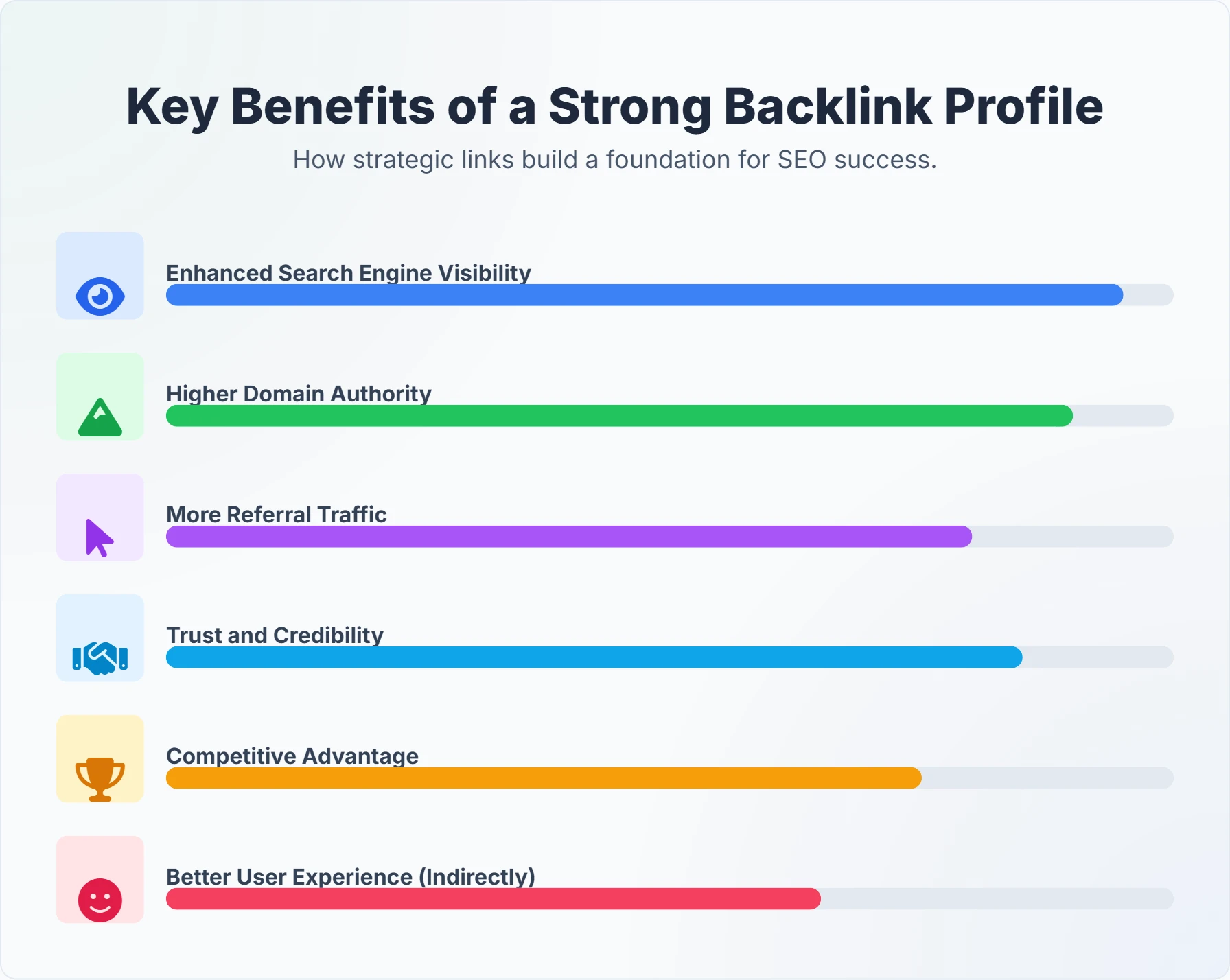
Cultivating a high-quality backlink profile yields compounding returns for your digital presence:
- Dominating Search Results: The most obvious benefit is ranking #1. Sites with strong profiles are harder to displace, creating a "moat" around your search visibility.
- Increased Domain Authority (DA/DR): While DA (Moz) and DR (Ahrefs) are third-party metrics and not official Google factors, they are accurate predictors of success. Increasing these metrics generally correlates with site-wide ranking improvements.
- Resilience to Updates: Sites with genuine, high-quality links are often more resilient to Google Core Updates. When an algorithm update shakes up the SERPs, sites with earned authority tend to remain stable or recover quickly.
- Competitive Advantage: In niches where everyone creates great content, backlinks are the tiebreaker. If you and a competitor have similar articles, the one with the better link profile wins.
- Building E-E-A-T: Google's emphasis on Experience, Expertise, Authoritativeness, and Trustworthiness (E-E-A-T) relies heavily on off-page signals. Links from industry associations, experts, or news sites validate your expertise. Work through our Google E-E-A-T SEO checklist to align your on-page and off-page trust signals.
How to Build High-Quality Backlinks: 10 Proven Strategies
Building links is hard work. It requires creativity, persistence, and value creation. Below are ten strategies that prioritize quality and long-term safety over risky shortcuts. If you are new to the discipline, start with the fundamentals in what is link building in SEO, then explore the broader tactics in our best off-page SEO strategies guide.
1. The "Link-Worthy" Content Asset
You cannot build links to a boring service page. You need an "asset" that people want to reference.
- Original Data & Studies: Conduct a survey of your industry or analyze public data to reveal a trend. Journalists love citing original statistics.
- Definitive Guides: Create the single most comprehensive resource on a topic (e.g., "The Ultimate Guide to Schema Markup").
- Free Tools: Calculators, generators, and checkers attract massive links. For example, our Schema Markup Generator naturally attracts links from SEO blogs and educational sites because it solves a specific problem.
2. Broken Link Building
The web is full of "link rot"—links that point to 404 error pages. This strategy turns the web's decay into your opportunity.
- Find a broken link: Use tools like Check My Links or Ahrefs to find broken links on authoritative resource pages in your niche.
- Create the replacement: Do you have content that covers the same topic? If not, create a better version of what used to be there (you can use the Wayback Machine to see the old content).
- The Outreach: Email the site owner. "Hi, I was reading your guide and noticed this link is dead. It’s a great resource, so I thought you’d want to know. I actually wrote a guide on the same topic here if you need a replacement." This works well because you are helping them fix an error on their site.
3. Competitor Backlink Analysis (The "Gap" Strategy)
Your competitors have already done the hard work of finding sites that link to your industry. Use that data.
- Analyze Competitors: Plug a competitor's URL into a backlink tool.
- Filter for Quality: Look for DoFollow links from blogs, news sites, or resource pages. Ignore directories or forums.
- Replicate: Visit those pages. Did they write a guest post? Pitch one. Are they listed on a resource page? Ask to be added. Did they get interviewed? Contact the podcaster.
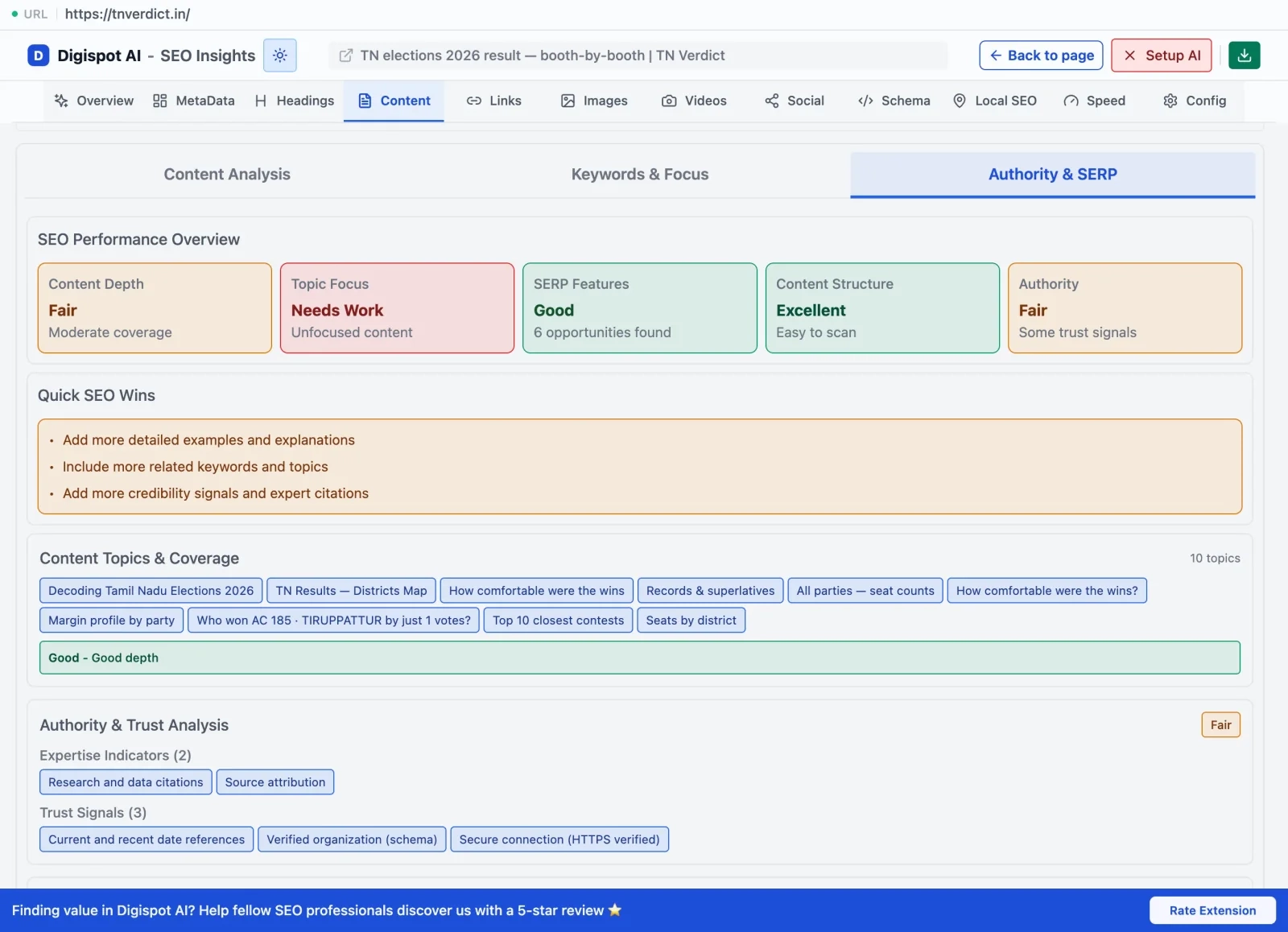
Get instant SEO insights on any competitor page to spot these opportunities with our free Chrome extension.
4. Guest Blogging (The Right Way)
Guest posting got a bad reputation because people automated it with spun content. However, writing genuine, high-quality articles for reputable industry publications is still valid.
- Vetting: Only pitch sites that have real traffic and engagement. Avoid sites that openly advertise "Guest posts for $50."
- Value: Don't just rewrite basic tips. Offer a unique perspective or case study.
- The Link: Include a link to a relevant blog post of yours within the body content where it adds value, rather than just stuffing a homepage link in the author bio.
For a repeatable pitching and vetting workflow, see our dedicated guest posting strategy for backlinks.
5. The Skyscraper Technique
Popularized by Brian Dean, this method leverages existing demand.
- Find content with many links: Locate a piece of content in your niche that has 100+ backlinks but is outdated or visually poor.
- Create something 10x better: Update the data, add custom graphics, include expert quotes, and make it deeper.
- Outreach: Contact everyone who linked to the inferior piece. "I noticed you linked to X. I just published a version that is up-to-date for 2025 and includes new data. It might be more useful for your readers."
6. HARO and Digital PR
Connect with journalists who need expert quotes.
- HARO (Help A Reporter Out) / Qwoted: Sign up as a source. You will receive daily emails from journalists at Forbes, Business Insider, and industry blogs asking for expert input.
- Be Fast: Journalists work on tight deadlines. Respond quickly with a quote that is "copy-paste" ready.
- Win Big: One successful pitch can land you a DR90 link that you could never buy.
7. Resource Page Outreach
Many industries have curated lists of "Best Tools," "Helpful Resources," or "Industry Links."
- Search Queries: Use Google search operators like
intitle:"resources" + keywordorinurl:"links" + keyword. - The Pitch: "I see you have a great list of SEO tools. Our Schema Visualizer is a free tool that helps with X. Would it be a good addition to your list?"
8. Podcast Interviews
Podcasts are high-leverage because they often provide a backlink in the show notes.
- Identify Shows: Look for podcasts in your niche that interview founders or experts.
- Pitch a Story: Don't pitch your product; pitch an educational topic you can speak on.
- Result: You get a backlink, brand exposure to a captive audience, and audio content you can repurpose.
9. Local Citations (Local SEO)
For local businesses, citations (NAP: Name, Address, Phone) are the foundation of map pack visibility.
- Directories: Start with the highest-authority aggregators and platforms—Google Business Profile, Apple Business Connect, Bing Places, Yelp, Yellow Pages, and TripAdvisor—then layer in industry-specific and city-level directories.
- Consistency: Your NAP data must be byte-for-byte identical across every platform, including abbreviations ("St." vs "Street") and phone formatting. Even minor discrepancies confuse Google's entity matching and dilute citation authority.
- Prune duplicates: Search your business name plus phone number to find stale or duplicate listings from moves or rebrands, and claim or merge them so conflicting addresses don't undercut your ranking signals.
- Google Business Profile: While not a "backlink" in the traditional sense, a fully optimized profile—complete with categories, hours, photos, and Q&A—is the single strongest driver of local pack rankings.
10. Unlinked Mentions
Sometimes people mention your brand but forget to link to you—a low-effort, high-conversion opportunity because the editorial decision to cite you has already been made.
- Monitor: Set up Google Alerts for your brand name, key product names, and your founders' names. For higher volume, a brand monitoring tool can surface mentions across news, forums, and social platforms in near real time.
- Qualify: Confirm the mention sits on a relevant, indexable page and that a link would genuinely help readers before reaching out—an unlinked mention on a spammy scraper site is not worth pursuing.
- Reclaim: Send a short, specific email thanking the author for the shoutout, pointing to the exact sentence, and suggesting the precise URL to link to. Making the change a one-click edit dramatically improves your success rate.
Backlink Building Strategies at a Glance
| Strategy | What it Involves | Key Benefit |
|---|---|---|
| Content Assets | Creating data studies, tools, or guides. | Attracts passive, high-authority links over time. |
| Broken Link Building | Replacing dead links on other sites. | High success rate; helps the webmaster fix errors. |
| Guest Blogging | Writing articles for industry publications. | Builds personal brand and authority links. |
| Competitor Analysis | Replicating competitors' link sources. | Finds pre-qualified link opportunities. |
| Skyscraper | Improving existing popular content. | leverages proven demand for a topic. |
| Digital PR (HARO) | Answering journalist queries. | Earns links from top-tier news sites (DR 80+). |
| Local Citations | Directory listings. | Essential for local map pack ranking. |
Before launching these campaigns, ensure your target pages are technically sound. A broken page wastes link equity. Review our on-page SEO best practices to prepare your content for incoming traffic.
What Makes a Backlink "High-Quality"?
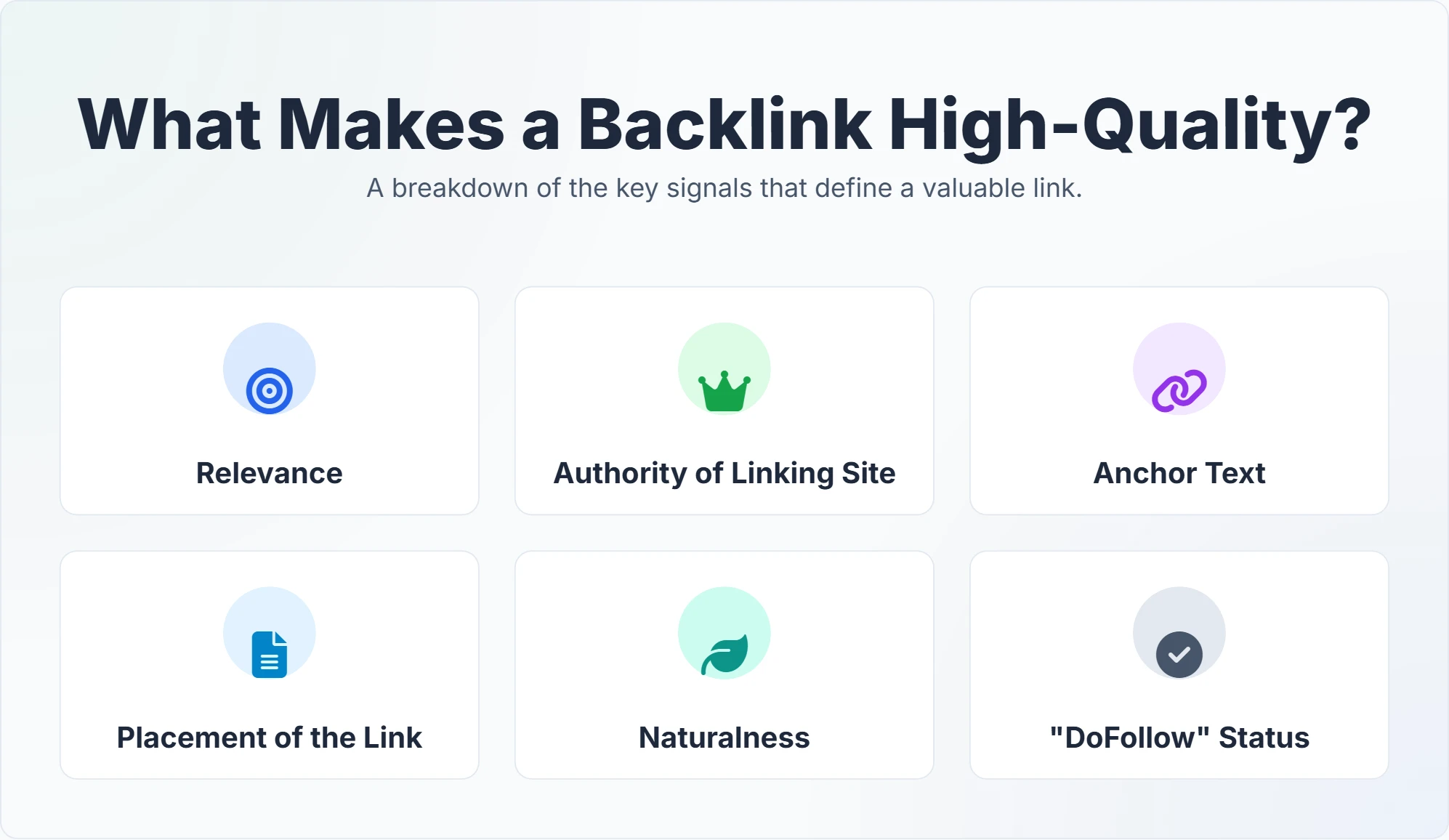
Quantity without quality is a recipe for penalties. In the modern SEO landscape, one link from a relevant industry leader is worth more than 1,000 links from random, low-quality directories. Here is the checklist for evaluating a link prospect:
- Topical Relevance: This is arguably the most important factor. If you sell "accounting software," a link from "accounting-today.com" is incredibly powerful. A link from "cheap-dog-toys.net" is irrelevant and potentially harmful. Google uses "Topical Trust Flow" to understand if the linking site has authority in your specific niche.
- Domain Authority: While metrics like DA or DR are estimates, they generally reflect the raw power of a site. Aim for sites with a DR of 30+.
- Traffic Trends: A real website has real traffic. If a site has a DR of 50 but receives zero organic traffic (checked via tools like Ahrefs/SEMrush), it might be a "link farm"—a site built solely to sell links. Avoid these.
- Editorial Standards: Is the content on the linking site high quality? Do they check facts? Hard-to-get links are the most valuable. If anyone can publish there instantly, the link has little value.
- Link Placement: Is the link in the main body content (editorial link)? Or is it hidden in the footer or a sidebar widget? Editorial links carry the most weight.
- Outbound Link Ratio: If the page links to 200 other websites, the "equity" passed to you is diluted. You want to be one of a few exclusive links on the page.
Common Backlink Mistakes to Avoid
The pressure to rank can lead to bad decisions. "Black Hat" SEO tactics might offer short-term gains but often result in catastrophic penalties that can de-index your website entirely.
1. Buying Links (PBNs and Link Farms)
Google's "SpamBrain" AI is incredibly good at detecting paid links. Private Blog Networks (PBNs)—networks of sites owned by one person to link to each other—are a primary target for Google updates. If you get caught, you will receive a Manual Action, and your traffic will flatline overnight.
2. Irrelevant Directory Submissions
Submitting your site to hundreds of low-quality "web directories" was a strategy in 2005. Today, it is considered spam. Only list your business in reputable, relevant directories (like G2, Capterra, or local chambers of commerce).
3. Over-Optimized Anchor Text
As mentioned earlier, forcing "Best SEO Tool" as the anchor text for every single backlink is a clear footprint of manipulation. It looks unnatural. Keep your anchor text profile diverse.
4. Ignoring Toxic Links
Sometimes, spammy sites will link to you without your permission. This is called "Negative SEO." While Google is good at ignoring these, a massive influx of porn or gambling links pointing to your B2B software site can trigger flags. Regular auditing is necessary—follow our guide on how to remove toxic backlinks safely before reaching for the Disavow Tool.
See our guide on common SEO mistakes to ensure your overall strategy remains compliant and effective.
Measuring and Analyzing Your Backlink Performance
You cannot improve what you do not measure. A successful campaign requires constant monitoring to see which links are moving the needle and which are falling off. For a structured process, see our step-by-step backlink analysis guide to auditing link profiles.
1. Google Search Console (GSC)
Your source of truth.
- Links Report: Navigate to "Links" in the sidebar.
- Top Linking Sites: See exactly who links to you.
- Top Linked Pages: Identify which of your content assets are attracting the most attention.
- Disavow Tool: If you identify a sophisticated attack of spam links, you can upload a "disavow file" here to formally ask Google to ignore them. Note: Use this with extreme caution.
2. Monitoring Metrics
- Referring Domains: This is your primary KPI. Are you gaining new, unique domains every month?
- Link Velocity: The speed at which you gain links. A sudden spike of 5,000 links in one day looks like spam. A steady growth curve looks organic.
- Lost Links: Tools can alert you when a link disappears. If a high-value link drops, you can reach out to the site owner to ask if it was removed by mistake.
3. Correlation with Rankings
Ultimately, links are a means to an end. Track your keyword rankings alongside your link growth. If you build 10 high-quality links to a specific page, does its ranking improve over the next 4-8 weeks? (Note that link effects are often delayed).
Digispot AI integrates with your analytics to help you correlate these technical efforts with real business outcomes, ensuring you aren't just building links for vanity metrics but for actual revenue growth.
Audit and Safeguard Your Link Profile with the Digispot AI SEO Spider
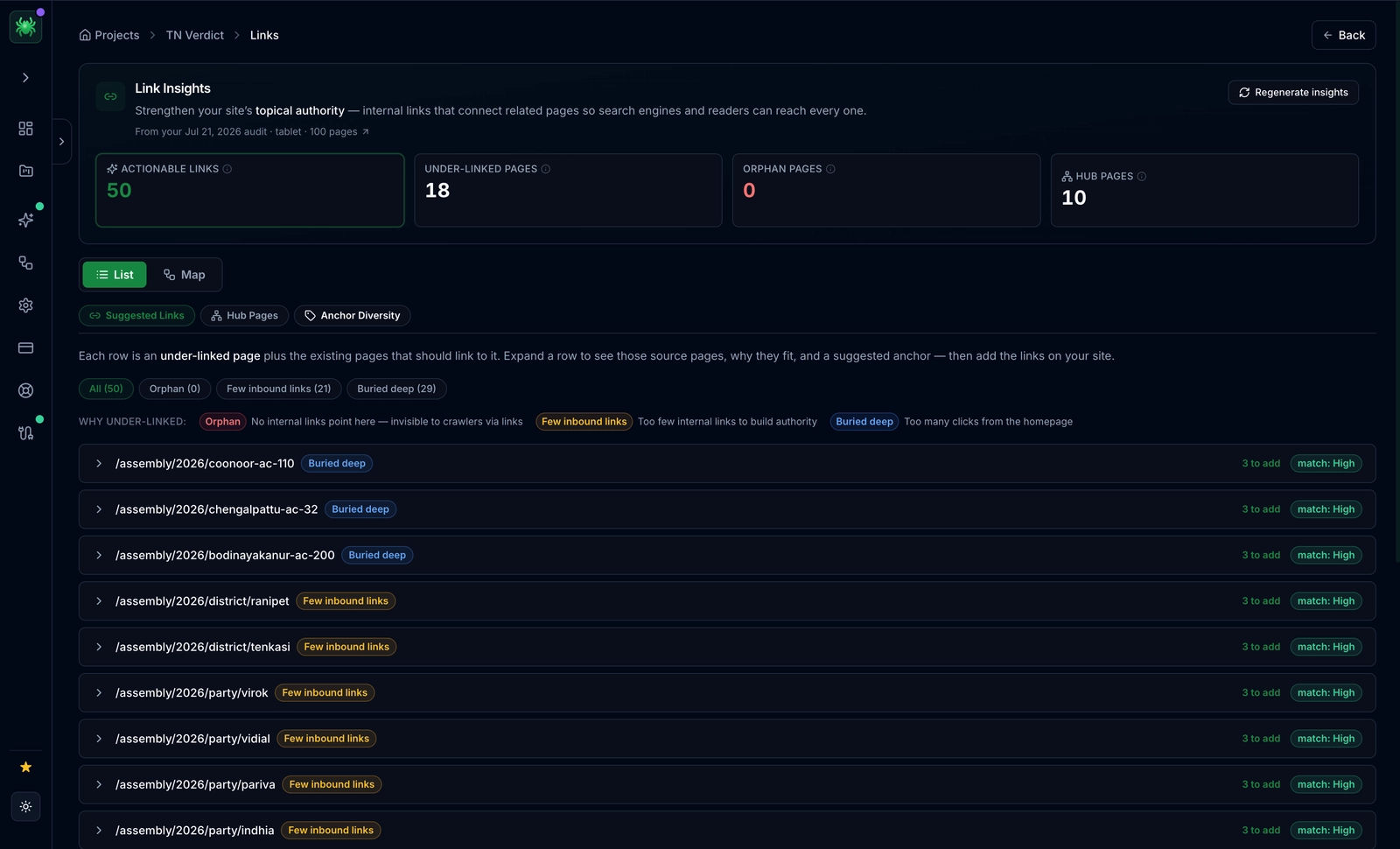
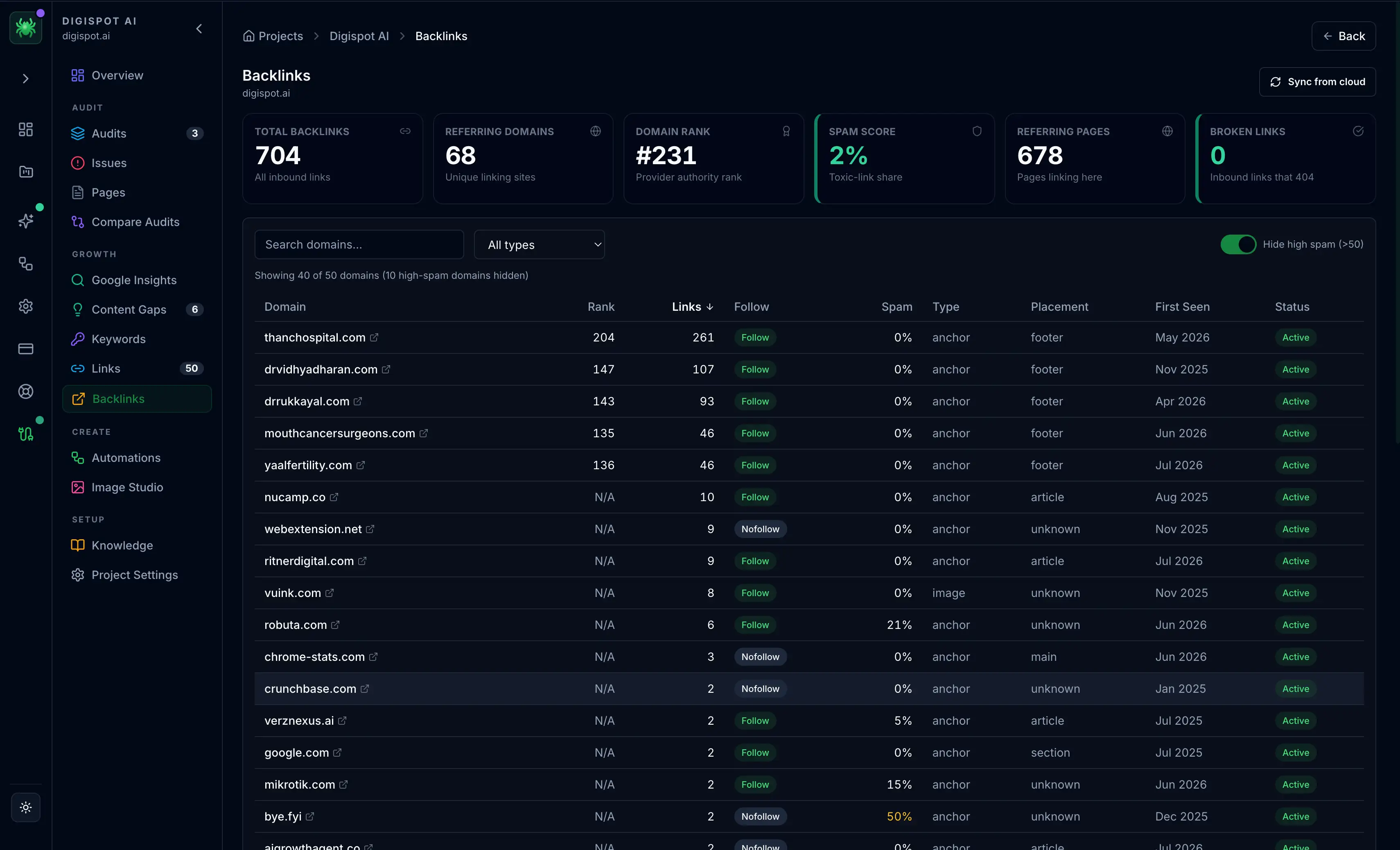
Backlink building is only half the equation; measuring and protecting the equity you earn is where campaigns are won or lost. The Digispot AI SEO Spider — billed as the only SEO crawler your AI agent can run — is a desktop crawler and auditor that renders pages in a real browser like Googlebot and runs 300+ SEO/AEO checks per page. Its Link Insights view lets you audit every referring domain, flag toxic or spammy links worth disavowing before they drag down authority, and track your anchor-text distribution so branded and exact-match ratios stay natural. You can also surface competitor link gaps to see which domains rival sites earn that you don't, then prioritize outreach accordingly. Because the crawl uses real-browser rendering, it keeps your linkable assets and internal linking healthy so acquired equity actually flows to the pages that need it. Best of all, issues are ranked by traffic-at-risk and synced with GSC and GA4, and a built-in MCP server lets an AI agent like Claude or Cursor run the crawl and apply fixes — from $14/mo.
Conclusion: Start Building Authority Today
Google backlink SEO is not a one-time task; it is a strategic discipline that demands consistency. In an era where AI can generate content in seconds, authority is becoming the scarcest and most valuable commodity. Backlinks are the primary way to demonstrate that authority.
By focusing on relevance over volume and earned media over paid schemes, you build a digital footprint that is resilient to algorithm updates. Whether you are leveraging broken link building, creating skyscraper content, or engaging in digital PR, the goal remains the same: to make your website a trusted pillar of your industry's community.
Start small. Audit your current profile, identify your best linkable assets, and begin outreach. The momentum you build today will pay dividends in organic traffic for years to come.
Ready to take the guesswork out of your SEO strategy? Try Digispot AI for comprehensive website audits that analyze over 200 ranking factors, helping you identify exactly where to focus your optimization efforts for maximum visibility.
References
Audit any page in seconds
300+ SEO checks including Core Web Vitals, schema markup, meta tags, and AI readiness — trusted by 1000+ SEO experts and marketers.
Frequently Asked Questions
Here are some of our most commonly asked questions. If you need more help, feel free to reach out to us.
Written by
Maya Krishnan
Digital growth expert
Maya is a seasoned expert in web development, SEO, and digital strategy, dedicated to helping businesses achieve sustainable growth online. With a blend of technical expertise and strategic insight, she specializes in creating optimized web solutions, enhancing user experiences, and driving data-driven results. A trusted voice in the industry, Maya simplifies complex digital concepts through her writing, empowering readers with actionable strategies to thrive in the ever-evolving digital landscape.