
Law Firm SEO - The Ultimate Guide to Getting More Clients
Dominate search rankings and attract high-value clients. The ultimate guide to law firm SEO shows you how to win online.
 Maya Krishnan
The battle for clients is no longer confined to the courtroom or referral networks. It is waged on the silent, fiercely competitive terrain of search engine results pages (SERPs). Your potential clients are not flipping through phone books; they are typing urgent questions into Google, seeking immediate answers and authoritative guidance. A staggering 96% of people in need of legal advice now begin their journey with an online search. If your firm isn't prominently visible at that exact moment of need, you are effectively invisible to the market.

Many law firms treat Search Engine Optimization (SEO) as a static marketing checklist—a series of disconnected tasks like adding keywords or claiming a profile. This is a critical error. SEO is not merely a tactic; it is a fundamental business strategy for building a lasting digital presence. Furthermore, with the rise of AI-driven search (AEO) on platforms like ChatGPT and Google's AI Overviews, the way you structure your data matters more than ever.
This guide provides the architectural blueprints to construct a dominant online presence, moving beyond fleeting tactics to build a secure and enduring legacy.
The Blueprint: Why Legal SEO is a Fundamentally Different Challenge
Before laying the first stone, you must understand the ground on which you build. SEO for law firms differs significantly from e-commerce or standard local business SEO. The stakes are higher, and the rules are stricter. This is primarily due to two concepts that Google prioritizes for sensitive industries: YMYL and E-E-A-T.
Your Money or Your Life (YMYL): A Higher Standard of Scrutiny
Google categorizes topics that can significantly impact a person's health, happiness, financial stability, or safety as "Your Money or Your Life" (YMYL) content. Legal advice falls squarely into this category. Whether a client is navigating a divorce, facing criminal charges, or planning an estate, the quality of the information they find has profound real-world consequences.
Because of this, Google's algorithms apply a much higher level of scrutiny to legal websites. A slick design isn't enough. Google needs certainty that you are a legitimate, trustworthy, and expert source before it risks ranking your site. This is where E-E-A-T becomes the gold standard for your strategy.
E-E-A-T: The Currency of Digital Trust
E-E-A-T stands for Experience, Expertise, Authoritativeness, and Trustworthiness. It is the framework Google uses to assess the quality and credibility of YMYL content. You can read our detailed breakdown in our E-E-A-T SEO Guide, but here is how it specifically applies to law firms:
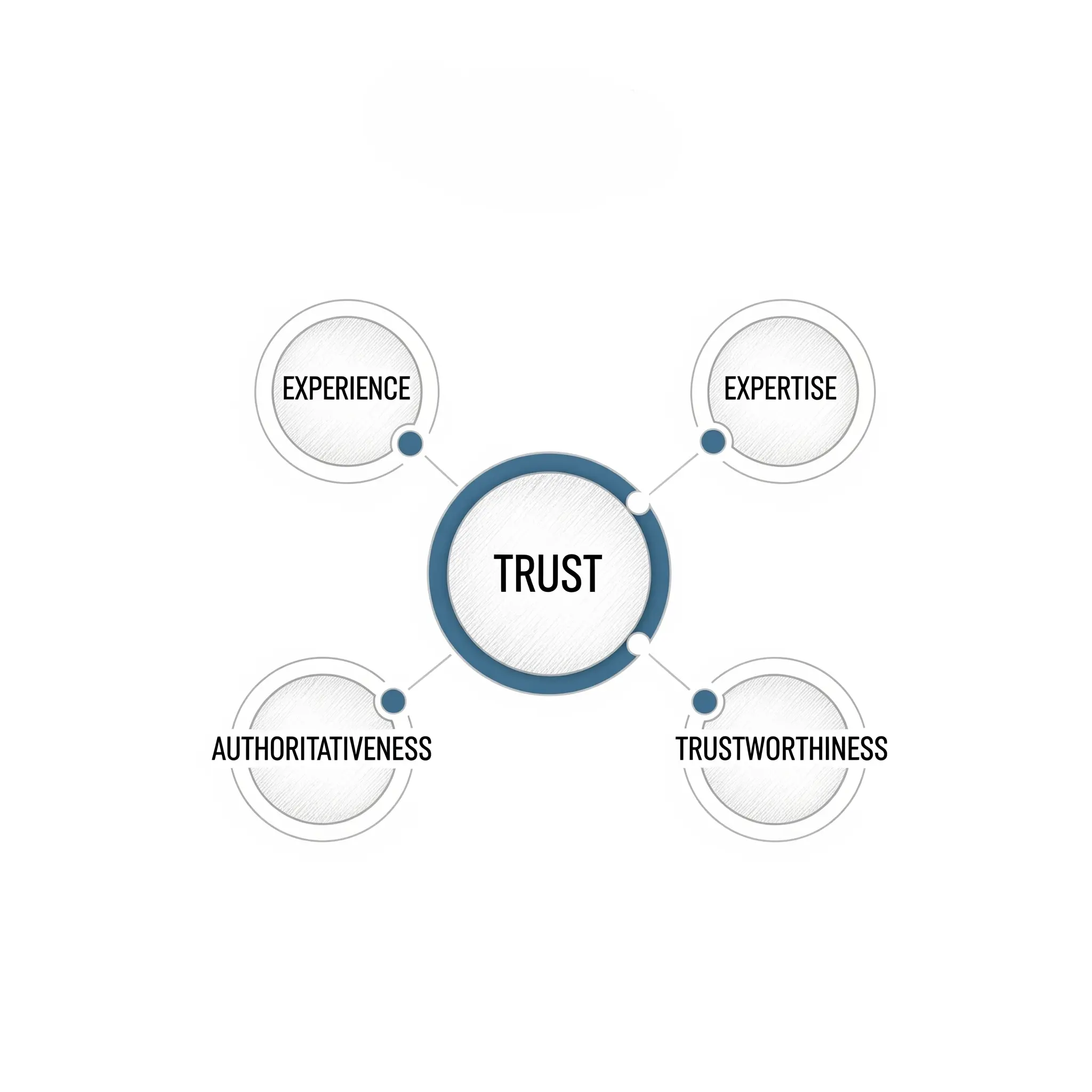
- Experience: Does the content demonstrate real, first-hand experience? This means showcasing your lawyers' direct involvement in the cases and practice areas you discuss. Don't just quote the statute; explain how you applied it in a recent case (anonymized, of course).
- Expertise: Is the content written or reviewed by a subject matter expert? Your website must clearly demonstrate that qualified, experienced attorneys are behind the information provided. Using generic content writers without attorney review can hurt your rankings here.
- Authoritativeness: Is your firm recognized as a leader in its field? This is determined by what other reputable sources online (other legal sites, news outlets, directories) say about you. Mentions in local news or awards from recognized legal bodies bolster this signal.
- Trustworthiness: Is your site secure, professional, and transparent? This includes having clear contact information, accessible privacy policies, client testimonials, and secure data handling (HTTPS).
The entire SEO strategy for a law firm must be architected to broadcast powerful E-E-A-T signals. Research from Online Marketing for Professional Services reveals that building trust through digital channels is directly tied to faster growth and higher profits. Your digital presence must be built on this principle of trust.
The Four Cornerstones of a Winning SEO Strategy
A successful SEO strategy is a multi-layered defensive structure. Your law firm's SEO strategy should be the same. Here are the four essential cornerstones.
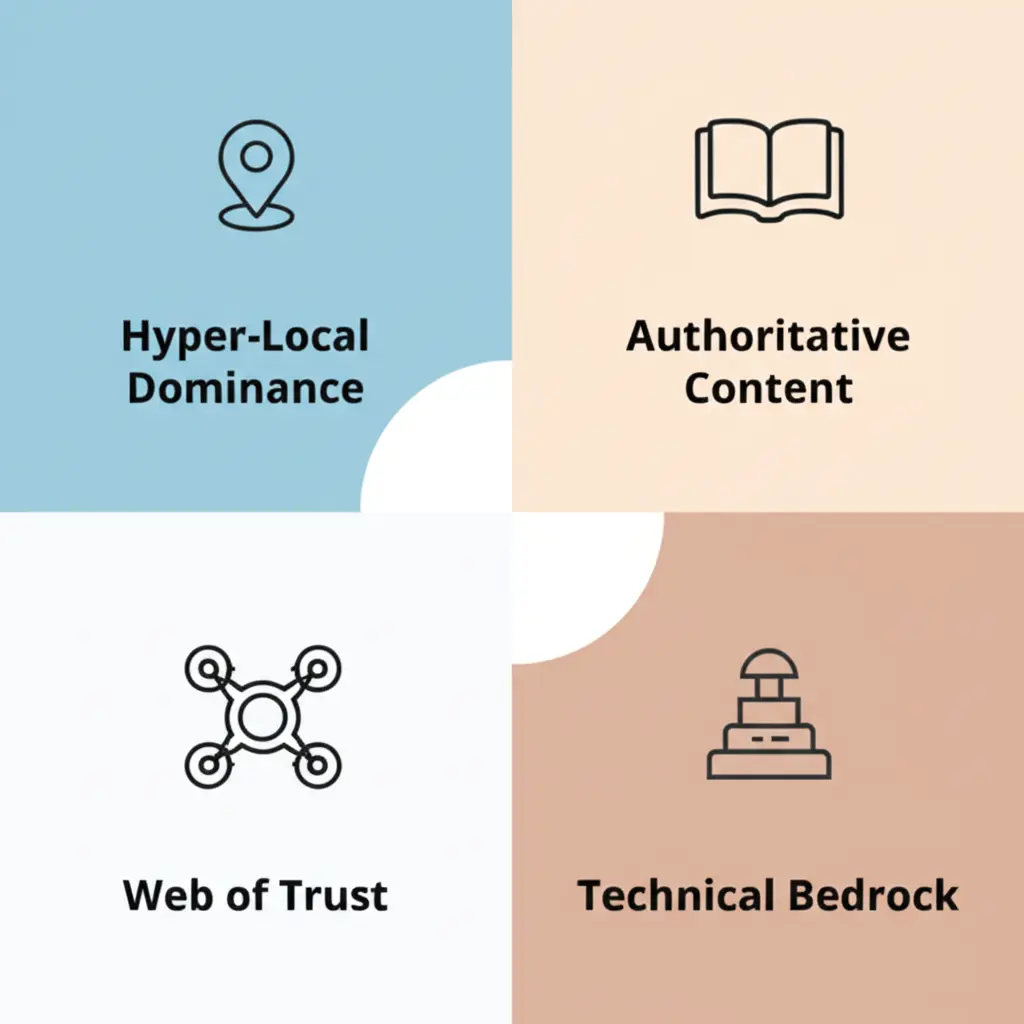
Cornerstone 1: Hyper-Local Dominance
For the vast majority of law firms, clients come from the immediate geographic area. Dominating your local market is non-negotiable. This is the first and most critical point of contact for potential clients using terms like "lawyer near me."
The Foundation: Google Business Profile (GBP)
Your Google Business Profile is the single most critical element of your local SEO strategy. It is the information box that appears in Google Maps and the Local Pack (the map showing three businesses). It's a free, powerful tool that many firms underutilize.
Optimizing your GBP is not a one-time setup. It requires ongoing management:
- Complete Every Section: Fill out every single field available: services, service areas, appointment links, and accessibility information. A detailed "from the business" description should be natural but infused with your primary keywords.
- Precise Categorization: Choose the most specific legal categories possible. Select "Personal Injury Attorney" or "Family Law Attorney" as your primary category rather than the generic "Law Firm." You can add secondary categories to cover other practice areas.
- High-Quality Photos and Videos: Regularly upload high-resolution photos of your office (inside and out), your team, and even short, professional videos. This proves you are a real, active business and helps users feel comfortable before they even call.
- Google Posts: Use Google Posts weekly to share recent blog articles, case results, and firm announcements. This signals to Google that your business is active and provides fresh content for the Knowledge Panel.
- Q&A Section: Proactively populate the Questions & Answers section. Ask and answer common questions potential clients might have (e.g., "Do you offer free consultations?", "What are your weekend hours?"). This is also a prime spot for voice search optimization.
The Reinforcement: Reviews and Local Content
- A Proactive Review Strategy: Positive client reviews are the most influential factor for potential clients. You need a systematic process to request reviews. This could be a simple, polite email or text message automation sent at the conclusion of a case. Crucially, you must respond to every review. A thoughtful, professional response to a negative review often builds more trust than a dozen positive ones because it shows character and responsiveness.
- Location-Specific Pages: Do not just list your practice areas. Create detailed, location-specific pages (e.g., "Chicago Car Accident Lawyer," "Naperville Real Estate Law"). These pages should not be duplicates. Each one must contain unique content relevant to that specific city, mentioning local landmarks, specific courthouses, or local accident statistics. This demonstrates deep local expertise.
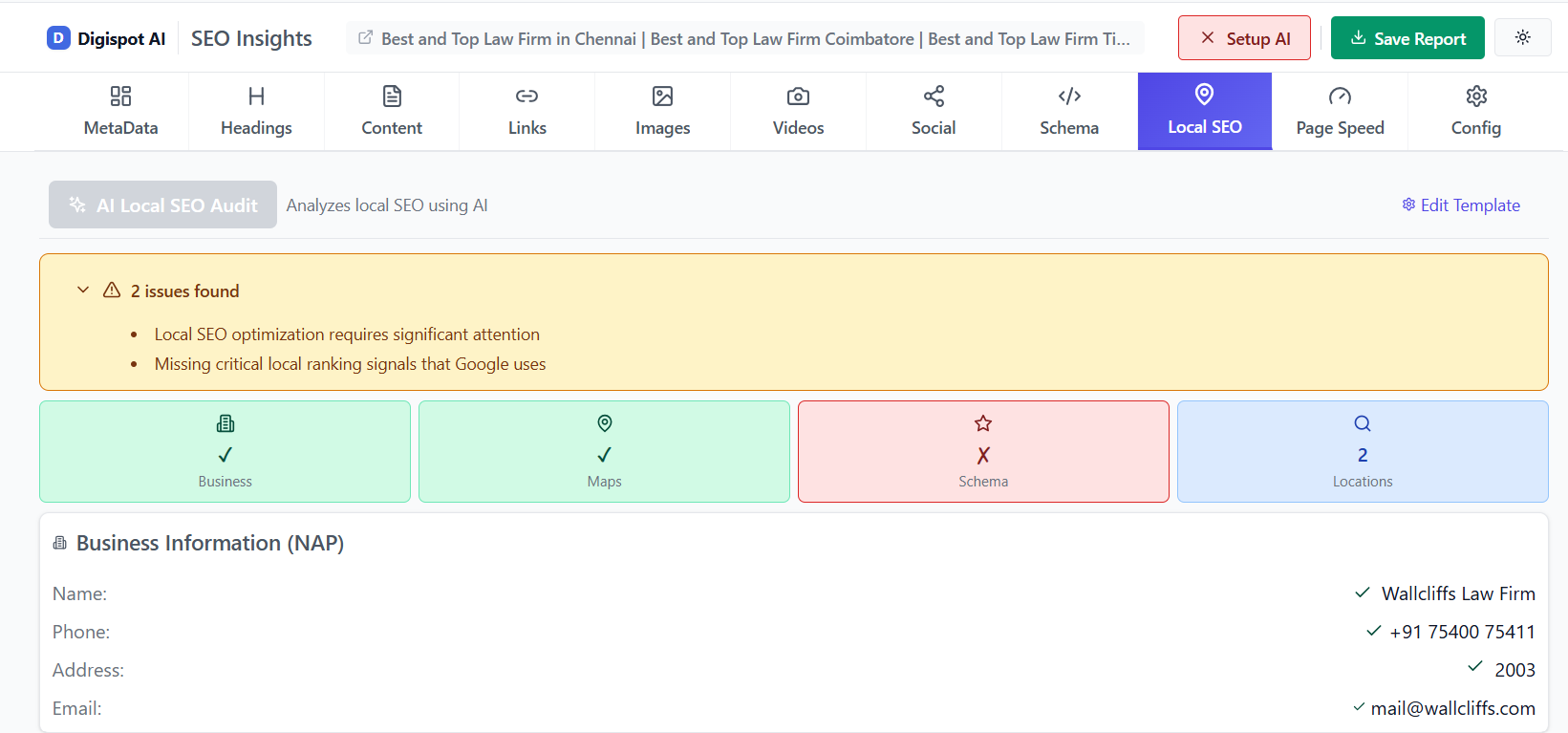
Pro Tip: Use the Digispot AI Chrome Extension to instantly analyze your competitors' location pages. You can see exactly which keywords they are targeting and identify gaps in their content strategy.
Cornerstone 2: Authoritative Content
Content is the source of your authority and the asset that draws people in. For law firms, content is not just marketing; it is the digital embodiment of your legal counsel. It must satisfy user intent completely.
Practice Area Pages as Pillar Content
Your core practice area pages (e.g., "Divorce," "DUI Defense," "Estate Planning") should be treated as "Pillar Pages." These should be the most comprehensive resources on the web for your local area. A weak, 300-word summary is insufficient for ranking against top competitors.
A strong practice area page should:
- Exceed 2,000 words of high-value information.
- Explain the legal issue in plain English, avoiding unnecessary legalese.
- Discuss relevant state-specific laws (e.g., "Section 5/11-501 of the Illinois Vehicle Code").
- Outline the legal process step-by-step.
- Answer frequently asked questions directly.
- Include internal links to related on-page SEO best practices.
- Feature clear calls-to-action ("Contact Us for a Consultation").
Blogging to Answer, Not Just to Post
The most effective legal blogs answer the highly specific questions your clients ask during intake. The goal is to capture "long-tail keywords"—specific phrases indicating a user is seeking a solution.
Instead of a generic "Car Accident Lawyer" post, target specific scenarios:
- "What to do immediately after a sideswipe collision in Illinois?"
- "How long do I have to file a personal injury claim in Cook County?"
- "Is Illinois a no-fault state for car accidents?"
Use client intake notes and conversations with your paralegals to generate an endless list of these real-world questions. Each post becomes a permanent digital asset. Before publishing, run your content through a tool like the Digispot AI On-Page SEO Analysis to ensure you haven't missed any optimization opportunities.
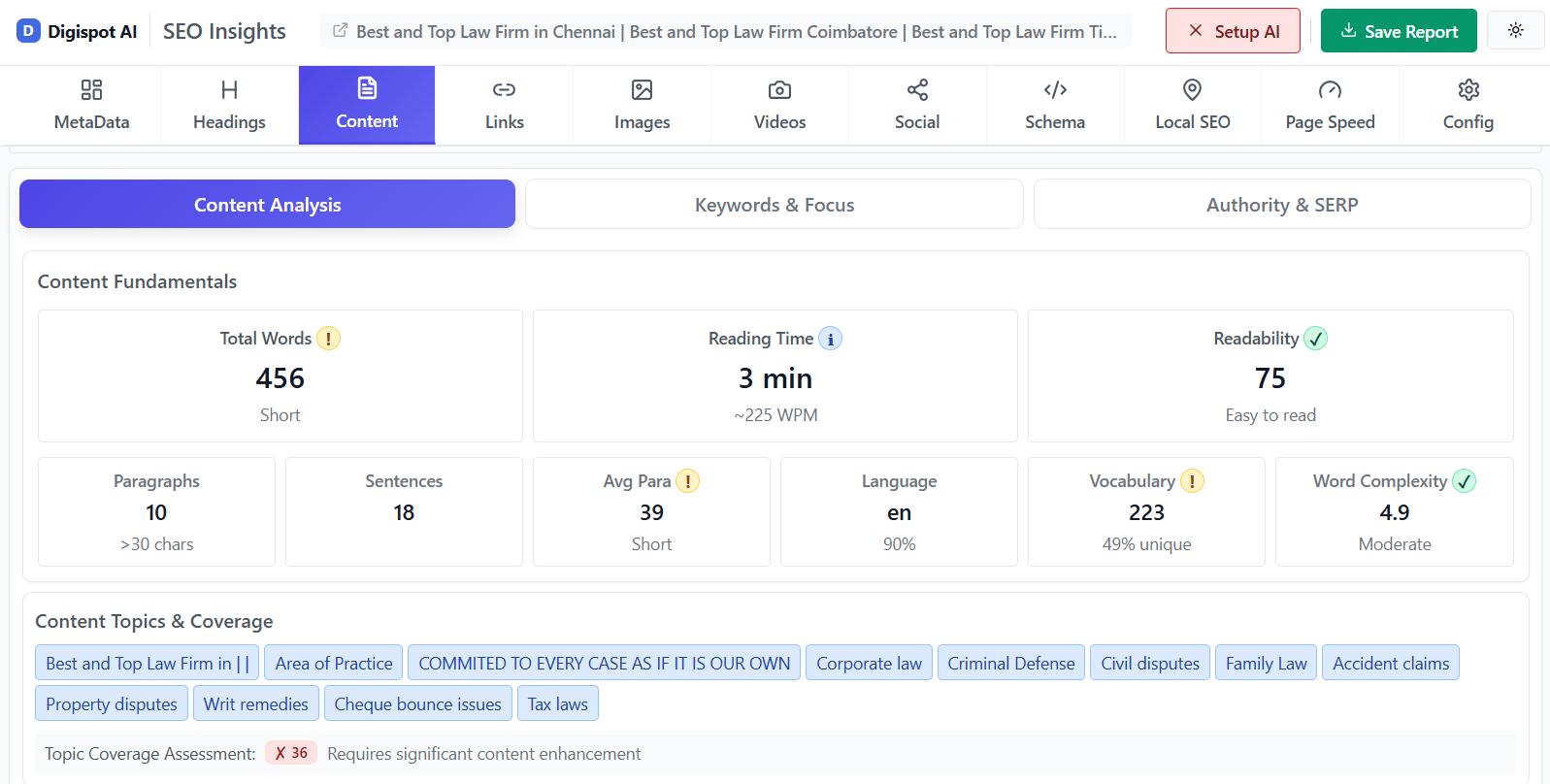
Turn invisible SEO data into clear visuals with our Free Chrome extension.
Demonstrating E-E-A-T in Your Content
- Author Bylines: Every blog post must have a clear author byline with a photo, name, title, and a link to their full biography page. This connects the content to a qualified human expert.
- Attorney Bios: Bio pages should be detailed, outlining education, bar admissions, awards, publications, and significant case experience. This is direct proof of Expertise.
- Case Studies and Results: Where ethically possible, create detailed case studies explaining the client's problem, your strategy, and the positive outcome. Anonymize details to protect privacy, but showcase your process. This demonstrates Experience.
Cornerstone 3: The Web of Trust and Authority
In SEO, your authority is amplified by backlinks—links from other websites to yours. Google views a backlink from a high-quality, relevant site as a vote of confidence. However, law firms must be careful; common SEO mistakes like buying low-quality links can lead to penalties.
Strategic Link Building for Law Firms:
- Legal Directories: Ensure your firm is listed accurately in major legal directories like Avvo, Justia, FindLaw, and Martindale-Hubbell. Don't forget state and local bar association directories, which carry immense authority.
- Sponsorships and Community Involvement: Sponsoring a local charity event, little league team, or community organization often results in a backlink from their website. This is a powerful local signal that competitors often miss.
- Guest Articles and Commentary: Offer to write a guest column for a local business journal or provide legal commentary for a news story. This positions your attorneys as experts and generates high-authority backlinks.
- Scholarships: Hosting a small annual scholarship for law students is a time-tested method for earning
.edubacklinks from university financial aid pages—one of the most trusted link types. - Become a Source: Use platforms like HARO (Help a Reporter Out) or Qwoted to respond to journalist queries. Being quoted in a major publication provides a high-value backlink and significant brand exposure.
Cornerstone 4: The Technical Bedrock
Technical SEO is the unseen infrastructure ensuring users and search engines have a seamless experience. If your technical foundation is weak, your content efforts will be wasted.
Core Web Vitals: The User Experience Metrics
Google measures user experience with Core Web Vitals. Your site must be fast and stable.
- Largest Contentful Paint (LCP): How fast does the main content load? (Aim for under 2.5 seconds).
- Interaction to Next Paint (INP): How quickly does your page respond to clicks?
- Cumulative Layout Shift (CLS): Does the layout jump around as it loads?
Optimizing these metrics involves compressing images, improving server response times, and cleaning up code. You can get a quick overview of these vitals using our Digispot AI Chrome Extension while analyzing your site. For a deeper dive into these metrics, read our guide on Core Web Vitals SEO.
Essential Technical Elements:
- Mobile-First Design: Your website must be flawless on mobile. Many legal searches happen in urgent situations on smartphones (e.g., at the scene of an accident). Google prioritizes the mobile version of your site for indexing.
- HTTPS Security: Your entire site must be secured with an SSL certificate. Clients will not submit sensitive case details on an insecure "http" site.
- Logical URL Structure: URLs should be clean and readable (e.g.,
yourfirm.com/practice-areas/family-law/instead ofyourfirm.com/page_id=123). - Schema Markup: This is critical for AEO (Answer Engine Optimization). Implementing
LegalServiceandAttorneyschema provides Google and AI models with structured data about your practice areas, location, and reviews.
Digispot AI helps you visualize and validate this code. After you've added the code, test it with our Schema Markup Visualizer to ensure Google reads it correctly.
Start Improving Your Search Visibility Today
This guide covers significant ground, but the path to dominance is built one step at a time. Here are your immediate action items:
- Adopt a Holistic Mindset: Stop treating SEO as a checklist. View it as the ongoing construction of your firm's primary digital asset.
- Prioritize E-E-A-T Above All: Because legal is a YMYL topic, every page must demonstrate Experience, Expertise, Authoritativeness, and Trust.
- Win Your Backyard First: Hyper-local SEO is paramount. An obsessively optimized Google Business Profile and a steady stream of reviews are the keys to dominating your local market.
- Content is Your Digital Counsel: Create content that provides genuine value and answers the specific questions your potential clients are asking.
- Build Authoritative Links: Pursue high-quality backlinks from authoritative sources in the legal and local communities.
- Technical Health is Non-Negotiable: A fast, secure, and mobile-perfect website is the foundation upon which all other SEO efforts are built.
By moving beyond basic tactics and adopting this comprehensive framework, you are building an enduring digital legacy. This approach attracts high-value clients, establishes your firm as a definitive authority, and secures your place in the future of the legal profession.
Ready to audit your current standing? Try Digispot AI for comprehensive website audits and actionable recommendations to help you rank higher and grow your firm.
References and Additional Resources
- Google Search Console
- Google Business Profile
- Avvo
- Google Analytics
- Google's Search Quality Rater Guidelines
- Digispot AI - FREE On-Page SEO Audit Tool
- Digispot AI - FREE Schema Markup Visualizer
- Digispot AI - FREE Chrome Extension
Related deep-dives
Continue with these closely related guides:
- jewelry seo — Jewelry SEO: Rank Higher & Sell More Online
- real estate seo — Real Estate SEO - The Ultimate Guide to Getting More Leads
Audit any page in seconds
300+ SEO checks including Core Web Vitals, schema markup, meta tags, and AI readiness — trusted by 1000+ SEO experts and marketers.
Frequently Asked Questions
Here are some of our most commonly asked questions. If you need more help, feel free to reach out to us.
Written by
Maya Krishnan
Digital growth expert
Maya is a seasoned expert in web development, SEO, and digital strategy, dedicated to helping businesses achieve sustainable growth online. With a blend of technical expertise and strategic insight, she specializes in creating optimized web solutions, enhancing user experiences, and driving data-driven results. A trusted voice in the industry, Maya simplifies complex digital concepts through her writing, empowering readers with actionable strategies to thrive in the ever-evolving digital landscape.