Why SEO Audit Matters? How does it help your business?
Discover how SEO audits drive organic growth, identify critical website issues, and create data-driven strategies to outrank competitors.
 Maya Krishnan
Imagine owning a prime retail store where the windows are boarded up and the door is jammed shut. Customers walk right past, unaware of the value inside. This is exactly what happens when your website has technical SEO issues—you are invisible to the very people searching for your services.
Your website’s organic presence is not just a marketing channel; it is a critical business asset. While competitors burn through ad budgets on temporary clicks, you could be building a sustainable traffic engine. An SEO audit is the blueprint for that engine. It reveals why you aren't ranking, uncovers hidden technical barriers, and provides a clear path to market dominance.
The Power of Smart Digital Strategy
Strategic optimization often beats deep pockets. Consider this real-world scenario: A neighborhood bookstore in Boston struggled against retail giants like Amazon and Barnes & Noble. They couldn't outspend these behemoths, so they had to outsmart them.
They revolutionized their digital presence by focusing on hyper-local intent and specific niche queries. Through a meticulous SEO audit, they fixed broken site architecture and optimized for terms like "rare book dealers Boston" rather than just "books." Today, they capture 60% of local "book recommendation" searches, driving more foot traffic than their big-box competitors—all without spending a dime on ads.
The Real Impact: Their organic strategy delivers 5-7x better ROI compared to paid search over a 12-month period. This is the power of the "long game."
We have worked with numerous small businesses at Digispot AI that consistently outrank billion-dollar corporations. How? By ensuring their technical foundation is flawless and being razor-focused on their audience's specific needs. Whether you are in healthcare, insurance, legal, or financial services, the first page of Google results is the difference between stagnation and exponential growth.
Why Organic Traffic is Your Most Valuable Asset
Organic search traffic is often referred to as "earned media" for a reason—you earn it through quality and technical excellence, not by renting space via ads. Here is why it is pure gold for your bottom line:
- 💡 Higher Trust & Credibility: 73% of users skip paid ads, instinctively preferring organic results. Ranking high signals to users that Google trusts your content, which transfers that trust to your brand.
- 💰 Cost Effectiveness: PPC stops the moment you stop paying. Organic traffic, once established, provides a continuous stream of visitors. It lowers your Customer Acquisition Cost (CAC) significantly over time.
- 📈 Compound Growth: Unlike paid ads which offer linear returns, organic traffic compounds. A well-optimized piece of content can bring in leads for years.
- 🎯 High-Intent Targeting: Users searching for "best project management software for small teams" are in a buying mindset. Organic search captures this intent at the perfect moment.
What Happens in a Professional SEO Audit?
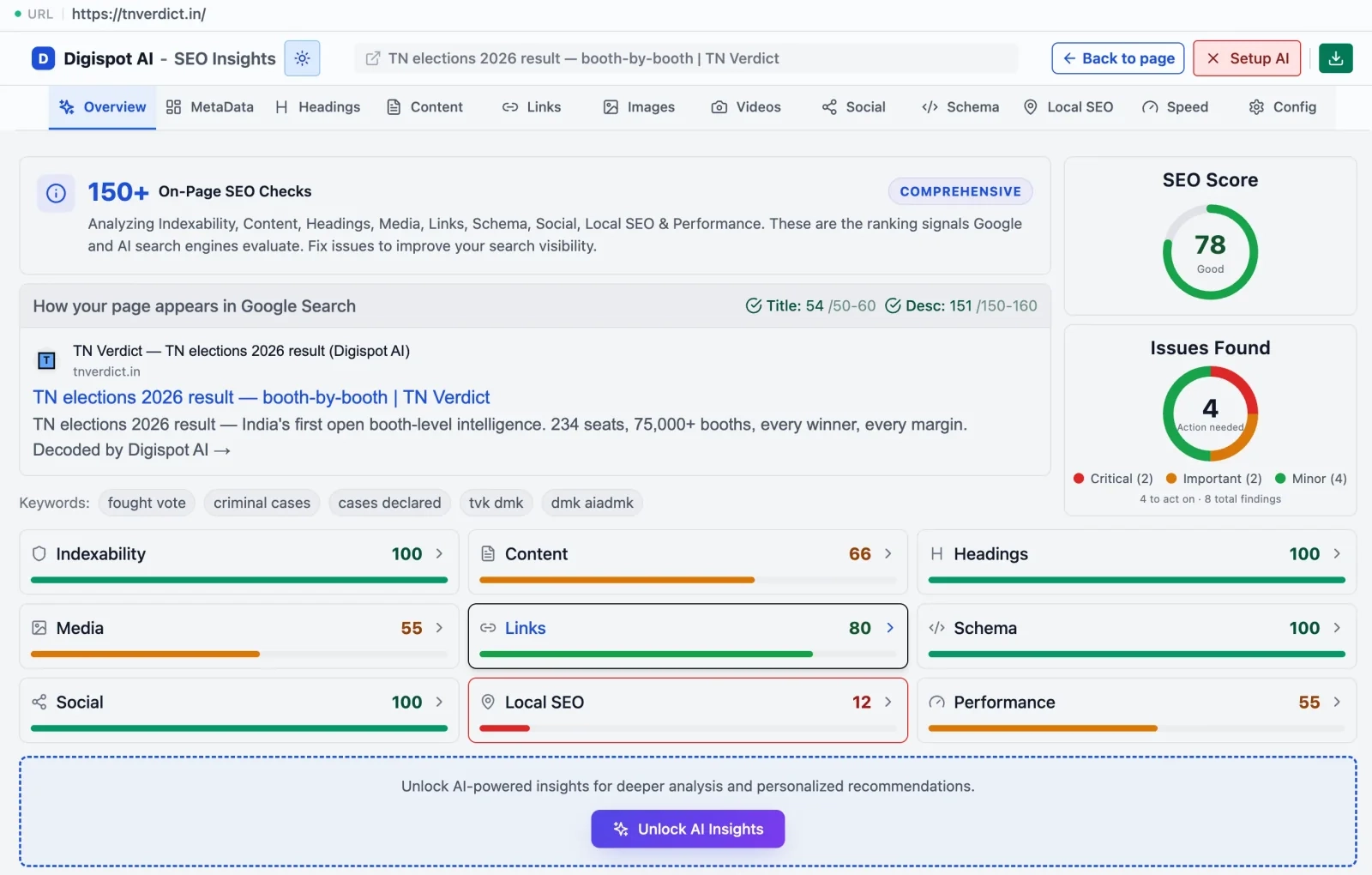
An SEO audit is far more than a simple automated scan. It is a comprehensive diagnostic of your website's health, analyzing over 200 ranking factors to find bottlenecks. With advanced SaaS platforms like Digispot AI, you can now execute these audits in minutes rather than days, leveraging multi-LLM engines to spot patterns human auditors might miss.
Here is exactly what SEO professionals examine during a deep-dive audit:
1. Technical Foundation
Just like a house needs a solid concrete slab, your website needs a robust technical infrastructure. If search engines cannot crawl your site efficiently, your content doesn't exist.
Crawling and Indexation
- 🤖 Robots.txt Configuration: This file gives instructions to search bots. One wrong
Disallow: /line can de-index your entire site. We check for accidental blocks and efficient crawl budget usage. - 🗺️ XML Sitemaps: Think of this as your website's GPS. It should list only your valid, indexable pages—excluding 404s or redirects to prevent wasting bot resources.
- 🔗 URL Structure: Clean, descriptive URLs are vital.
yoursite.com/blog/seo-guideprovides semantic meaning to engines and users, whereasyoursite.com/p=123provides none. - 🎯 Canonical Tags: These tags tell Google which version of a page is the "master" copy. They are essential for preventing duplicate content issues, especially on e-commerce sites with product variants.
To ensure you aren't missing critical technical steps, refer to our SEO audit checklist for 2026 for a complete breakdown of technical factors.
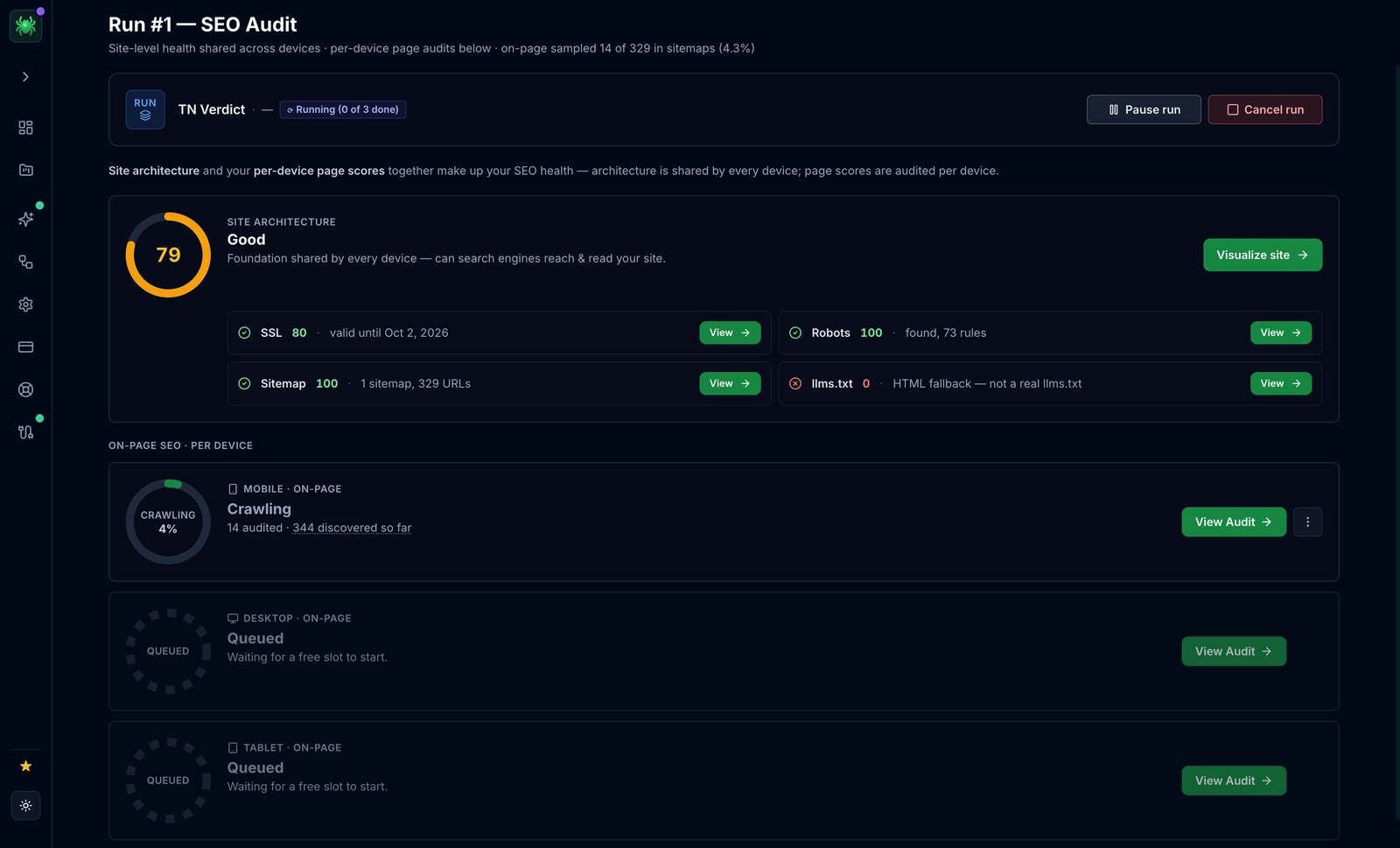
Site Architecture
- 📱 Mobile Responsiveness: Google uses mobile-first indexing. If your mobile site is a stripped-down version of your desktop site, your rankings will suffer.
- 🔍 Navigation Depth: Important pages should be within 3 clicks of the homepage. Deeply buried pages rarely get crawled or ranked.
- 🕸️ Internal Linking: This distributes "link equity" (authority) throughout your site. You must create clear paths for users and search engines to discover related content.
Pro Tip: Get instant insights on any page you visit, including schema validation and header checks, with our free Chrome extension.
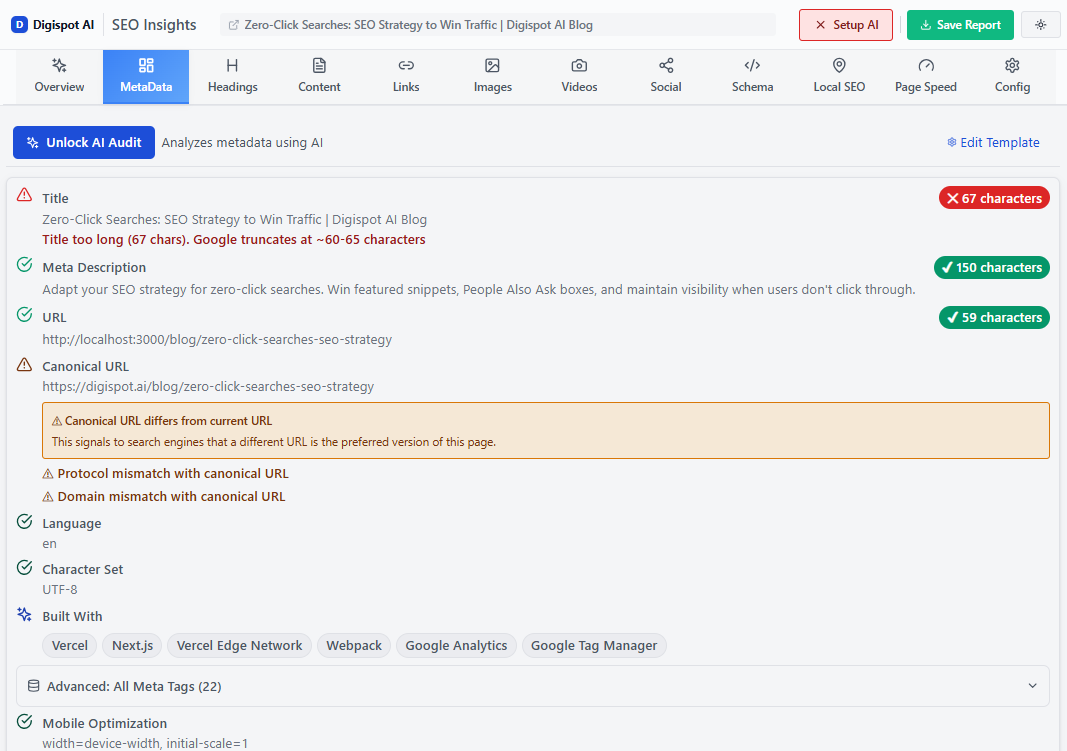
Turn invisible SEO data into clear visuals with our Free Chrome extension
2. Content Quality
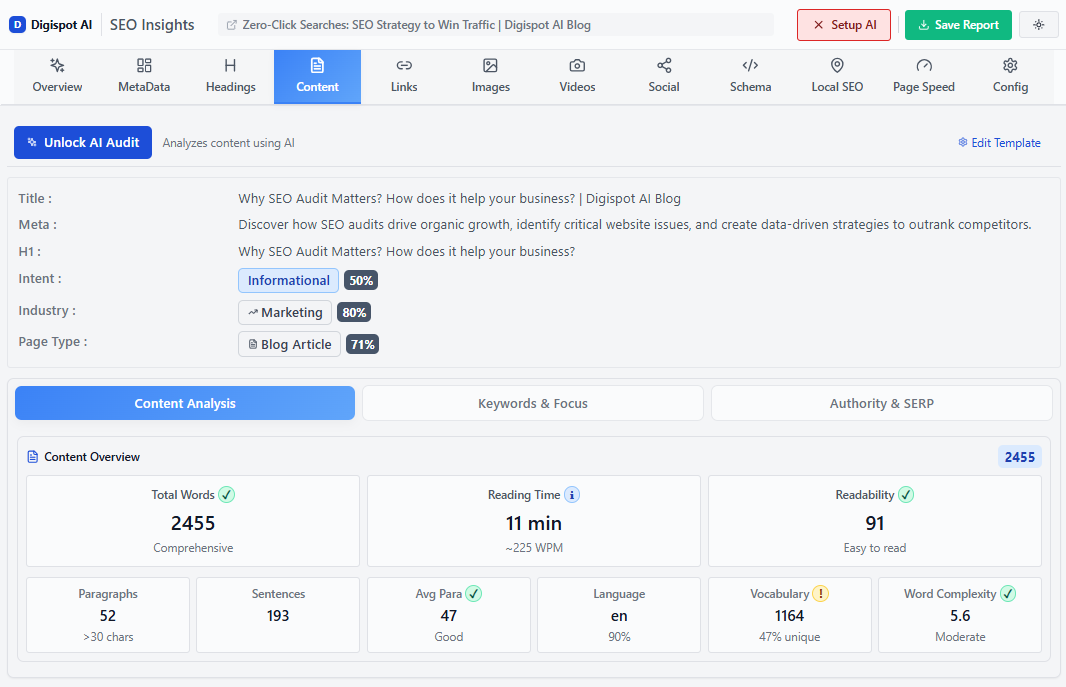
Content isn't just king—it's the kingdom itself. However, creating content without strategy is just noise. An audit evaluates if your content actually serves business goals.
- 📚 Topic Authority: Are you covering a topic comprehensively? We look for "content clusters"—groups of related pages that link to each other, signaling deep expertise to Google.
- 🎯 User Intent Match: If a user searches "how to fix a leaky tap," they want a tutorial, not a product page for a wrench. An audit ensures your page types match the query intent.
- 🔄 Content Freshness: Information decays. Regular updates signal relevance. An audit identifies outdated statistics or old years in titles (e.g., "Best Tips for 2021") that kill click-through rates.
- 📝 Heading Structure: Proper use of H1, H2, and H3 tags helps bots understand hierarchy. Learn how heading hierarchy helps clarify context for search engines.
3. User Experience (UX)
Google's Core Web Vitals have made user experience a direct ranking factor. It’s no longer enough to have good information; the delivery must be seamless.
- ⚡ Core Web Vitals: We analyze LCP (loading speed), INP (responsiveness/interactivity), and CLS (visual stability). Poor scores here can result in ranking penalties.
- 📱 Mobile Performance: Testing isn't just resizing a browser window. It involves checking touch targets, font readability without zooming, and load times on 4G networks.
- ⏱️ Engagement Metrics: High bounce rates and low time-on-site often indicate that users aren't finding what they need, or the page is broken.
For a deeper dive into optimizing speed and stability, read our Core Web Vitals SEO guide.
From Audit to Action: Your Success Roadmap
Data is useless without action. Here is how a local artisanal coffee roaster transformed their digital presence using audit insights.
They discovered through their audit that their product pages weren't optimized for local search—they were ranking for generic terms like "coffee beans" where competition was impossible, instead of "fresh roasted coffee [city name]".
The Implementation:
- Schema Markup: They added LocalBusiness and Product schema to help Google understand their inventory and location.
- Page Speed: They compressed huge image files that were slowing down their mobile site.
- Local Keywords: They rewrote meta descriptions and H1s to include geo-modifiers.
The Results:
- Local organic traffic increased by 300% in 4 months.
- Online orders grew by 250% directly attributable to organic search.
- They now rank #1 for "specialty coffee [city name]" and appear in the Local Pack.
Digispot AI can help you identify and fix these exact issues automatically with AI-powered audits analyzing 300+ ranking factors.
Tools That Power Professional Audits
You cannot fix what you cannot measure. Here are the essential tools used by top strategists.
Essential Free Tools
-
Google Search Console (GSC): Your SEO command center. This is the only source of truth from Google itself. It helps you monitor your website's presence, track performance metrics like CTR and Position, and receive alerts about critical indexing issues (like 404s or server errors). It reveals exactly which queries bring traffic, allowing you to double down on what works.
-
Google Analytics (GA4): Understanding user behavior. While GSC tells you how users find you, GA4 tells you what they do once they arrive. You can analyze conversion paths, engagement rates, and user demographics. This data is crucial for understanding if your traffic is actually relevant to your business goals.
-
Google PageSpeed Insights: Performance monitoring. This tool analyzes the code and asset delivery of your web pages. It provides a granular breakdown of what is slowing your site down—be it uncompressed images, heavy JavaScript, or slow server response times—and offers code-level suggestions for fixing them.
-
Mobile-Friendly Test: Mobile optimization testing. This checks if your website is usable on mobile devices. With the majority of searches now happening on mobile, ensuring your site passes this test is non-negotiable for maintaining visibility.
-
Digispot Free Tools: We integrate these data points natively. You can also use our standalone On-Page SEO Analysis tool to audit any URL instantly or our Schema Markup Generator to create valid structured data in minutes.
Professional Tools
- Screaming Frog: The industry standard for technical crawling. It mimics a search bot to find broken links, redirect chains, and missing meta data across thousands of pages.
- SEMRush/Ahrefs: primarily used for competitive intelligence. These tools show you what keywords your competitors rank for and their backlink profiles.
- Digispot AI: An automated, all-in-one platform. Unlike manual tools, Digispot uses AI to prioritize issues by revenue impact. We also offer capabilities to decode your competitor's SEO strategies and provide clear, plain-English instructions on how to beat them.
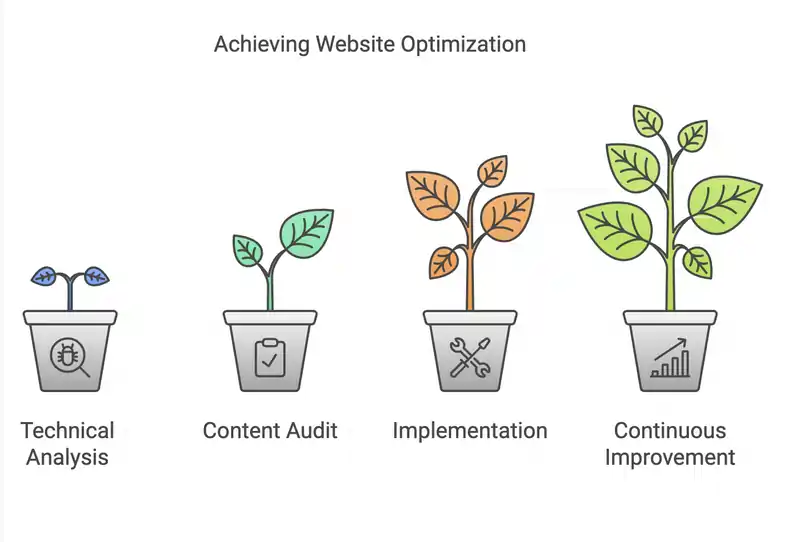
Your 30-Day Action Plan
Transforming your SEO doesn't happen overnight, but a structured approach ensures steady progress. Avoid common SEO mistakes by following this phased plan:
Week 1: Technical Analysis & Triage
- Run a Crawl: Use Digispot AI or a crawler to scan your entire site.
- Fix Critical Errors: Prioritize 4xx (broken links) and 5xx (server) errors. These are "stop signs" for Google bots.
- Check Indexing: Verify in GSC that your important pages are indexed and not blocked by robots.txt or "noindex" tags.
- Speed Check: Identify the top 5 slowest pages and compress their images or defer non-essential JavaScript.
Week 2: Content Audit & Strategy
- Gap Analysis: Identify keywords your competitors rank for that you do not.
- Thin Content Check: Find pages with under 300 words or low value. Decide whether to rewrite, merge, or delete them.
- Optimization: Update titles and meta descriptions for pages with high impressions but low clicks (Low CTR).
- Internal Linking: Review your top-performing blog posts and add internal links to your product or service pages.
Week 3: Implementation & On-Page SEO
- Structure Data: Implement Schema markup (FAQ, Article, Product) to capture rich snippets.
- Content Updates: Execute the rewrites planned in Week 2, ensuring you follow on-page SEO best practices.
- UX Improvements: specific fixes for layout shifts (CLS) or button spacing on mobile.
Week 4: Continuous Improvement & Monitoring
- Track Changes: Annotate your analytics to mark when changes were made.
- Measure Improvements: Look for movement in average position and impressions first; traffic and conversions follow later.
- Adjust Strategy: If a page hasn't moved after optimization, re-evaluate the search intent or build more internal links to it.
Ready to Transform Your Digital Presence?
While this list may seem extensive, the cost of inaction is far higher. Every day without proper SEO is a day your competitors are capturing your potential customers, building brand loyalty that you are missing out on.
You don't need to be a technical wizard to start. Put your first step forward, and this SEO journey will become clearer. With Digispot AI's automated platform, you can get a comprehensive analysis of your website's SEO health in minutes, identifying the exact levers to pull for growth.
Want to see how your website stacks up against competitors and discover untapped opportunities? Ready to improve your search visibility? Try Digispot AI for comprehensive website audits and actionable recommendations. Start your free audit today with our sign up.
Related deep-dives
Continue with these closely related guides:
- log file seo analysis — Log File SEO Analysis: Googlebot Insights
References and Further Reading
Audit any page in seconds
300+ SEO checks including Core Web Vitals, schema markup, meta tags, and AI readiness — trusted by 1000+ SEO experts and marketers.
Frequently Asked Questions
Here are some of our most commonly asked questions. If you need more help, feel free to reach out to us.
Written by
Maya Krishnan
Digital growth expert
Maya is a seasoned expert in web development, SEO, and digital strategy, dedicated to helping businesses achieve sustainable growth online. With a blend of technical expertise and strategic insight, she specializes in creating optimized web solutions, enhancing user experiences, and driving data-driven results. A trusted voice in the industry, Maya simplifies complex digital concepts through her writing, empowering readers with actionable strategies to thrive in the ever-evolving digital landscape.