Product Lifecycle SEO: Optimize Every Stage
Align SEO strategy with product lifecycle stages. Optimize for launch, growth, maturity, and decline phases to maximize organic visibility and conversions.
 Maya Krishnan
Great products often fail to find their audience because search strategy is treated as an afterthought—a layer of paint applied after the house is built. This disconnect creates a frantic game of catch-up where marketing teams struggle to reverse-engineer visibility for products that weren't built with search behavior in mind. Product-Lifecycle-SEO flips this dynamic.
Instead of treating SEO as a static checklist or a one-time launch event, Product-Lifecycle-SEO aligns your optimization efforts with the natural evolution of your product. From the whiteboard sessions of ideation to the final sunsetting of a legacy SKU, search data should inform every decision. This approach ensures your digital presence adapts to how users actually search, whether they are discovering a problem, comparing solutions, or looking for support on a mature tool.
In an era dominated by AI-driven search engines like ChatGPT, Perplexity, and Google's AI Overviews, static strategies die quickly. This guide outlines how to operationalize Product-Lifecycle-SEO to build a resilient, high-performing digital footprint that grows alongside your business.
What is Product-Lifecycle-SEO?
Product-Lifecycle-SEO (PLC-SEO) is the strategic synchronization of search engine optimization with the four classic stages of a product's life: Introduction, Growth, Maturity, and Decline. It moves SEO from a downstream marketing tactic to an upstream product requirement.
Traditional SEO often reacts to existing pages. PLC-SEO anticipates future pages. It asks critical questions before code is written: How will users search for this feature? What schema markup is required to trigger rich snippets? How does the URL structure support future category expansion?
This methodology mirrors the product's own trajectory:
- Ideation & Research: Leveraging search volume data to validate product-market fit and feature prioritization.
- Development: Baking technical SEO standards (speed, mobile-friendliness, structured data) into the codebase.
- Launch: Executing a "Day Zero" indexing strategy to capture immediate demand.
- Growth: Aggressively targeting non-branded, high-intent, and comparison queries to steal market share.
- Maturity: Focusing on retention, brand defense, and entity authority to maintain dominance.
- Decline/Rejuvenation: Managing the transfer of link equity through strategic redirects and archival processes.
When you synchronize these efforts, you stop fighting the algorithm and start feeding it exactly what it needs at every phase.
Why is Product-Lifecycle-SEO Crucial for Your Business?
Relying on a "launch and leave" strategy is the fastest way to accumulate technical debt and lose organic market share. Product-Lifecycle-SEO offers compounding advantages that go beyond simple rankings.
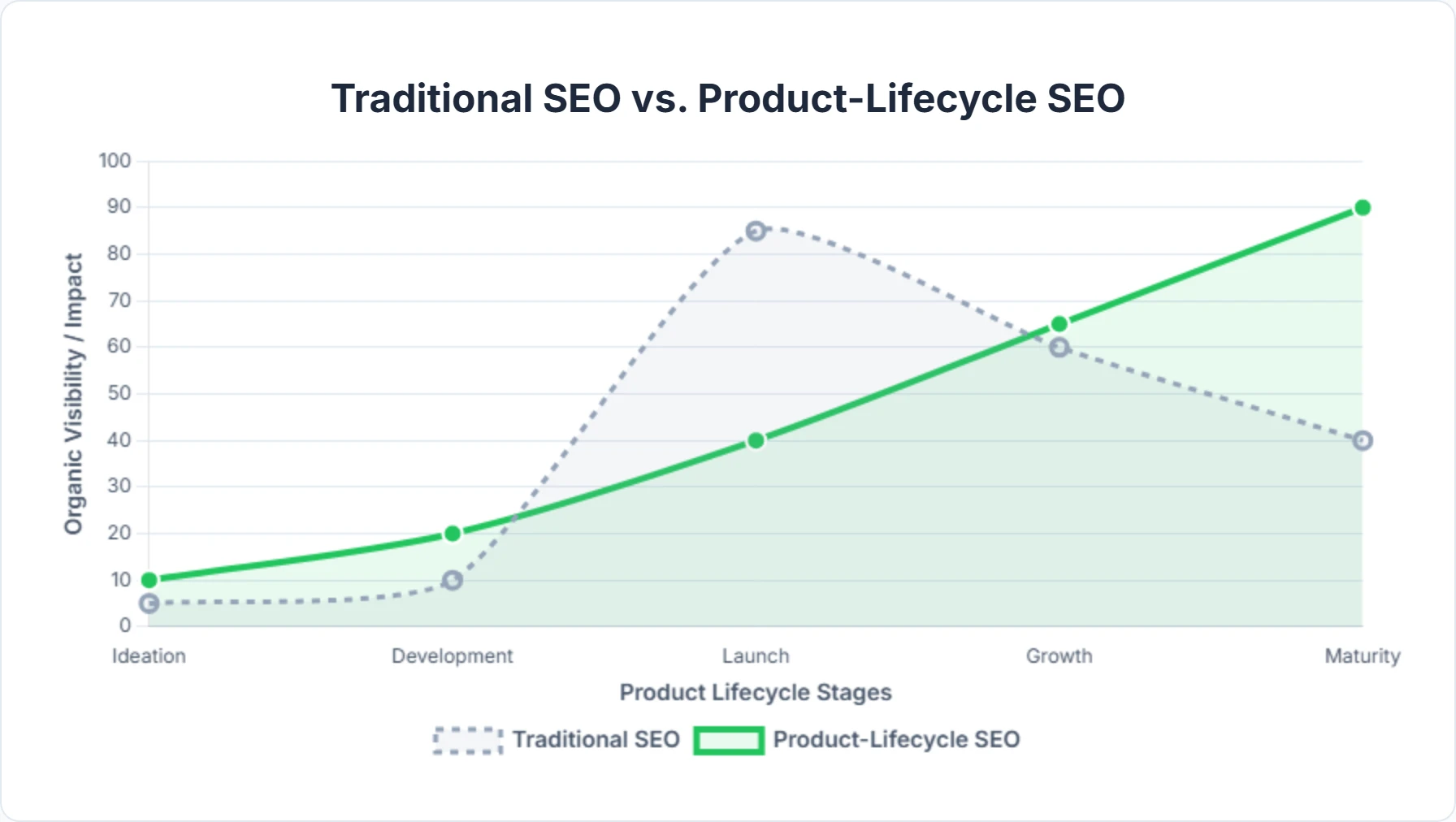
1. Maximized Visibility from Day One Most product pages take months to rank because they are published cold. By building pre-launch teaser content and optimizing site architecture during development, you allow search crawlers to understand your topic clusters before the "buy" button even goes live. This reduces the "sandbox" effect and accelerates time-to-revenue.
2. Increased Traffic and Qualified Leads Different stages of the lifecycle attract different types of intent. Early-stage SEO captures "informational" seekers (top of funnel). Growth-stage SEO captures "commercial" investigators (middle of funnel). By optimizing for the full lifecycle, you nurture users from their first question to their final purchase, increasing the lifetime value (LTV) of the traffic you acquire.
3. Enhanced User Experience and Relevance Google's ranking algorithms—and increasingly AI answer engines—prioritize relevance. A user searching for a mature product often needs support docs or changelogs, while a user searching for a new product needs pricing and features. PLC-SEO ensures the landing page matches the specific intent of the product's current market position, reducing bounce rates and signaling quality to search engines.
4. Mitigation of Technical Debt Retrofitting SEO onto a completed React or Angular application is expensive and risky. It often requires code refactoring that delays roadmap delivery. Integrating SEO requirements during the development phase prevents these costly pivots. Digispot AI can help you identify these architectural issues early with automated audits analyzing 300+ ranking factors before you deploy.
5. Competitive Moats Your competitors are likely reacting to trends. By using search data to predict feature demand during ideation, you can launch with content that already answers the questions your competitors haven't even thought to ask. This proactive stance builds "topical authority" that is difficult for rivals to displace.
How Does Product-Lifecycle-SEO Work? A Stage-by-Stage Breakdown
To implement this effectively, you need to map specific SEO deliverables to your product roadmap. Here is the operational breakdown for each stage.
Stage 1: Ideation and Research – Laying the Groundwork
Before a line of code is written, SEO data acts as a market intelligence tool. This stage is about validating assumptions and structuring your future site hierarchy.
- Market Gap Analysis: Do not just guess what features users want; look at what they are searching for but not finding. High search volume combined with low-quality existing results indicates a prime opportunity.
- Intent Modeling: Categorize potential keywords by intent (Informational, Navigational, Transactional). If 80% of queries for your product category are informational, your launch strategy must be content-heavy, not just sales-page heavy.
- Competitor Content Audit: Analyze the top-ranking pages for your target terms. Are they using video? Calculators? extensive FAQs? Your product must support these content formats natively.
- Entity Association: Define how you want your brand and product to be understood by Google's Knowledge Graph. What other entities (technologies, problems, industries) should you be associated with?
- Opportunity Discovery: Use tools to find long-tail questions. For example, if you are building email software, are users searching for "email automation for real estate"? If so, that is a vertical feature you should consider.
Digispot AI Advantage: The platform's Opportunity Finder analyzes search trends and competitor gaps to validate your product concepts against real-world demand. It helps you pivot from "gut feeling" development to data-backed feature prioritization.
Stage 2: Development and Planning – Building with SEO in Mind
This is the most critical phase for technical SEO. Decisions made here regarding URL structure, JavaScript rendering, and page speed will dictate your crawling budget and indexing speed for years.
- Architecture & URL Structure: Plan a logical hierarchy. Avoid deep nesting (e.g.,
domain.com/products/category/sub-category/v2/product-name). Keep URLs flat, descriptive, and keyword-rich. - Technical Stack Validation: If you are using a Single Page Application (SPA) framework, ensure you have a server-side rendering (SSR) or static site generation (SSG) strategy. Google needs to see the HTML, not just a blank container.
- Core Web Vitals Budgeting: Set performance budgets for Largest Contentful Paint (LCP) and Cumulative Layout Shift (CLS). Developers should know that a page cannot pass QA if it exceeds these thresholds. Learn more about optimizing Core Web Vitals to keep your technical foundation solid.
- Structured Data Strategy: define which Schema.org types apply. Product, FAQPage, BreadcrumbList, and VideoObject schemas should be hard-coded into the templates.
- Staging Environment Audits: Never launch without auditing your staging site. Check for accidental
noindextags, broken internal links, or missing metadata that might have been copied from dev environments.
Digispot AI Advantage: Developers can use the Digispot AI Chrome Extension to run instant audits on staging environments. This allows them to catch missing H1 tags or broken schema before the code merges to production.
Stage 3: Launch – Making a Grand, Discoverable Entrance
Launch day is about maximizing indexation speed and controlling the narrative. You want Google to crawl, index, and rank your new pages immediately.
- Sitemap Management: Do not rely on Google to find your new URLs. Submit a dedicated XML sitemap for the launch to Google Search Console. Ensure your
robots.txtallows access to these new assets. - Day Zero Content: Publish support content immediately. "How-to" guides, configuration tutorials, and "vs" comparison pages should go live alongside the product page. This establishes immediate topical relevance.
- Press & Link Acquisition: Coordinate your PR release with your SEO team. Ensure press releases and partner announcements link to the specific product page, not just the homepage. Use distinct anchor text to target your primary keywords.
- Schema Validation: As soon as the page is live, test your structured data. Use the free Schema Markup Generator to ensure your pricing and availability data is readable for rich snippets.
- Server Log Analysis: Monitor server logs in the first 48 hours to ensure Googlebot is crawling the new sections efficiently and not hitting 5xx errors.
Digispot AI Advantage: The platform's real-time integration with Google Search Console allows you to monitor impressions and URL inspection status instantly. If a page isn't indexed, Digispot AI will flag the technical reason why.
Stage 4: Growth – Expanding Reach and Dominating Keywords
The product is live. Now you must scale. The goal is to move from ranking for branded terms (e.g., "Digispot features") to non-branded, high-volume terms (e.g., "best SEO audit tool").
- Content Hub Expansion: Build "Hub and Spoke" content clusters. Create a pillar page for a broad topic and link out to specific feature pages. This distributes page authority throughout your site.
- User-Generated Content (UGC): Encourage reviews and testimonials. Implement Review schema to display star ratings in search results. Fresh reviews signal to Google that the product is active and popular.
- International SEO: If the product takes off, look at localization. Implement
hreflangtags correctly to target different regions and languages without creating duplicate content issues. - Competitor Interception: Create aggressive comparison pages (e.g., "Your Product vs. Competitor"). These pages often have high conversion rates because the user is near the bottom of the funnel.
- Internal Linking Optimization: As your blog grows, ensure older posts are updated to link to the new product pages. Learn more about internal linking strategies to pass authority effectively.
Digispot AI Advantage: The Content Studio uses AI agents to help you scale content production. It can analyze top-ranking competitor pages and suggest content structures that cover the "semantic gaps" your current site is missing.
Stage 5: Maturity – Maintaining Authority and Exploring Niches
In the maturity phase, growth slows, and the goal shifts to defense and efficiency. You must protect your rankings from aggressive newcomers.
- Content Refresh Cycles: Decay is real. Update your "best practices" guides and tutorials annually. Google rewards "freshness." Change dates, add new examples, and verify that all screenshots are current.
- E-E-A-T Enforcement: Bolster your Experience, Expertise, Authoritativeness, and Trustworthiness. Ensure author bios are robust and that your site references authoritative external sources. Read our E-E-A-T SEO Guide for specific tactics on building trust signals.
- Brand SERP Management: Search your brand name. What appears? You should control the entire first page—social profiles, knowledge panels, and review sites. Push down negative sentiment by optimizing positive assets.
- Cannibalization Cleanup: Over time, you may have created multiple pages targeting similar keywords. Audit your site for keyword cannibalization and consolidate competing pages into single, authoritative resources.
- Conversion Rate Optimization (CRO): Traffic is steady, so focus on conversion. Test new meta descriptions to improve CTR. Improve page load speeds on mobile to reduce bounce rates.
Digispot AI Advantage: Continuous auditing monitors for "Keyword Drift"—where a page starts ranking for irrelevant terms or loses ranking for core terms. It alerts you to drops in authority so you can intervene before revenue is impacted.
Stage 6: Decline or Rejuvenation – Strategic Optimization for the Future
When a product is sunset or replaced, SEO prevents the loss of hard-earned domain authority.
- The 301 Redirect Strategy: Never just delete a product page (returning a 404 error) unless it has zero backlinks and zero traffic. Always 301 redirect the URL to the most relevant equivalent product or parent category. This passes the "link juice" to the rest of your site.
- Unavailable Product Schema: If a product is temporarily out of stock, update the Schema
availabilityproperty toOutOfStockrather than removing the page. If it is gone forever, useDiscontinuedschema attributes where supported. - Content Archiving: Move documentation for legacy products to an archive subfolder. Add a banner to these pages linking users to the newer version. This keeps the old content helpful for existing users while funneling new users to the current product.
- Rejuvenation Launches: If you are pivoting the product (e.g., v2.0), treat it as a new launch (Stage 3) but leverage the existing URL strength. Update the content heavily and request a re-crawl via Search Console.
Digispot AI Advantage: The platform helps visualize redirect chains. If you redirect an old product to a new one, and then that new one to a newer one, you lose authority. Digispot identifies these chains so you can straighten them out for maximum SEO efficiency.
The Core Benefits: Unlocking Growth with Product-Lifecycle-SEO
Adopting this lifecycle approach transforms SEO from a cost center into a growth engine.
| Business Outcome | How Product-Lifecycle-SEO Achieves It |
|---|---|
| Improving Business Visibility | Ensures consistent high rankings across all product stages, making your offerings constantly discoverable to relevant searches. |
| Increase in Traffic & Leads | Drives more qualified organic traffic by continuously optimizing for evolving search queries and user intent, converting visitors into valuable prospects. |
| Time and Cost Savings | Proactive SEO integration prevents costly fixes post-launch, streamlines content creation, and maximizes the ROI of marketing efforts. |
| Enhanced Brand Authority | Builds a strong, credible online presence by consistently providing valuable, optimized content that answers user questions and establishes your brand as a leader. |
| Deeper Market Insights | Continuous monitoring of SEO performance and search trends provides invaluable data on customer behavior and market shifts, informing product and marketing strategies. |
| Sustainable Competitive Edge | Establishes a long-term, adaptive SEO strategy that is harder for competitors to replicate, ensuring your product maintains its leading position. |
| Optimized User Experience | Focuses on delivering fast, relevant, and engaging content that satisfies user intent at every touchpoint, reducing bounce rates and improving engagement metrics. |
Navigating the SEO Landscape with Advanced Tools
The complexity of modern search—spanning mobile-first indexing, Core Web Vitals, and AI-generated answers—requires tools that offer more than basic keyword tracking.
Digispot AI Platform: Your Partner in Every Product Stage
The Digispot AI platform is engineered to automate the heavy lifting of Product-Lifecycle-SEO. By using a multi-LLM engine (integrating GPT-4, Claude, and Gemini), it provides semantic understanding that matches how modern search engines actually work.
- Comprehensive Website Auditing (Mobile & Desktop): Digispot AI simulates Google's mobile-first crawler. It detects issues that only appear on mobile devices, such as clickable elements being too close together or JavaScript execution failures. Try Digispot AI to uncover these hidden bottlenecks.
- Seamless Integrations: By connecting directly with Google Search Console and Google Analytics, Digispot overlays traffic data on top of technical health metrics. You can see exactly how a technical error (like a broken canonical tag) correlates with a drop in traffic.
- Opportunity Finder: This feature is your ideation partner. It scans the SERPs for your target topics and identifies "content voids"—questions users are asking that no competitor has adequately answered.
- Content Studio with AI Agents: Writing SEO content for every stage of the lifecycle is resource-intensive. The Content Studio generates briefs and drafts that are pre-optimized for semantic relevance, ensuring you hit the right entity density without keyword stuffing.
- 300+ Ranking Factors Analysis: Search is nuanced. Digispot analyzes over 200 distinct signals, from server response time (TTFB) to image alt text quality. This granular level of detail allows you to prioritize fixes based on their potential impact on rankings.
- Cloud Platform for Automated Best Practices: The platform acts as a centralized governance tool. You can set SEO standards that apply across all your domains, ensuring that regional teams or different product squads adhere to the same high standards of optimization.
Beyond the Platform: The Digispot AI Free Community Chrome Extension
For product managers and developers who need quick answers without logging into a full dashboard, the Digispot AI Free Community Chrome Extension provides instant intelligence.
- Instant Page Audits in Your Browser: Navigate to any URL—yours or a competitor's—and get an immediate health score. Check meta tags, header structure, and load performance in seconds.
- Powered by Popular LLM Models: The extension uses AI to interpret the data. Instead of just saying "H1 missing," it explains why that matters for the specific context of the page you are viewing.
- Supports Schema Markup Detection & Visualization: Troubleshooting structured data is notoriously difficult. The extension visualizes the JSON-LD code on the page, showing you exactly which schema types are present and if they have errors. This is essential for verifying Product Schema implementation during the launch phase.
Get instant SEO insights on any page with our free Chrome extension.
Practical Steps: Implementing Product-Lifecycle-SEO Effectively
Transitioning to this model requires a shift in workflow. Here is a practical checklist to get started:
- Embed SEO in the Product Charter: Add an "SEO Sign-off" step to your product requirement documents (PRDs). No feature moves to development without an SEO review.
- Establish "SEO Guardrails" in Code: For engineering teams, implement automated tests in your CI/CD pipeline that fail a build if critical SEO elements (like
noindexon production) are detected. - Create Lifecycle-Specific Content Calendars: Don't just plan "blog posts." Plan "Launch Support" content, "Growth Comparison" content, and "Maturity Retention" content.
- Audit Your Tech Stack: Ensure your CMS or frontend framework supports modern SEO requirements like server-side rendering and automated sitemap generation. Try the free On-Page SEO Analysis tool to baseline your current capabilities.
- Monitor AEO Metrics: Start tracking how your brand appears in AI answers. Is ChatGPT citing your support docs? If not, your content may be too unstructured.
- Educate Cross-Functional Teams: Hold workshops for developers on Core Web Vitals and for writers on Semantic SEO. The more your team understands the "why," the better the execution.
- Regular "Health Checks": Schedule quarterly deep-dive audits using Digispot AI to catch the "rot" that accumulates over time—broken links, outdated schema, and slow pages. Read our SEO Audit Checklist for a structured approach to these reviews.
Common Challenges and How to Overcome Them
Implementing Product-Lifecycle-SEO is a cultural shift as much as a technical one. Here is how to navigate common hurdles.
- Challenge 1: Siloed Teams
- The Friction: Developers want to ship code fast; SEOs want to minimize code bloat. Marketing wants creative headlines; SEOs want keyword-rich titles.
- The Solution: Create shared KPIs. If organic traffic is a metric for the product team, not just the marketing team, alignment happens naturally. Use Digispot AI's reporting to show developers how their code improvements directly boosted traffic.
- Challenge 2: Overwhelm with Data
- The Friction: With thousands of pages and hundreds of ranking factors, teams get "analysis paralysis."
- The Solution: Prioritize ruthlessly. Not every error matters equally. Focus on critical blockers (indexing issues) first, then high-impact optimizations (content quality), and finally micro-optimizations. Digispot AI helps by categorizing issues by severity.
- Challenge 3: Keeping Up with Algorithm Changes
- The Friction: Google updates its core algorithm thousands of times a year.
- The Solution: Stop chasing algorithms and start chasing user intent. While technical tactics change, the core goal of satisfying users does not. However, utilizing an AI-powered platform that updates its audit criteria automatically ensures you never miss a technical shift.
- Challenge 4: Resource Constraints
- The Friction: "We don't have budget for an SEO agency."
- The Solution: Leverage automation. Tools like the Schema Markup Generator and AI content assistants allow small teams to punch above their weight class.
- Challenge 5: Proving ROI
- The Friction: SEO is a long game, and executives want quarterly results.
- The Solution: Map SEO metrics to revenue. Don't report on "keyword rankings"; report on "share of voice" and "organic assisted conversions." Show how protecting brand traffic during the Maturity phase reduces reliance on paid search spend.
Conclusion
Product-Lifecycle-SEO is the difference between a product that spikes and crashes and one that builds sustainable, compounding value. By shifting your perspective from "optimizing pages" to "optimizing the lifecycle," you align your business with the reality of how users search and behave.
From the initial spark of an idea to the strategic sunsetting of a legacy tool, search intelligence should guide your path. This approach reduces risk, lowers customer acquisition costs, and builds a digital asset that dominates its category.
Do not wait for the next product launch to start. You can audit your current lifecycle stage today. Are you in the Growth phase but missing comparison content? Are you in Maturity but suffering from technical debt?
Ready to improve your search visibility? Try Digispot AI for comprehensive website audits and actionable recommendations that fit every stage of your product's journey.
Related deep-dives
Continue with these closely related guides:
- luxury product seo — Luxury Product SEO: Premium Brand Optimization
- electronics seo — Electronics SEO: Tech Product Optimization Guide
References
- Technical SEO Techniques and Strategies | Google Search Central
- Creating helpful, reliable, people-first content | Google Search Central
- How To Use Search Console | Google Search Central
- Google Analytics for Developers
- Schema Markup Testing Tools | Google Search Central
- Digispot AI - FREE On Page SEO Audit Tool
- Digispot AI - FREE Chrome Extension for SEO Insights
- Structured data general guidelines | Google Search Central
Audit any page in seconds
300+ SEO checks including Core Web Vitals, schema markup, meta tags, and AI readiness — trusted by 1000+ SEO experts and marketers.
Frequently Asked Questions
Here are some of our most commonly asked questions. If you need more help, feel free to reach out to us.
Written by
Maya Krishnan
Digital growth expert
Maya is a seasoned expert in web development, SEO, and digital strategy, dedicated to helping businesses achieve sustainable growth online. With a blend of technical expertise and strategic insight, she specializes in creating optimized web solutions, enhancing user experiences, and driving data-driven results. A trusted voice in the industry, Maya simplifies complex digital concepts through her writing, empowering readers with actionable strategies to thrive in the ever-evolving digital landscape.