Best Semrush Alternative for 2026: Digispot AI
Looking for a Semrush alternative? Discover how Digispot AI replaces Screaming Frog, Ahrefs, Semrush, and Surfer for just $169/yr. Try it free today.
 Maya Krishnan
Best Semrush Alternative for 2026: Digispot AI vs Legacy SEO Tools
Finding a comprehensive yet cost-effective Semrush alternative is becoming a top priority for modern marketing teams looking to scale their organic search presence without breaking the bank. Legacy SEO suites have grown bloated and expensive, leaving a gap for agile, AI-first platforms to redefine how we audit, optimize, and track rankings. Digispot AI represents this next generation of search engine optimization, bridging the gap between traditional Google search and the emerging world of AI answer engines.
Key Takeaways
- Consolidate the stack: Digispot AI replaces Screaming Frog, Ahrefs, Semrush, and Surfer in one workspace, so audit, keyword, content, and traffic data stay in sync instead of scattered across tools.
- Crawl what bots actually see: A real Chromium engine renders JavaScript-heavy frameworks natively, catching dynamic content and internal links that HTTP-based crawlers miss.
- Optimize for AI search, not just Google: The built-in LLMBot vs Googlebot comparison exposes AEO gaps before they cost you citations in AI answer engines.
- Automate fixes with MCP: A native Model Context Protocol server lets Claude or Cursor query your live crawl data and stage fixes — no CSV exports or tab-switching.
- Start free, save big: A free Chrome extension and 7-day Spider trial let you validate against your Semrush data before switching, at $169/yr versus ~$1,679/yr.
Table of Contents
- What is a Semrush Alternative and Why Do You Need One?
- Why Modern Marketing Teams Are Moving Away from Semrush
- Digispot AI: The Consolidated Alternative to Legacy SEO Platforms
- Feature-by-Feature Comparison: Digispot AI vs. Semrush
- The MCP Advantage: Connecting Live SEO Crawls to AI Agents
- LLMBot vs. Googlebot: Optimizing for AI Search Engines
- Pricing Reality Check: Semrush Pro vs. Digispot AI Starter
What is a Semrush Alternative and Why Do You Need One?
A Semrush alternative is any software platform that replaces the core functionalities of legacy SEO suites — keyword tracking, backlink analysis, and technical site auditing — often at a more competitive price point or with a more modern feature set. As organic search undergoes its most rapid transformation in decades, relying on platforms designed in the desktop era is no longer sufficient.
The High Cost of Legacy SEO Tool Suites
For years, digital marketing departments accepted the high costs of legacy SEO tools as a necessary cost of doing business. However, as budgets tighten, paying thousands of dollars annually for bloated software suites is increasingly difficult to justify. Many organizations realize they only use a fraction of the features bundled into these expensive platforms, yet they are forced into high-tier pricing plans just to access basic data exports or manage multiple client projects.
The Evolution of Search: From Googlebot to LLM Crawlers
Search is no longer a single-destination ecosystem dominated exclusively by Googlebot. Users now find information through conversational interfaces, AI search engines, and Large Language Models like ChatGPT, Claude, and Perplexity. Legacy tools remain hyper-focused on traditional SERPs, largely ignoring how AI agents crawl, index, and cite web content.
To remain visible online, businesses must optimize for both human searchers and AI crawlers — a shift that requires new tooling.
Why Modern Marketing Teams Are Moving Away from Semrush
While Semrush has historically been a reliable standard for SEO professionals, its architecture has struggled to keep pace with rapid technological shifts.
The Financial Burden of Fragmented SEO Tooling
Semrush's Pro plan starts at $1,679/year and quickly escalates when adding team members, API access, or additional projects. For growing agencies and startups, this pricing model creates an artificial barrier to growth.
Because legacy platforms don't excel at every aspect of search marketing, teams often end up paying for a fragmented stack on top of Semrush:
- A dedicated crawler (Screaming Frog and its modern alternatives) for complex site audits.
- An AI writer (Surfer or Clearscope) for content optimization.
- A separate rank tracker for real-time monitoring.
This fragmentation leads to disjointed workflows, data silos, and a massive annual software bill that eats into marketing margins.
Why Traditional Crawling Fails Modern Web Frameworks
Many legacy SEO platforms rely on basic HTML crawlers that struggle to parse modern JavaScript-heavy frameworks like React, Next.js, and Nuxt.js. When a crawler can't execute JavaScript efficiently, it misses critical on-page elements, internal links, and dynamic content — leading to inaccurate audit reports that don't reflect what search engine bots actually see.
The failure mode is subtle. An HTTP crawler fetches the raw HTML response, but on a client-rendered app that response is often little more than an empty <div id="root"> and a bundle of JavaScript. Titles, canonical tags, structured data, and the bulk of the body copy only appear after the browser executes that script and hydrates the page. A crawler that stops at the raw response reports those pages as thin, duplicate, or missing metadata — even when the rendered version is perfectly optimized. Just as damaging, links injected by the framework never enter the crawl graph, so the tool under-reports internal linking and orphans pages that are actually well connected.
Digispot AI sidesteps the problem by rendering every page in a real Chromium instance, executing scripts and waiting for hydration before it reads the DOM — the same way Googlebot's Web Rendering Service works. That means the audit reflects the rendered page, not a hollow shell. If you're wrestling with these issues on a specific stack, our JavaScript dynamic rendering guide walks through diagnosing and fixing them in detail.
Digispot AI: The Consolidated Alternative to Legacy SEO Platforms
Digispot AI was built from the ground up to address the inefficiencies of legacy SEO suites — combining advanced technical auditing, real-time data integration, and native AI capabilities.
Replacing Five Fragile Subscriptions with One Unified Workspace
Instead of bouncing between Screaming Frog for crawling, Ahrefs for backlinks, Semrush for keywords, Surfer for content, and manual dashboards for GSC and GA4, Digispot AI consolidates these workflows into a single workspace:
┌─────────────────────────────────────────────────────────────────────────┐
│                           DIGISPOT AI WORKSPACE                         │
├───────────────────┬───────────────────┬───────────────────┬─────────────┤
│  Technical Audit  │  Keyword & Rank   │  Content Studio   │  GSC & GA4  │
│  (JS Rendering)   │  Tracking         │  (AI Writer)      │  Integration│
└───────────────────┴───────────────────┴───────────────────┴─────────────┘
This integration ensures your audit data directly informs your content strategy, and your actual GSC traffic data validates your keyword tracking — eliminating the data reconciliation that currently costs hours every month.
A Frictionless Entry Point: The Free Chrome Extension
To help teams experience the platform without any initial commitment, Digispot AI offers a free Chrome extension — an on-the-spot auditing assistant that runs instant on-page checks, analyzes schema markup, and identifies technical errors directly from your browser. It's used by 1,000+ SEO professionals and rated 4.8/5 on the Chrome Web Store.
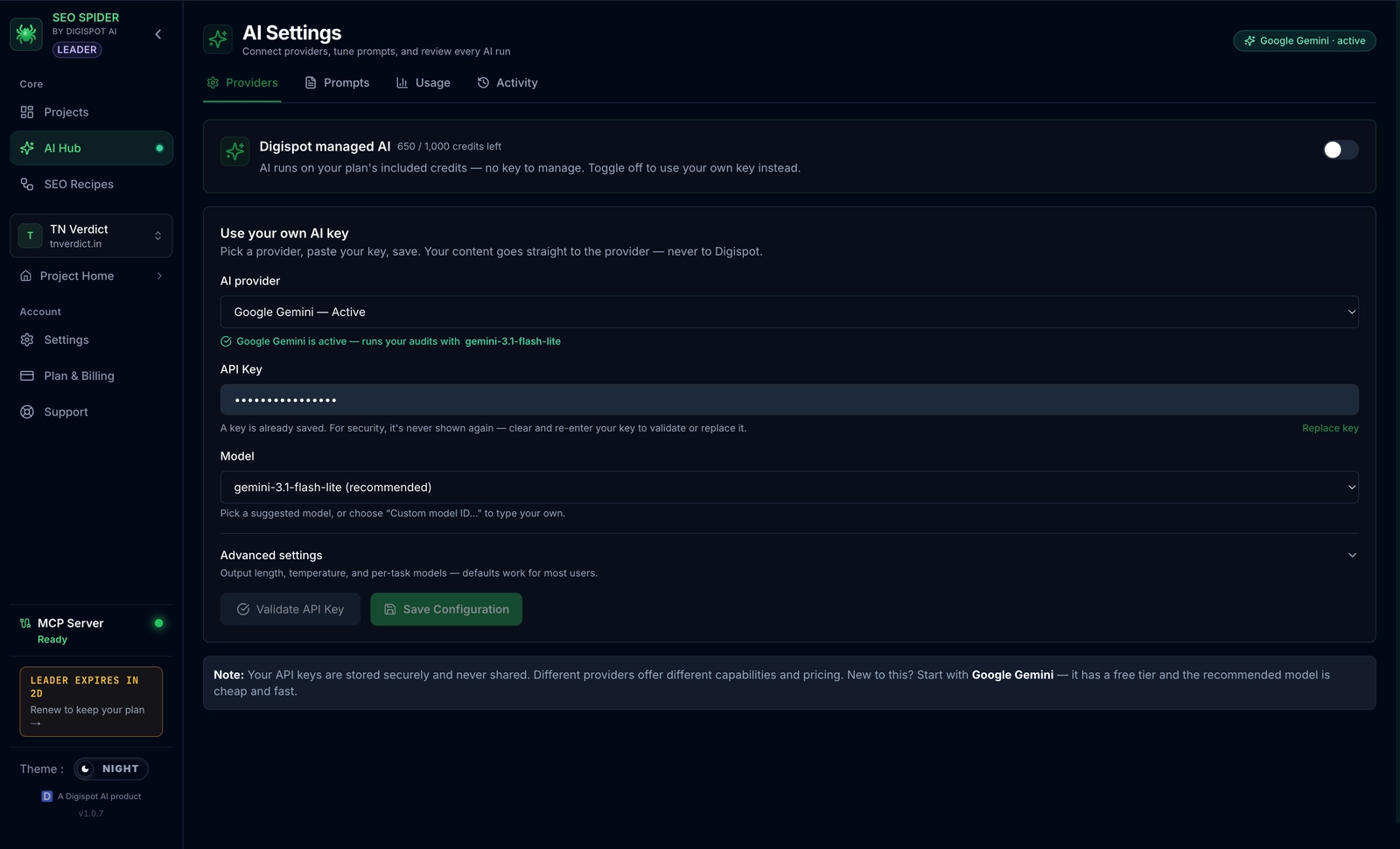 Digispot AI's MCP server connects Claude or Cursor directly to live crawl data — enabling AI agents to query findings, generate fixes, and apply them without any manual tab-switching.
Feature-by-Feature Comparison: Digispot AI vs. Semrush
| Feature | Semrush | Digispot AI |
|---|---|---|
| Entry-Level Price | ~$1,679/yr | $169/yr (Starter) |
| Site Crawling | Cloud-based, HTTP crawler | Real Chromium (macOS desktop) |
| JS Rendering | Limited / Higher tiers | Native real-browser rendering |
| Keyword Research | Yes | Yes (Cloud Platform) |
| Backlinks Analysis | Yes | Yes (Cloud Platform) |
| Content Tools | SEO Writing Assistant | AI Content Studio + Content Opportunities |
| AEO / LLM Checks | No | Yes — LLMBot vs Googlebot comparison |
| AI Agent Integration (MCP) | No | Yes — Claude, Cursor, any MCP client |
| GSC + GA4 Integration | Separate modules | Unified workspace, traffic-weighted |
| Mobile vs Desktop Audit | No | Separate audits per device |
| Local-First Privacy | Cloud-only | Crawl data stays on your Mac |
| Free Entry Point | Free trial | Free Chrome extension + 7-day Spider trial |
Data Privacy and Local-First Architecture
In an era of increasing data privacy regulations, cloud-only SEO tools pose compliance challenges. Digispot AI introduces a local-first architecture. Crawls, reports, and screenshots stay on your own machine by default — ensuring complete compliance with corporate data privacy standards and making it effortless to audit staging sites behind firewalls.
The MCP Advantage: Connecting Live SEO Crawls to AI Agents
One of the most significant capabilities separating Digispot AI from legacy software is its native support for the Model Context Protocol (MCP).
What is an MCP Server for SEO?
MCP is an open standard that allows AI models like Claude to securely connect to external data sources and tools. Digispot AI includes a built-in MCP server that lets you point your AI agent or development environment directly at your live crawl data.
Instead of exporting CSV files and pasting them into ChatGPT, Claude or Cursor can query your live SEO database directly via MCP:
┌──────────────┐       MCP Query       ┌─────────────────────┐
│  AI Agent    │ ────────────────────> │ Digispot MCP Server │
│ (e.g. Claude)│ <──────────────────── │  (Live Crawl Data)  │
└──────────────┘     Structured Data   └─────────────────────┘
Automating Technical Fixes with AI-Driven Workflows
With MCP, the gap between identifying an SEO issue and fixing it is virtually eliminated. You can instruct Claude: "Query the Digispot crawl data for pages missing alt tags or meta descriptions, write the optimized fixes, and stage them for deployment."
Semrush has no equivalent integration for agentic AI workflows — its users must manually copy, paste, and write code to resolve technical issues.
LLMBot vs. Googlebot: Optimizing for AI Search Engines
The search landscape is splitting into two distinct paradigms: traditional search engines indexing the web for link retrieval, and LLMs parsing the web to answer user queries directly.
The New Frontier of AI Search Optimization
Winning a spot in the "sources" or "citations" of an AI-generated answer requires optimization strategies focused on clear entity relationships, structured data, and authoritative content structure — not just ranking position #1 on Google.
This is a different game with different rules. An LLM doesn't rank ten blue links; it extracts and synthesizes facts, then attributes them to a handful of sources. To be one of those sources, a page has to be machine-legible: claims stated plainly near the headings that frame them, entities named explicitly rather than referenced by pronoun, and supporting structured data (FAQ, Article, Organization schema) present in the rendered DOM. Content that buries its answer three scrolls deep, or that only surfaces the answer after a JavaScript interaction, is effectively invisible to a crawler that reads once and moves on. Our answer engine optimization guide breaks down these tactics, and how to optimize for AI crawlers covers the crawl-access side of the same problem.
The practical risk is asymmetry: a page can rank beautifully on Google while being completely absent from ChatGPT and Perplexity answers, because the two crawlers see different versions of it. That gap is invisible in Semrush, which only measures traditional SERP position.
Digispot AI's SEO Spider runs a side-by-side LLMBot vs Googlebot comparison, showing you exactly where AI crawlers see different content than Googlebot. This exposes JS-rendered schema, dynamic content, and structured data that LLM bots miss — letting you fix AEO gaps before they cost you citations. Semrush has no equivalent.
Pricing Reality Check: Semrush Pro vs. Digispot AI Starter
For many businesses, the decision to switch comes down to financial reality. The pricing disparity between legacy platforms and modern alternatives is stark.
| Semrush Pro | Digispot AI Starter | |
|---|---|---|
| Annual Cost | ~$1,679/yr | $169/yr |
| Pages Crawled | 100,000/month (site audit) | 10,000 pages |
| JS Rendering | Limited | Full real Chromium |
| AI Agent (MCP) | No | Yes |
| LLMBot Checks | No | Yes |
| GSC + GA4 Overlay | Separate modules | Built-in, unified |
Calculating Your Annual Savings
For an agency managing multiple clients, the savings scale rapidly:
- Legacy stack (Semrush Pro + Screaming Frog + Surfer): ~$3,000+/year per seat
- Digispot AI (Starter plan + free Chrome extension): $169/year per seat
- Annual savings: Over $2,800 per seat — reinvestable into content creation, link building, or team growth
Ready to consolidate your stack? Try the Digispot AI SEO Spider free for 7 days — no credit card required. Or start instantly with the free Chrome extension.
For a deeper look at how Digispot compares to another legacy heavyweight, see our Digispot AI vs. Ahrefs comparison.
Related deep-dives
Continue with these closely related guides:
- seo workflow automation — SEO Workflow Automation for Agencies: Cut Reporting Time by 80%
- seo tools for in-house — SEO Tools for In-House Teams: Automate Audits, Track Rankings, Prove ROI
- digispot ai chrome extension — Digispot AI Chrome Extension: Free On-Page SEO & SERP Auditor
Audit any page in seconds
300+ SEO checks including Core Web Vitals, schema markup, meta tags, and AI readiness — trusted by 1000+ SEO experts and marketers.
Frequently Asked Questions
Here are some of our most commonly asked questions. If you need more help, feel free to reach out to us.
Written by
Maya Krishnan
Digital growth expert
Maya is a seasoned expert in web development, SEO, and digital strategy, dedicated to helping businesses achieve sustainable growth online. With a blend of technical expertise and strategic insight, she specializes in creating optimized web solutions, enhancing user experiences, and driving data-driven results. A trusted voice in the industry, Maya simplifies complex digital concepts through her writing, empowering readers with actionable strategies to thrive in the ever-evolving digital landscape.