Digispot AI vs Ahrefs: AI-Driven SEO Alternative 2026
Tired of paying $100+ a month for Ahrefs or Semrush? See how Digispot AI replaces your SEO stack — crawling, keywords, backlinks, AI agents — for less.
 Maya Krishnan
Most SEO teams are running a stack that looks something like this: Screaming Frog for crawling, Ahrefs for keywords and backlinks, Surfer or Clearscope for content, and then Google Search Console and GA4 open in separate tabs for performance data.
That is five separate tools, five logins, five monthly invoices, and zero shared context between them.
When a crawl in Screaming Frog surfaces a thin-content issue, you manually cross-reference GSC to check whether that page gets any traffic. When Ahrefs shows a keyword gap, you open Surfer to check how much content you need to write. Nothing talks to anything else, and the total annual bill can easily exceed $3,000 before your agency adds any markup.
There is a better way.
Key Takeaways
- Consolidate the stack, not just the invoice. Digispot AI replaces separate crawler, keyword, backlink, and content tools with one platform that shares a single source of truth — so a crawl finding, GSC traffic, and content brief all reference the same data.
- Start free, scale cheaply. The SEO Insights Chrome extension (150+ checks) and Spider Scout tier (100 pages) cost nothing; the $169/yr Starter plan already undercuts a single Screaming Frog license.
- Prioritize by traffic, not severity. Built-in GSC and GA4 integration weights every issue by the traffic it actually risks, so you fix what matters instead of chasing an abstract score.
- Crawl the way Google sees pages. Real Chromium rendering catches JavaScript-injected content, lazy-loaded images, and dynamic canonicals that Ahrefs' and Semrush's HTTP crawlers miss.
- Get AI-native, not bolt-on AI. The project-scoped MCP server lets Claude, Cursor, or any MCP client query live crawl data and write fixes directly — no export, no copy-paste.
The Real Cost of the Fragmented SEO Stack
Before comparing tools, it is worth doing the honest math on what this stack actually costs per year:
| Tool | What it does | Annual cost |
|---|---|---|
| Screaming Frog | Site crawling | ~$325/yr |
| Ahrefs Lite | Keywords + backlinks | $1,548/yr |
| Semrush Pro | Keywords + competitor research | $1,679/yr |
| Surfer SEO | Content optimization | ~$948/yr |
| GSC + GA4 | Traffic performance | Free (but isolated) |
| Total | $4,000–$4,500/yr |
Most teams don't run all five simultaneously, but even two or three of these tools stack up fast. And none of them share data. Every insight requires a manual export, a copy-paste into a spreadsheet, and a judgment call about which tool to trust when the numbers disagree.
The fragmented stack is not an SEO problem — it is an operations problem that bleeds into your SEO results.
Digispot AI vs. Ahrefs vs. Semrush: Feature Comparison
Here is how Digispot AI stacks up against the two dominant tools on the market across the capabilities that actually matter in 2026.
| Capability | Digispot AI (SEO Spider) | Ahrefs | Semrush |
|---|---|---|---|
| Site crawling | Real Chromium (sees JS-rendered content) | Basic HTTP crawler | Basic HTTP crawler |
| Keyword research | Yes (cloud platform) | Yes | Yes |
| Backlinks analysis | Yes | Best in class | Strong |
| Content tools | AI Content Studio + Content Opportunities | Content Explorer | SEO Writing Assistant |
| AEO / LLM readiness checks | Yes — LLMBot vs Googlebot comparison | No | No |
| AI-agent integration (MCP) | Yes — Claude, Cursor, any MCP client | No | No |
| GSC + GA4 integration | Yes — built-in, weights every issue by traffic | Limited | Yes |
| Mobile vs desktop audit | Separate audits per device | No | No |
| Local-first privacy | Yes — crawl data stays on your machine | Cloud-only | Cloud-only |
| Free entry point | Chrome extension (150+ checks) + 7-day Spider trial | Ahrefs Webmaster Tools (limited) | Free trial |
| Starting price | $169/yr (Starter) | $1,548/yr | $1,679/yr |
The three capabilities where Digispot has no direct equivalent in Ahrefs or Semrush are the ones that define how SEO will be practiced for the next few years: real-browser crawling, AEO readiness, and AI-agent integration.
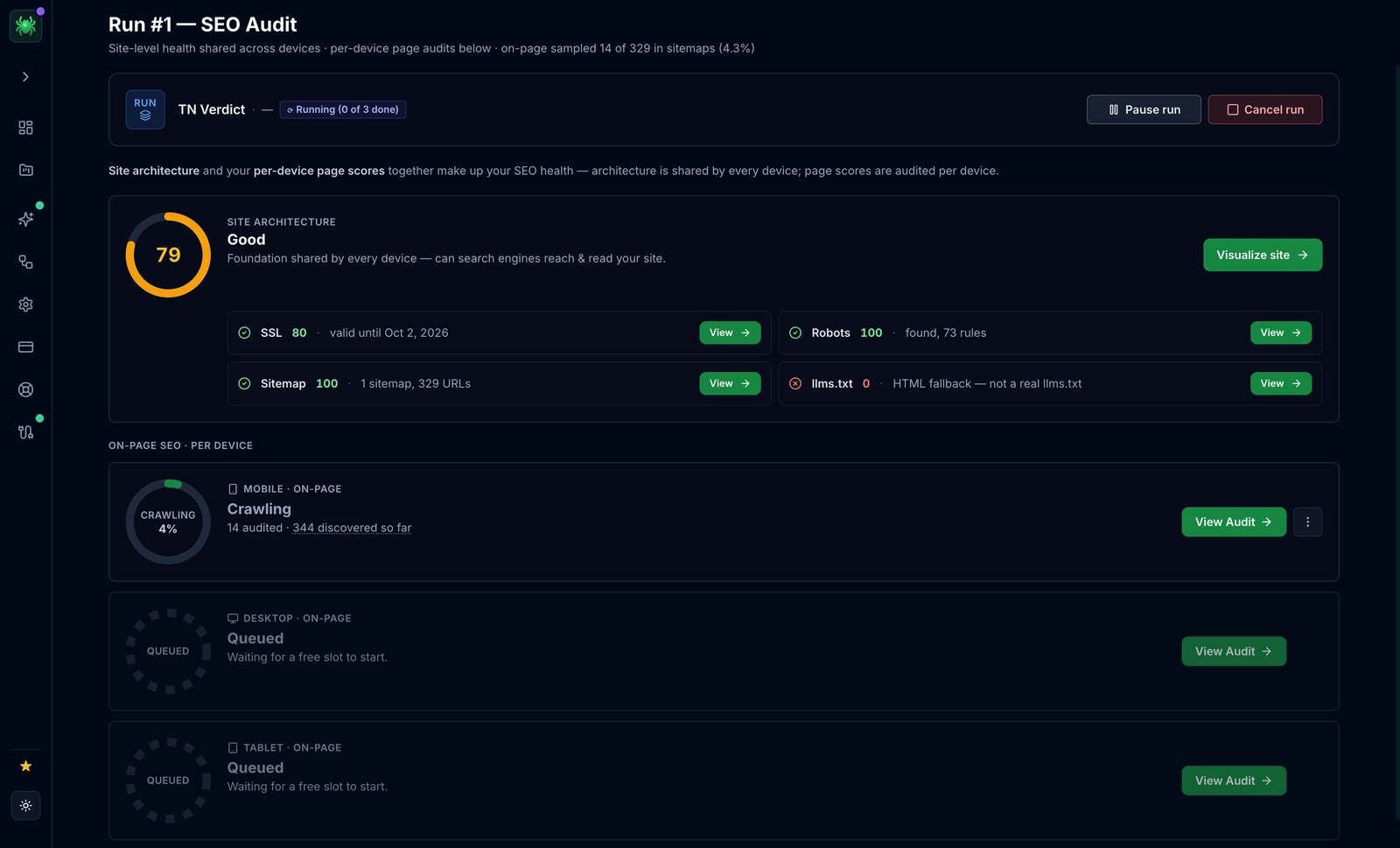 Digispot AI's real-browser crawler surfaces rendering issues — JS-rendered schema, lazy-loaded images, dynamic canonicals — that Ahrefs and Semrush's HTTP crawlers miss entirely.
AI-Native vs. Bolt-On AI: Why It Matters
Ahrefs added an AI writing assistant. Semrush added AI-generated recommendations. Both are useful — but they are AI layered on top of a tool that was designed before the LLM era. The underlying data models, crawlers, and APIs were never built with AI agents in mind.
Digispot AI was built differently.
The SEO Spider includes a built-in MCP (Model Context Protocol) server. This is not a chatbot. It is a project-scoped interface that lets AI agents — Claude, Cursor, or any MCP-compatible client — directly query your crawl data and act on findings.
In practice, this means an AI agent can:
- Run a full crawl of your site.
- Pull every issue ranked by traffic at risk.
- Write the fix (a corrected title tag, a canonical, a new meta description) directly into your codebase.
- Confirm the fix resolves the issue on the next crawl.
No export. No copy-paste. No switching between tabs.
The MCP server enforces safe-write access only — agents can read everything and write fixes, but they cannot delete projects or reset crawl data. The boundary is enforced by the server, not a prompt, which matters for agency environments where multiple people and agents operate on the same project.
This is what "AI-native" looks like: the audit data lives in a structured interface that any AI can query, not in a PDF report that an AI has to parse after the fact.
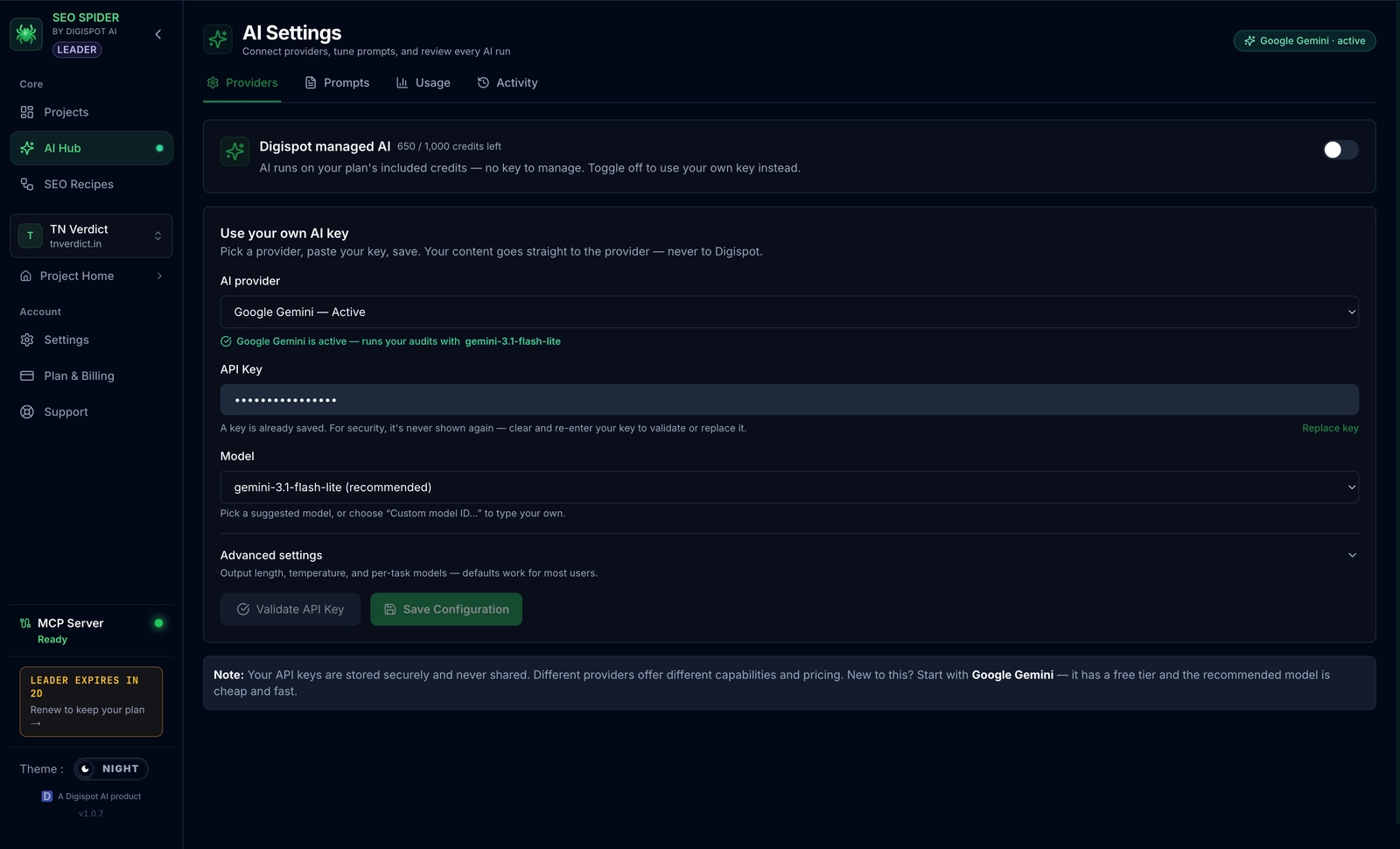 The built-in MCP server lets AI agents like Claude or Cursor query live crawl data, generate fixes, and apply them — without any manual export or tab-switching.
The same AI-native design shows up in the crawler itself. Alongside the standard Googlebot render, the SEO Spider runs an LLMBot pass and diffs the two — flagging pages where the content an answer engine can extract differs from what a search crawler sees. That matters as more discovery moves into ChatGPT, Perplexity, and AI Overviews, where structured, cleanly-extractable content wins the citation. If a key page hides its answer behind a script that only a full browser executes, the LLMBot-vs-Googlebot comparison catches it before it costs you visibility. This is the practical side of answer engine optimization — the guide covers how to structure pages so both Googlebot and answer engines extract the same content. Neither Ahrefs nor Semrush exposes this dual-render check today.
Pricing Reality Check
The most common objection to switching tools is inertia, not price — but price is worth examining clearly.
| Plan | Annual cost | Pages crawled | Devices |
|---|---|---|---|
| Digispot Spider Scout | Free | 100 pages | 1 |
| Digispot Starter | $169/yr | 10,000 pages | 1 |
| Digispot Starter (cloud) | $588/yr | Unlimited | 1 |
| Ahrefs Lite | $1,548/yr | Limited audit | — |
| Semrush Pro | $1,679/yr | 100K pages/month | — |
For a startup founder or small in-house team, the Starter plan at $169/yr covers everything Screaming Frog does — plus AEO checks, AI-agent integration, and GSC/GA4 weighting — at roughly half the price of Screaming Frog alone.
For agencies that need keyword research, backlinks, and client-facing dashboards, the Digispot cloud platform at the Starter or Professional tier replaces the Ahrefs + Semrush combination. One subscription, one login, shared data across your entire team.
The consolidation math usually looks like: cancel Ahrefs ($1,548/yr) + cancel your crawler license ($325/yr) → move to Digispot Professional ($1,188/yr). Net saving of roughly $685/yr, with more capability than either tool you cancelled.
Who Each Tool Is Best For
Solo founder or startup with a limited budget
Start with the free SEO Insights Chrome extension — 150+ on-page checks, a built-in AI chat assistant, and SERP intelligence in one browser tab. When you are ready to crawl your whole site, the Spider Scout tier handles up to 100 pages at no cost. You do not need Ahrefs or Semrush at this stage.
In-house SEO team at a growing brand
The SEO Spider plus the cloud platform gives you a complete audit, keyword, and backlinks workflow. The GSC and GA4 integration means every issue is ranked by the traffic it is actually costing you — not just by abstract severity. The Content Studio handles content briefs and AI-generated drafts without a separate Surfer subscription.
Agency managing 20–100+ client sites
The MCP server is where Digispot becomes genuinely irreplaceable for agencies. You can build AI agent workflows that audit a client site, generate the fix plan, and route tasks to the right team member — all automatically. The cloud platform's client-facing dashboards mean clients see their own score without requiring a Semrush seat.
How to Migrate Without Losing Continuity
Switching crawlers mid-project feels risky. Here is how to do it cleanly:
-
Run Digispot alongside your existing tool for one sprint. Compare crawl outputs on a domain you know well. You will quickly calibrate where the data matches and where Digispot's real-browser rendering surfaces issues your old crawler missed (typically: lazy-loaded images, JS-rendered schema, and dynamic canonical tags). If your site is built on React, Vue, or any client-side framework, this gap is usually the largest — our JavaScript dynamic rendering guide explains why HTTP crawlers under-report content on these stacks.
-
Import your GSC property. Once connected, Digispot immediately weights every existing issue by its GSC traffic data. You get the fix-first ranking instantly — no manual prioritization needed. If you also connect GA4, engagement and conversion signals feed the same view; our roundup of the best SEO analytics tools and metrics covers which signals to weight and why traffic-first prioritization beats chasing an abstract score.
-
Move keyword data last. Keyword research data lives in CSVs anyway. Export your tracked keywords from Ahrefs, import them into Digispot's keyword module, and you carry your historical baseline with you. This is also a good moment to prune the list — collapse near-duplicate terms into clusters and resolve any keyword cannibalization before it follows you into the new tool, rather than re-importing a bloated tracking set.
-
Preserve continuity on a domain move. If your switch coincides with a re-platform or domain change, run the crawl overlap against a staged copy first and follow the SEO site migration checklist so redirects, canonicals, and internal links carry their equity across the cutover.
-
Cancel your old tools after one full crawl cycle. Do not cancel before you have confirmed the new crawl catches everything the old one did. One sprint of overlap is inexpensive insurance.
The Verdict
Ahrefs and Semrush are excellent tools. If you are a large enterprise with separate teams for crawling, keyword research, and content, keeping specialized tools for each function is defensible.
For everyone else — agencies, in-house teams, and founders who want one platform that reflects how SEO actually works today — the fragmented stack is costing more than money. It is costing you the speed and context you need to make good decisions quickly.
Digispot AI is built around the idea that your audit data, keyword data, backlink data, and AI agents should all share the same ground truth. That is not a feature — it is the architecture that makes AI-driven SEO possible.
Try the SEO Spider free for 7 days, or explore the full feature set to see how it maps to your current workflow.
Related deep-dives
Continue with these closely related guides:
- top 10 seo tools — Top 10 SEO Tools in 2026: Essential Software Guide
- seo analytics — SEO Analytics: Track & Improve Website Ranking
- seo tools for in-house — SEO Tools for In-House Teams: Automate Audits, Track Rankings, Prove ROI
- seo workflow automation — SEO Workflow Automation for Agencies: Cut Reporting Time by 80%
- google search console integration — Google Search Console Integration for SEO Teams: Unified GSC and GA4 Data
Audit any page in seconds
300+ SEO checks including Core Web Vitals, schema markup, meta tags, and AI readiness — trusted by 1000+ SEO experts and marketers.
Frequently Asked Questions
Here are some of our most commonly asked questions. If you need more help, feel free to reach out to us.
Written by
Maya Krishnan
Digital growth expert
Maya is a seasoned expert in web development, SEO, and digital strategy, dedicated to helping businesses achieve sustainable growth online. With a blend of technical expertise and strategic insight, she specializes in creating optimized web solutions, enhancing user experiences, and driving data-driven results. A trusted voice in the industry, Maya simplifies complex digital concepts through her writing, empowering readers with actionable strategies to thrive in the ever-evolving digital landscape.