How to Find and Analyze Backlinks: Complete SEO Guide
Master backlink analysis. Learn how to audit referring domains, identify toxic links, and use Digispot AI to build a high-authority link profile.
 Maya Krishnan
Understanding who links to your website is critical to establishing search engine authority and driving organic growth. By conducting a systematic backlink analysis, marketing teams can uncover hidden optimization opportunities, identify toxic spam, and build a sustainable competitive advantage.
This guide walks you through the exact steps to audit your link profile, evaluate link health, and use modern SEO tools to scale your organic performance.
Key Takeaways
- Quality beats volume: one link from a relevant, authoritative domain outweighs dozens from unrelated, low-authority sites.
- Start with Google Search Console, then layer on a dedicated tool for domain rank, spam scores, and competitor data that GSC doesn't expose.
- Audit monthly against five checks: referring-domain diversity, dofollow ratio, anchor-text distribution, toxic domains, and link velocity.
- Handle toxic links carefully — disavow only what you're confident is harmful, since Google treats the disavow tool as an advanced, easy-to-misuse feature.
- Redistribute earned equity internally so the whole site benefits from a single high-value backlink, not just the page that received it.
Table of Contents
- What Backlinks Are and Why They Still Matter in 2026
- The Anatomy of a Quality Backlink: Key Metrics to Evaluate
- How to Find All Backlinks Pointing to Your Website
- How to Audit Your Backlink Profile: The 5-Point Checklist
- Running an Advanced Backlink Analysis with Digispot AI
- How to Build High-Quality Backlinks in 2026
- Monitoring Your Backlink Profile Over Time
What Backlinks Are and Why They Still Matter in 2026
At their core, backlinks are hyperlinks from one website to another. In the eyes of search engines, each backlink acts as an editorial vote of confidence. When a reputable site links to your content, it signals to search crawlers that your information is trustworthy, accurate, and valuable. This mechanism of authority transfer, rooted in Google's foundational PageRank algorithm, remains a cornerstone of SEO.
However, search engine algorithms have evolved past simple link-counting. Today, they evaluate the quality, relevance, and context of each link — not just the volume.
How Modern Search Engines Value Link Equity
Modern search engines don't treat all link equity equally. A single link from an authoritative, industry-specific publication carries far more weight than dozens of links from unrelated, low-quality forums or directories.
Search engines also analyze real-world user interaction signals. If a backlink is placed contextually within a high-traffic article and actively sends engaged referral traffic to your site, that link transfers significantly more equity than a buried footer link on a site nobody visits.
The Role of Backlinks in AI-Driven Search
As search behavior shifts toward AI answer engines like ChatGPT, Perplexity, and Google's AI Overviews, the role of backlinks has expanded. These conversational engines rely on established link graphs to map relationships between entities and verify information accuracy. A strong, authoritative backlink profile is increasingly a prerequisite for being cited as a trusted source in AI-generated answers — not just for ranking in traditional blue-link results.
What a Typical Backlink Profile Looks Like
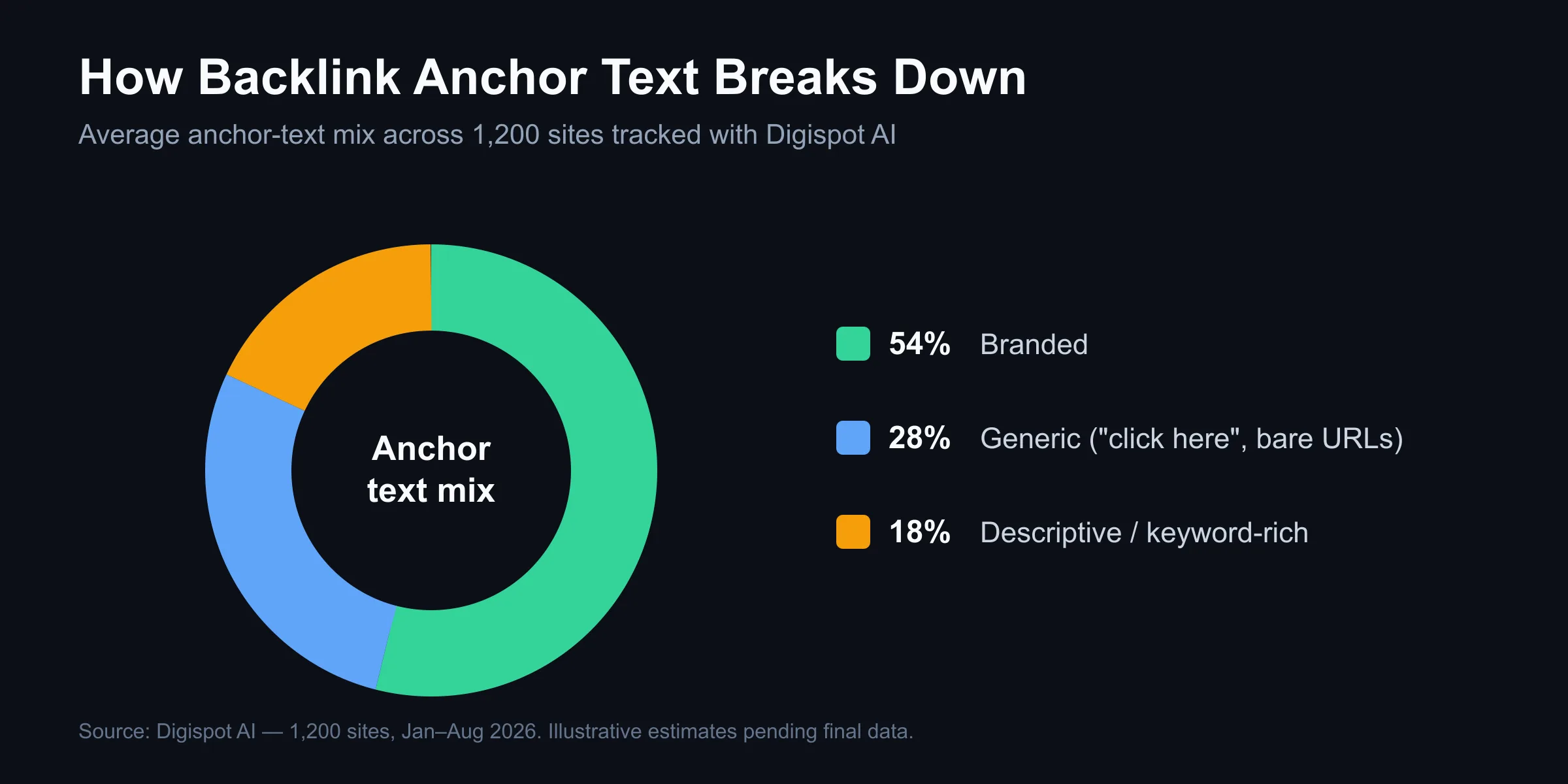
Before you audit your own links, here's the shape of a typical profile. We analyzed the backlink data across 1,200 sites tracked with Digispot AI:
- Dofollow vs. nofollow: the average profile runs roughly 68% dofollow / 32% nofollow — a healthy, natural-looking mix.
- Anchor text: about 54% branded, 28% generic ("click here", bare URLs), and only 18% descriptive / keyword-rich — most sites badly under-use descriptive anchors.
- Toxic links: 1 in 5 profiles (21%) carried at least one clearly toxic or spammy referring domain worth reviewing for disavow.
- Concentration: on most sites the top 10 referring domains accounted for the majority of link equity — so a single lost link can hurt.
The takeaway: healthy link profiles are defined less by raw volume than by a natural dofollow mix, branded-leaning anchors, and the absence of toxic domains.
Methodology: aggregated from backlink data across 1,200 sites tracked with Digispot AI between January and August 2026, de-duplicated by domain.
The Anatomy of a Quality Backlink: Key Metrics to Evaluate
To execute a successful backlink analysis, you must understand the individual metrics that define link quality. Evaluating these metrics lets you separate high-value editorial links from low-quality spam that could trigger algorithmic penalties.
Dofollow vs. Nofollow: Balancing Your Link Profile
When analyzing links, you will encounter different HTML attributes that tell search engines how to treat the connection:
- Dofollow Links: Standard hyperlinks that actively pass PageRank and authority from the referring site to yours.
- Nofollow Links (
rel="nofollow"): Tell search engines not to pass authority. They still drive referral traffic but don't directly boost rankings. - UGC and Sponsored Links (
rel="ugc",rel="sponsored"): Categorize links within user-generated content or paid promotions.
A natural link profile always features a healthy mix of all these attributes. A profile consisting of 100% dofollow links looks unnatural to search algorithms and may trigger an over-optimization review.
The Importance of Topical Relevance and Anchor Text Distribution
Topical relevance is the alignment between the subject matter of the referring website and your own. A link from a tech or marketing publication to an SEO platform is topically relevant. A link from a culinary blog to the same platform is not, and provides minimal SEO value.
Anchor text — the clickable text housing the hyperlink — is equally critical. Your anchor text profile should be diverse and natural:
- Branded Anchors: Your brand name (e.g., "Digispot AI").
- Naked URLs: The direct web address (e.g., "digispot.ai").
- Generic Anchors: Phrases like "click here" or "this article."
- Exact/Partial Match Anchors: Phrases targeting your primary keywords.
Over-optimizing with too many exact-match commercial keywords can signal manipulative link-building and trigger algorithmic penalties — it's one of the most common self-inflicted issues we cover in 10 common SEO mistakes to fix.
How to Find All Backlinks Pointing to Your Website
Before you can analyze your links, you need to gather the data. Combining first-party search engine data with third-party crawling software gives you the most accurate picture.
Extracting Link Data from Google Search Console
GSC is the most reliable starting point for finding links Google actually indexes:
- Log into Google Search Console.
- Navigate to the Links report in the left-hand menu.
- Under External links, review "Top linking sites," "Top linking pages," and "Top linking text."
- Click Export External Links to download your full link list as a CSV or Google Sheet.
GSC has limitations: it doesn't provide real-time updates, competitive insights, or advanced metrics like domain rank and spam scores. That's where a professional backlink tool fills the gap.
Going Beyond GSC: Using Professional Backlink Tools
A dedicated backlink analysis platform like Digispot AI's Backlinks module lets you:
- Monitor competitors' link-building efforts.
- Analyze referring domains by authority, spam score, and dofollow ratio.
- Identify which backlinks are actively driving organic traffic by overlaying GSC and GA4 data.
Combining GSC exports with Digispot's backlink data gives you a complete picture of both what Google sees and what actually converts.
How to Audit Your Backlink Profile: The 5-Point Checklist
Run this checklist regularly to keep your link profile clean and aligned with search engine guidelines.
1. Referring Domain Diversity Ensure links come from a wide variety of unique domains. 1,000 links from one website is far less valuable than one link from 1,000 unique, authoritative domains.
2. Dofollow-to-Nofollow Ratio Confirm your link attributes represent a natural mix. A healthy profile typically has 60–80% dofollow links, with the remainder being nofollow, UGC, and sponsored.
3. Anchor Text Distribution Look for over-optimization. If exact-match commercial terms make up more than 10% of your total anchor text, diversify your profile to avoid spam filter triggers.
4. Toxic Domain Identification Scan referring domains for link farms, low-quality directories, or adult/gambling sites that have linked to you without your consent.
5. Link Velocity and Lost Links Track how quickly you are acquiring or losing links. A sudden drop in referring domains could indicate a broken redirect issue. A sudden spike in low-quality links may signal a negative SEO campaign.
Identifying and Mitigating Toxic Links
If your audit reveals a high concentration of manipulative links, take action. Unnatural link profiles can result in manual actions or algorithmic devaluations that suppress search visibility. Isolate the spammy domains in your backlink tool and compile a disavow file to submit to Google Search Console when necessary.
Before you disavow anything, work through a quick decision checklist:
- Did you (or a past agency) build or pay for the link? If yes, and it's manipulative, it's a disavow candidate. If it appeared organically, Google usually ignores it on its own.
- Is there a manual action in GSC? If the Security & Manual Actions report flags "unnatural links," disavow is often required as part of the reconsideration process. Without a manual action, be conservative.
- Would removing it lose real value? A moderate-authority site with a slightly elevated spam score may still be a legitimate link — don't disavow reflexively.
For example, a B2B SaaS site suddenly receiving hundreds of anchor-heavy links from unrelated gambling and pharma domains within a single week is a textbook negative-SEO pattern worth disavowing at the domain level. In contrast, one older forum link with a middling spam score rarely justifies action. Google's own Search Central documentation is explicit that the disavow tool is an advanced feature that can hurt your site if misused — so reach for the row-by-row export in a dedicated tool rather than blanket-disavowing. For a full walkthrough of cleanup and recovery, see our guide on how to remove toxic backlinks safely.
Running an Advanced Backlink Analysis with Digispot AI
Traditional workflows require exporting massive CSVs, switching between multiple browser tabs, and manually calculating metrics. Digispot AI simplifies this by consolidating backlink data, search console metrics, and crawl insights into a single workspace.
Step 1: Map Referring Domains and Spam Scores
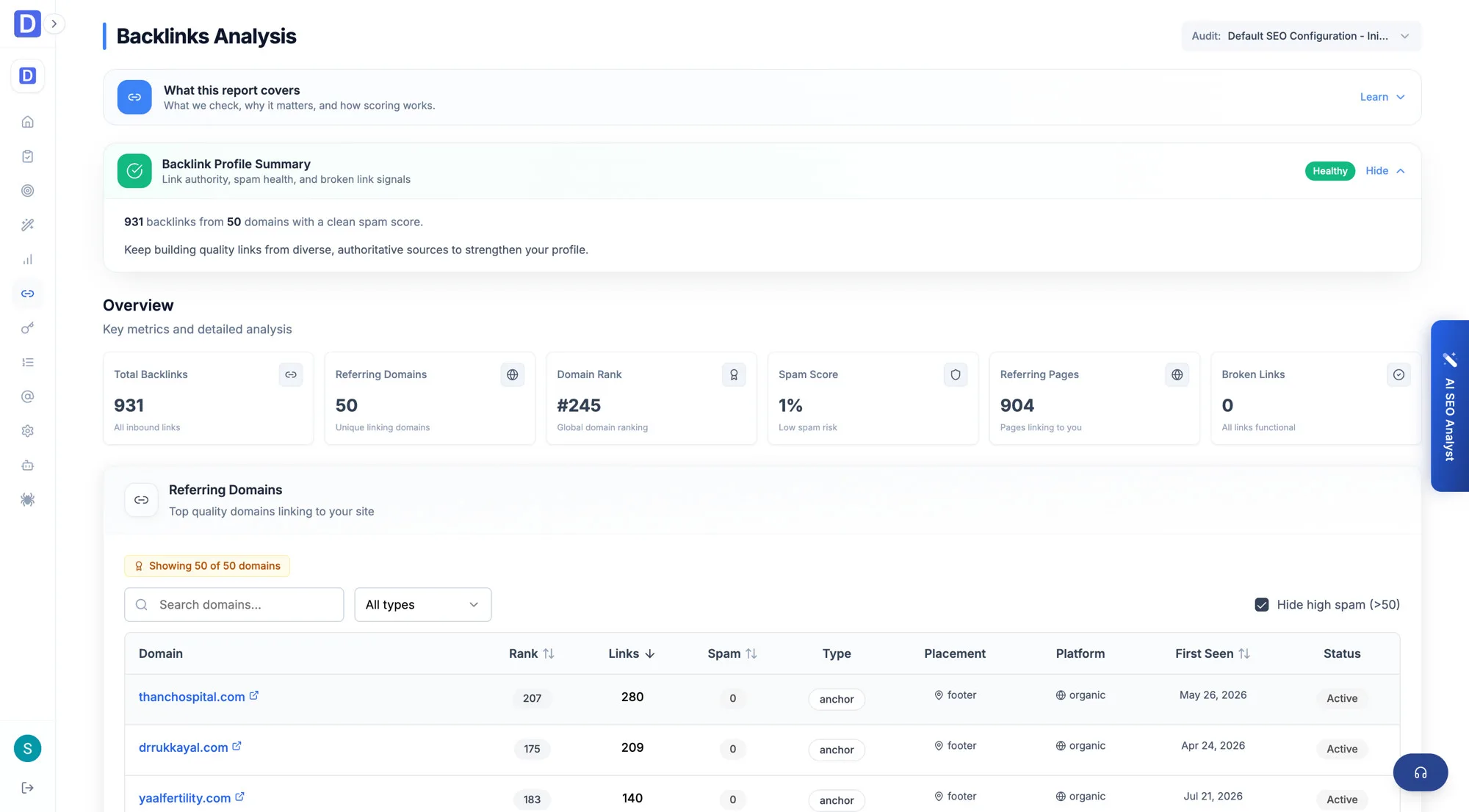
In the Digispot AI Cloud Platform's Backlinks Analysis module, your complete link profile is mapped automatically. The module groups incoming links by referring domain, measures domain rank, and assigns a real-time spam score to each source:
[Digispot AI Backlinks Dashboard]
 ├── High-Authority Domains  → Prioritize & nurture
 ├── Neutral Referral Domains → Monitor monthly
 └── High Spam Score Domains → Flag & action (disavow)
This automated categorization isolates high-risk domains without hours of spreadsheet sorting.
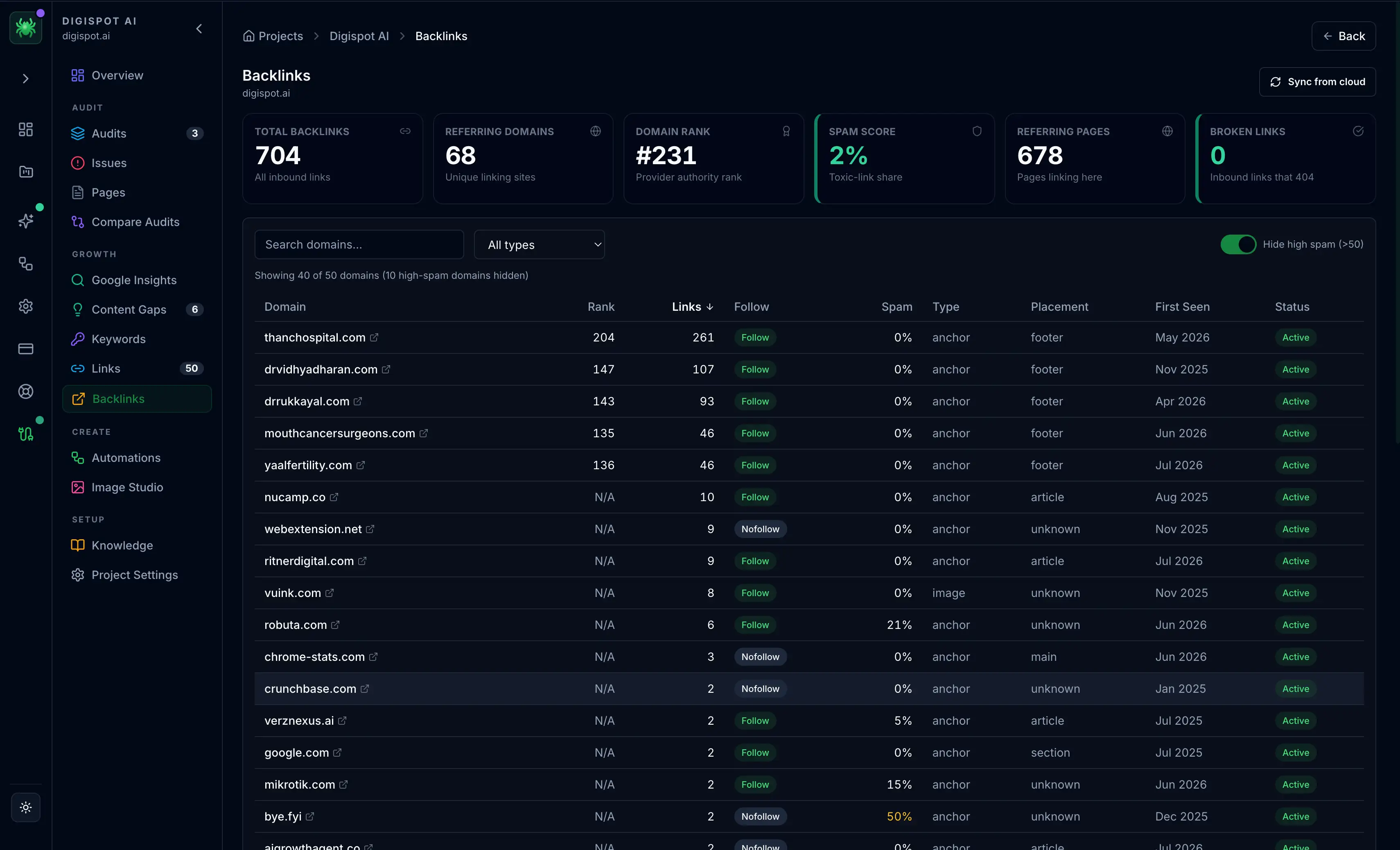 The Digispot AI Backlinks Analysis module maps your full link profile — grouping referring domains by authority, spam score, and link type so you can act on risks immediately.
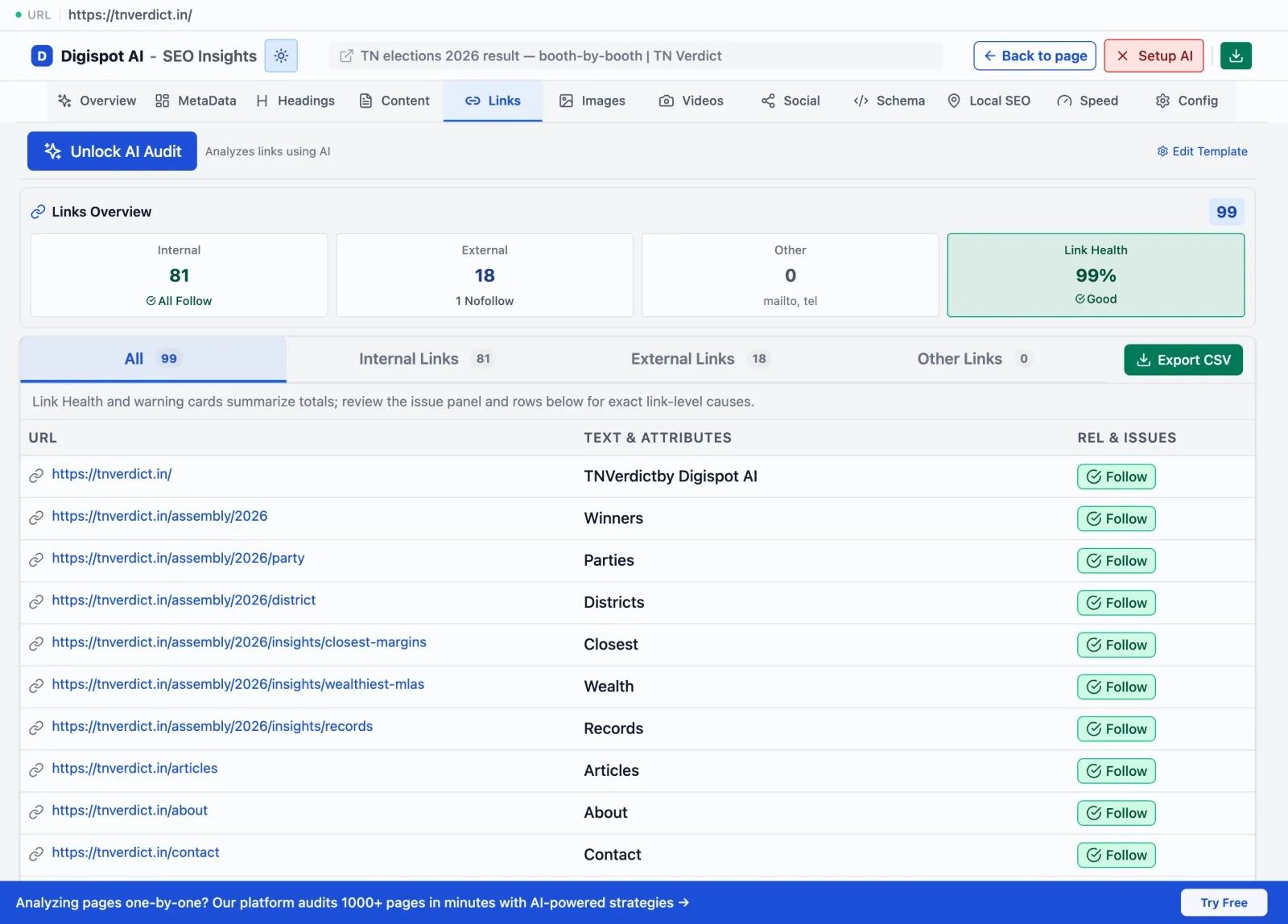 The Chrome extension's links panel surfaces every internal and external link on a page — with follow status, anchor text, and broken link flags — for quick spot-checks during outreach or content reviews.
Step 2: Cross-Reference with Crawl and Traffic Data
The Digispot SEO Spider uses real Chromium rendering to crawl your pages exactly as modern search engine bots do. By integrating GSC and GA4 data directly into the crawl, Digispot AI automatically weights your backlink insights by actual traffic impact — so you fix broken links that are costing real sessions, not just abstract authority.
The free Digispot AI Spider lets you run quick link analysis checks on any page directly from your browser without launching a full crawl.
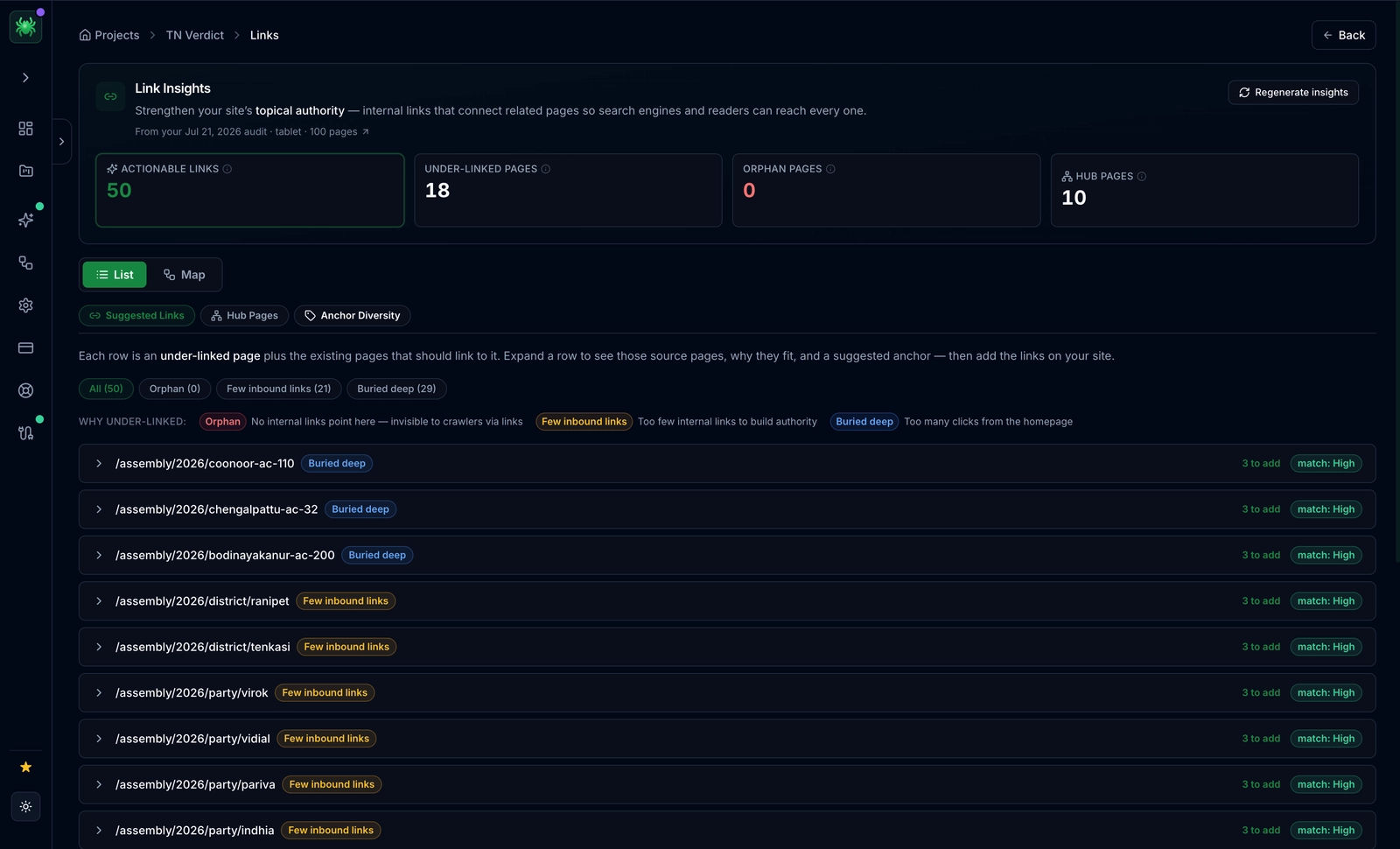 Digispot AI's Link Insights module maps your full internal link graph — surfacing orphan pages, shallow link depth, and weak anchors pointing to your most important commercial pages.
How to Build High-Quality Backlinks in 2026
Acquiring high-quality backlinks requires a strategic, relationship-driven approach. Manipulative link schemes are easily detected by AI-driven search algorithms, making organic outreach and value creation more important than ever.
Digital PR and Data-Driven Content
The most effective way to earn high-authority backlinks is to become a primary source of information for journalists and industry publications:
- Digital PR: Use platforms like Connectively (formerly HARO) to provide expert quotes to journalists writing in your niche.
- Data-Driven Content: Conduct proprietary surveys, analyze public datasets, or publish interactive calculators. Journalists frequently link back to websites that provide original statistics.
Internal Link Equity Distribution
Once you secure external links, maximize their value through strong internal linking. Distribute the equity earned by your high-performing assets to your commercial landing pages so your entire site benefits — not just the page that earned the link.
In practice, this looks like a simple three-step workflow:
- Identify your link magnets. Find the pages that earned the most authoritative referring domains — usually data studies, guides, or tools.
- Map them to commercial targets. For each magnet, pick the two or three revenue pages most topically related to it.
- Add descriptive internal links from the magnet to those targets, using keyword-rich (but natural) anchor text rather than "click here."
An easy edge case to miss: a page can earn dozens of backlinks yet still be an orphan internally, meaning almost none of that equity flows onward. Crawl for orphan and shallow-depth pages so no earned authority gets stranded. For the full framework, see our internal linking strategy for SEO, and if you're consolidating this into a broader review, our guide on how to check website SEO shows where backlink and internal-link checks fit in the wider audit.
Monitoring Your Backlink Profile Over Time
A backlink profile is dynamic. Websites update content, remove old pages, or close entirely, causing you to lose link equity over time. Consistent monitoring is essential.
Key Metrics for Your Monthly Backlink Report
| Metric | Target Trend | Action If Off-Target |
|---|---|---|
| Net New Referring Domains | Steady upward growth | Increase digital PR and content outreach |
| Link Velocity | Stable or accelerating | Investigate sudden drops for broken redirects |
| Average Spam Score | Under 5% | Audit incoming links; prepare disavow list |
| Lost Backlinks | Minimal | Reach out to publishers to restore removed links |
How to Spot a Negative SEO Campaign
Negative SEO occurs when a competitor intentionally points thousands of low-quality, spammy links at your website to trigger a penalty. If you notice an unexplained spike in referring domains from unrelated niches, you may be targeted.
Use Digispot AI's Backlinks module to quickly isolate the spammy domains, compile a clean disavow file, and submit it to Google Search Console before the links cause lasting damage.
Ready to audit your backlink profile? Explore Digispot AI's Backlinks Analysis module or start a free 7-day trial of the SEO Spider to see your full link profile alongside your crawl and traffic data in one workspace.
Related deep-dives
Continue with these closely related guides:
- what is link building? — What is Link Building? The Complete SEO Guide for 2026
- toxic backlinks removal & — Toxic Backlinks Removal & Disavow: The Complete Recovery Guide (2026)
- to get free — How to Get Free Quality Backlinks for SEO
Audit any page in seconds
300+ SEO checks including Core Web Vitals, schema markup, meta tags, and AI readiness — trusted by 1000+ SEO experts and marketers.
Frequently Asked Questions
Here are some of our most commonly asked questions. If you need more help, feel free to reach out to us.
Written by
Maya Krishnan
Digital growth expert
Maya is a seasoned expert in web development, SEO, and digital strategy, dedicated to helping businesses achieve sustainable growth online. With a blend of technical expertise and strategic insight, she specializes in creating optimized web solutions, enhancing user experiences, and driving data-driven results. A trusted voice in the industry, Maya simplifies complex digital concepts through her writing, empowering readers with actionable strategies to thrive in the ever-evolving digital landscape.