SEO Analytics Tools: Measure & Improve Rankings
Master SEO analytics with the right tools. Track rankings, analyze traffic, measure ROI, and make data-driven decisions to improve performance.
 Maya Krishnan
Ranking #1 on Google is no longer just about writing good content. It is an engineering challenge, a data science problem, and a psychological study all wrapped into one. Some websites dominate search results while others with similar content remain invisible. The difference? The visible sites are managed by teams who obsess over performance data, using SEO analytics to reverse-engineer their success.
Visibility is the currency of the modern web. If search engines cannot find, understand, or value your site, your business effectively does not exist for a massive segment of your market. But understanding performance is complex. Algorithms change daily, user behavior shifts, and competitors are constantly optimizing.
This is where SEO analytics and insights tools become your competitive advantage. They act as a radar system, cutting through the noise to show you exactly what is working, what is broken, and where the biggest opportunities lie.
In this guide, we will break down the mechanics of SEO analytics. We will look at how to move from raw data to revenue-generating strategy using platforms like Digispot AI. You will learn to audit your site, spy on competitors (legally), and use free tools to fix issues before they hurt your bottom line.
Key Takeaways
- Start with the free stack. Google Search Console and Google Analytics give you the ground-truth data on impressions, clicks, and on-page behavior that every paid tool builds on top of.
- Prioritize by impact, not volume. A tool's value is in telling you which fixes move the needle, so chase striking-distance keywords and high-intent terms before vanity rankings.
- Connect ranking data to revenue. Overlay GA4 engagement and conversion data on rankings so you optimize for qualified traffic, not just clicks.
- Set a cadence and stick to it. Use a weekly pulse check for breakages and a monthly deep dive for backlinks, decay, and Core Web Vitals—don't react to daily fluctuations.
- Plan for AI search. Answer Engine Optimization matters now; choose tools that track entities and AI answers, not just the ten blue links.
What Exactly Are SEO Analytics and Insights Tools?
At the most basic level, SEO analytics tools are software platforms that aggregate data about your website’s relationship with search engines. However, calling them "data aggregators" sells them short. Think of these tools as a 24/7 diagnostic team for your digital presence.
While Google Analytics tells you what users do after they arrive, SEO analytics tools explain how they found you—or why they didn't. They monitor the health of your site from the perspective of a search engine bot.
These platforms process millions of data points to answer specific strategic questions:
- Crawlability: Can Googlebot access my most important pages?
- Indexability: Is my content actually in the search index, or is it blocked by technical errors?
- Rankings: Which keywords are driving traffic, and which ones are slipping?
- Authority: Who is linking to me, and does Google trust those links?
- Competition: What are my rivals doing differently to outrank me?
Modern tools like Digispot AI go a step further by incorporating AEO (Answer Engine Optimization). They analyze how your content appears not just in traditional search, but in AI-generated answers on platforms like ChatGPT, Perplexity, and Google's AI Overviews. This shifts the focus from simple "keywords" to "entities" and "context."
Why Are SEO Analytics Crucial for Your Business?
Operating without SEO analytics is like driving a car with a painted-over windshield. You might be moving, but you have no idea if you are on the right road or about to drive off a cliff. Data provides the clarity needed to invest your marketing budget where it actually generates returns.
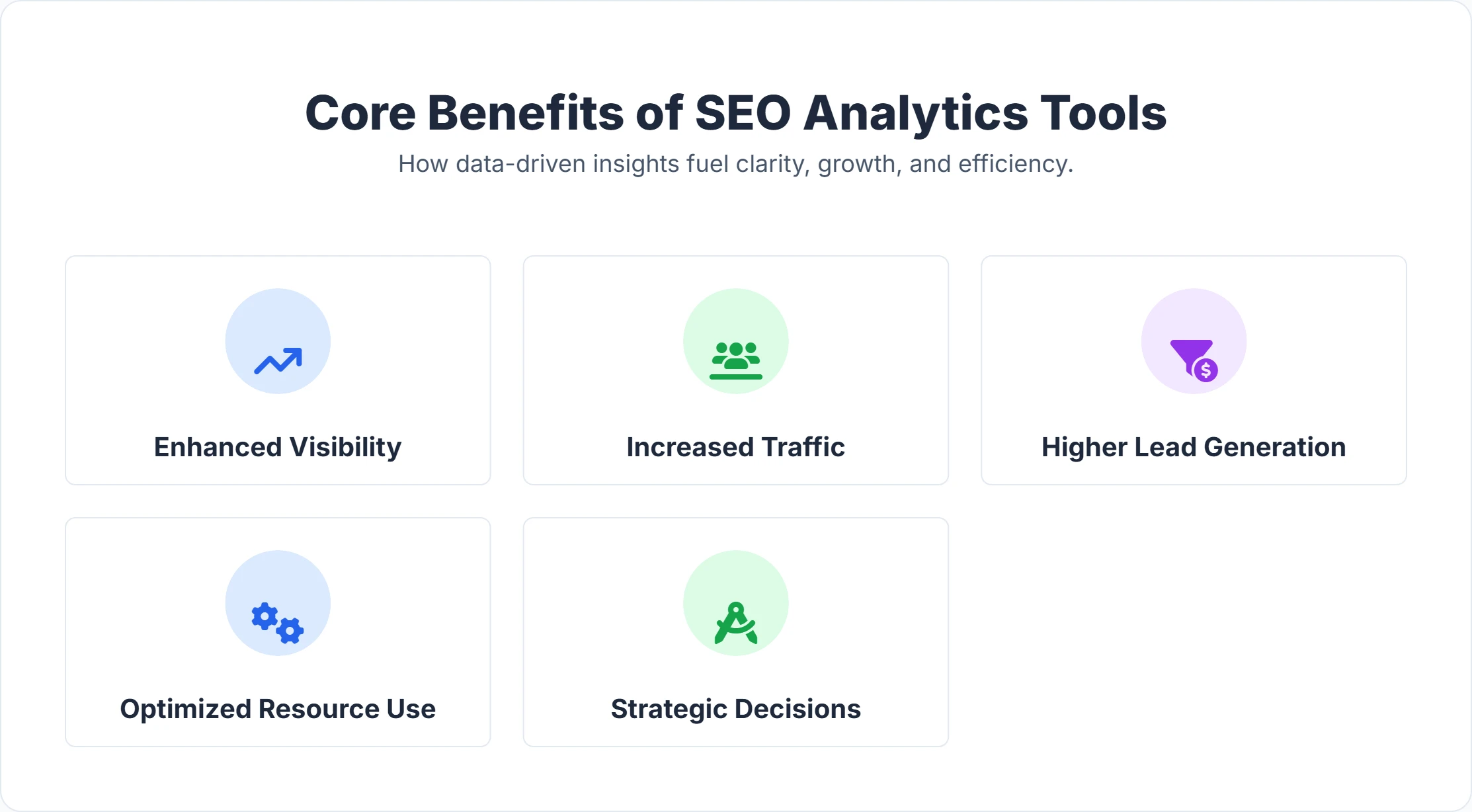
1. Improving Business Visibility
Search visibility is not static. You might own the snippet for a high-value term today and lose it tomorrow due to a minor algorithm update or a competitor's content refresh. Analytics tools monitor these fluctuations in real-time.
They identify the specific pages that are losing traction so you can update them before traffic plummets. Conversely, they highlight pages that are striking distance from the top 3 spots—often, a few minor tweaks to headers or meta descriptions on these "low-hanging fruit" pages can double their traffic overnight.
2. Increase in Traffic and Business Leads
Not all traffic is created equal. Ten thousand visitors who bounce immediately are worth less than one hundred visitors who sign up for a demo. Advanced insights tools help you distinguish between vanity metrics and value.
By integrating ranking data with conversion metrics, you can identify which keywords drive revenue, not just clicks. This allows you to pivot your content strategy. Instead of chasing high-volume, low-intent generic terms, you can target specific long-tail queries that signal high purchase intent. This precision targeting increases lead quality and conversion rates significantly.
3. Time and Cost Savings
SEO is labor-intensive. Manual audits can take weeks. Checking rankings manually is impossible at scale. Analytics tools automate these heavy lifts.
Imagine you have a technical issue causing 500 pages to generate 404 errors. Finding these manually is impossible. A tool spots them instantly. By automating the discovery of issues, your team spends their time fixing problems rather than hunting for them.
Additionally, organic search is the most cost-effective long-term acquisition channel. By using analytics to improve organic rankings, you reduce dependence on paid ads (PPC). Every organic click you earn is a click you didn't have to buy from Google or Facebook.
4. Data-Driven Decision Making
Marketing meetings often devolve into opinions. "I think we should write about X" or "I feel the homepage looks cluttered." Analytics replace "I think" with "The data shows."
If the data shows that users drop off after 10 seconds on your service pages, you know you have a content or UX problem. If the data shows your competitor gets 50% of their traffic from a topic you haven't covered, you have a clear mandate to create that content. This objectifies your strategy and helps align stakeholders.
5. Competitive Advantage
Your competitors are likely using these tools to analyze you. You need to return the favor. Competitive intelligence features allow you to X-ray rival strategies.
You can see exactly where they get their backlinks. You can analyze their top-performing content structure. You can even spot keywords they have stopped targeting, which might indicate those terms are no longer profitable. This allows you to learn from their expensive experiments without spending a dime. For a deeper dive into how to leverage this, read our guide on analyzing and improving your backlink profile.
How Do SEO Analytics Tools Work? Key Capabilities Explained
Modern SEO platforms are ecosystems of interconnected tools. To get the most out of them, you need to understand the mechanics of their core features.
1. Comprehensive Website Auditing: The Health Check-up
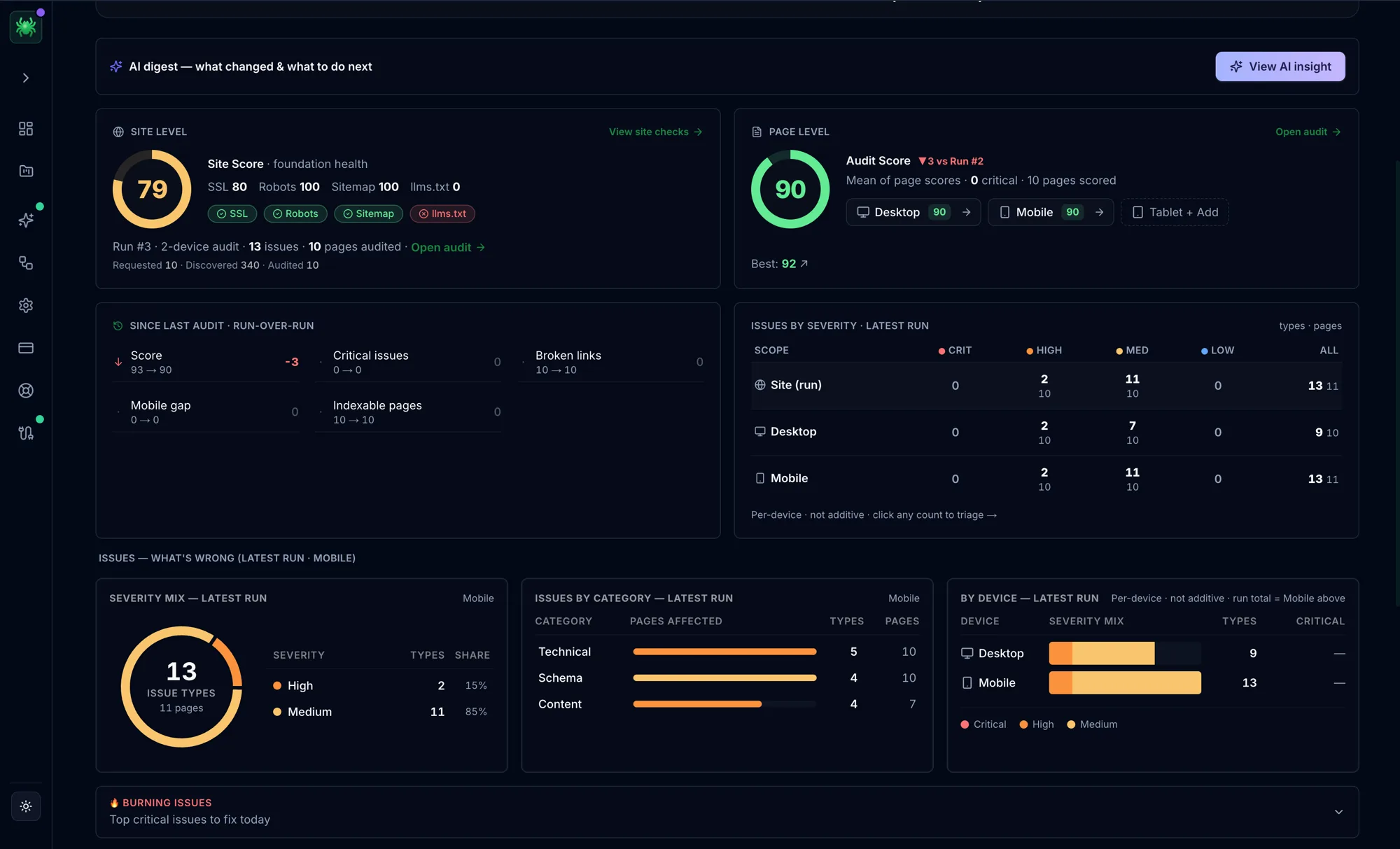
The foundation of SEO is technical health. If your site is slow, broken, or confusing to robots, your content doesn't matter. An audit tool crawls your website exactly like a search engine does, following links and analyzing code.
- Crawl Simulation: The tool sends a "bot" to traverse your site structure. It maps out every URL it finds, identifying orphan pages (pages with no internal links) and crawl loops that waste search budget.
- Core Web Vitals Analysis: User experience is a ranking factor. Tools analyze metrics like Largest Contentful Paint (LCP) and Cumulative Layout Shift (CLS). If your pages shift around while loading or take too long to become interactive, Google will penalize you. For a detailed breakdown of these metrics, check out our Core Web Vitals guide.
- Status Code Monitoring: It flags 4xx (client errors) and 5xx (server errors) codes immediately. A sudden spike in 500 errors could indicate a server failure that needs immediate attention.
Digispot AI excels here by not just listing errors, but categorizing them by impact. It tells you which fixes will move the needle most, so you aren't wasting time on minor warnings while critical errors persist.
2. Seamless Integration with Core Marketing Platforms
Data silos kill insights. The best tools aggregate data from multiple sources to create a "single source of truth."
- Google Search Console (GSC): This provides the raw truth about your organic performance—impressions and clicks. However, GSC's native interface has limits on data retention and visualization. Third-party tools ingest this data, store it historically (bypassing the 16-month limit), and overlay it with other metrics. If you are not yet extracting the full value from GSC's own reports, our Google Search Console guide for SEO walks through the Performance, Pages, and Indexing reports before you layer a paid tool on top.
- Google Analytics (GA4): By connecting GA4, you overlay engagement data on top of ranking data. You might see that a keyword ranks #1 but has a 90% bounce rate. This insight tells you that while your SEO is working, your content is failing to satisfy the user's intent.
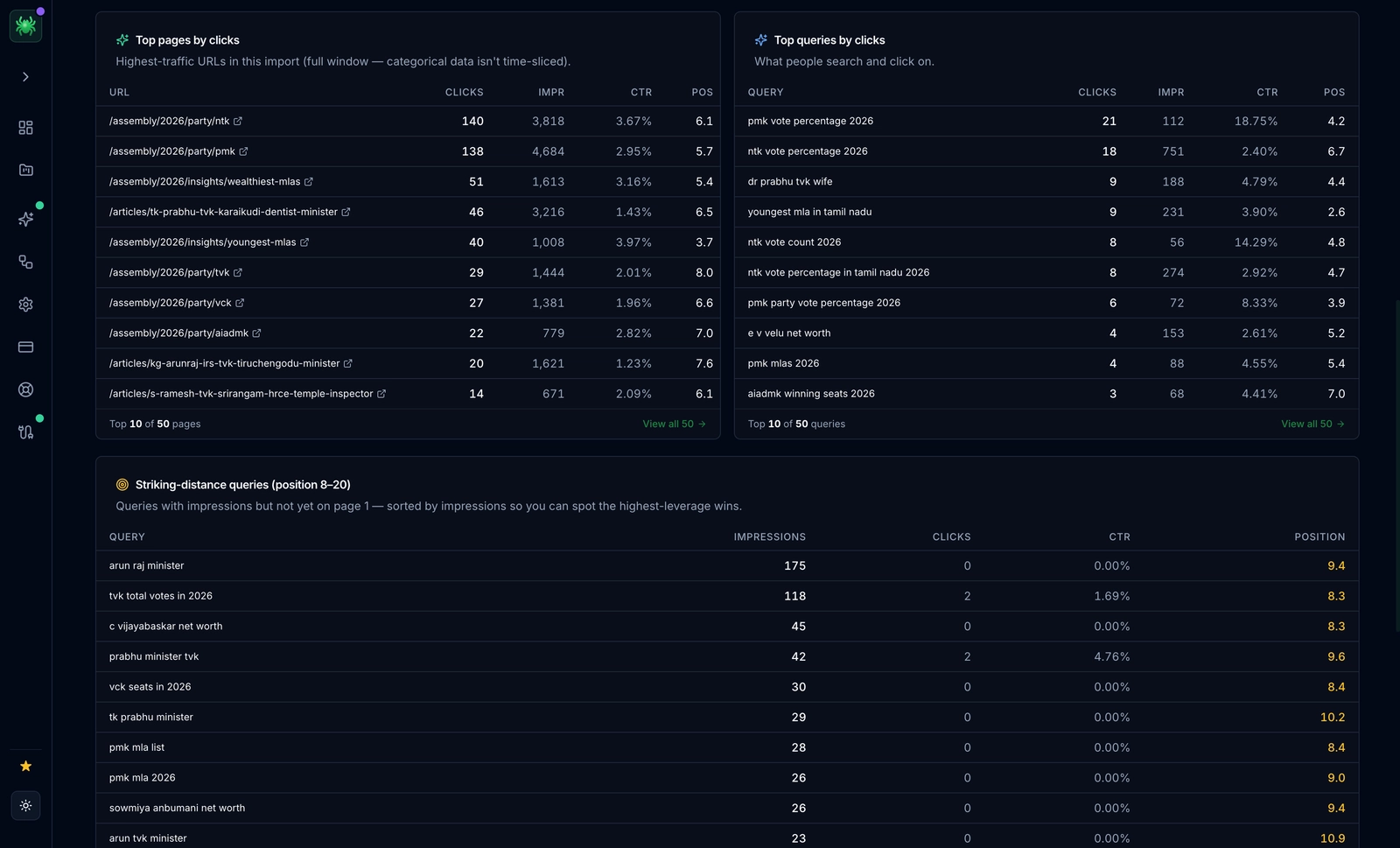
3. Opportunity Finder: Unearthing Growth Potential
Growth often comes from finding gaps in the market.
- Keyword Gaps: You input your domain and three competitor domains. The tool outputs a list of keywords they rank for, but you don't. This is practically a "to-do" list for your content team. Before you act on it, sort the gaps by intent and difficulty—a term a rival ranks for with a thin page is a far easier win than one backed by dozens of referring domains. A structured competitor SEO analysis turns that raw list into a prioritized roadmap rather than a wish list.
- Striking Distance Keywords: The tool identifies keywords where you rank on the bottom of page 1 (positions 6-10) or top of page 2 (positions 11-20). These are your highest ROI opportunities. A small content update or a few internal links can bump these into top positions significantly faster than trying to rank a new page from scratch. The fastest wins usually come from three tactics: tightening the title tag and H1 to match the exact query, adding a concise answer block that can capture a featured snippet, and pointing internal links from your strongest pages at the target URL. Before you build a brand-new page for a striking-distance term, confirm you don't already have a competing URL splitting the signal—if you do, resolving that keyword cannibalization is the higher-leverage fix.
4. Content Studio: AI-Powered Content Creation
Modern SEO isn't just about keywords; it's about semantic relevance. Search engines use Natural Language Processing (NLP) to understand topics.
- Semantic Analysis: Tools analyze the top 10 results for a query to understand related terms and entities. If you are writing about "coffee," the tool knows you must also mention "roast," "beans," "brewing," and "acidity" to be considered comprehensive.
- AI Drafting: Platforms like Digispot AI use multiple LLMs (Large Language Models) to assist in drafting. Unlike generic AI writers, these are constrained by SEO data. They suggest headers, outline structures, and entities that are proven to satisfy search intent.
If you are looking to master the quality signals that Google looks for in content, review our guide on E-E-A-T (Experience, Expertise, Authoritativeness, and Trust).
5. Deep Dive into 200+ Ranking Factors
Google's algorithm is a black box, but we know the inputs. Comprehensive tools monitor over 200 known signals.
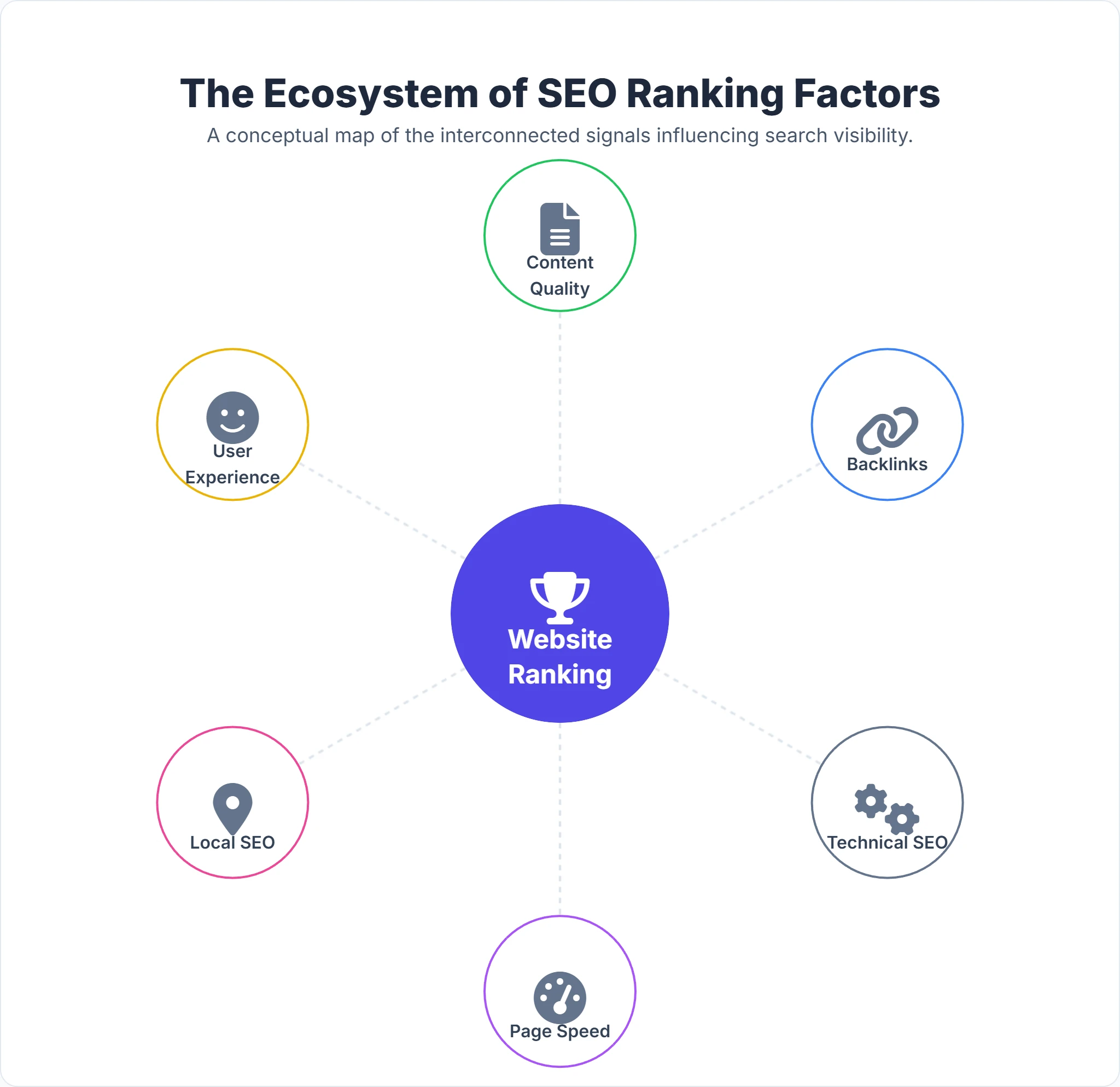
- On-Page Factors: Title tags, meta descriptions, H1-H6 hierarchy, image alt text, and keyword density.
- Off-Page Factors: Backlink quality, anchor text distribution, and domain authority.
- Technical Factors: HTTPS security, canonical tags, hreflang implementation (for international sites), and XML sitemap validity.
- Local SEO: NAP (Name, Address, Phone) consistency across directories and Google Business Profile optimization.
6. Support for Schema Markup: Enhancing Visibility
Schema markup is how you speak directly to search engine bots. It turns unstructured text into structured data.
- Rich Snippets: Correct schema can win you star ratings, recipe cards, event times, and product pricing directly in search results. These visual elements drastically increase Click-Through Rate (CTR).
- Entity Recognition: Schema helps disambiguate your content. It tells Google that "Apple" refers to the technology company, not the fruit.
Implementing this code manually is error-prone. You can use the free Schema Markup Generator to create valid JSON-LD code for articles, products, FAQs, and more in seconds.
7. Detection and Visualization: Making Data Understandable
A spreadsheet with 50,000 rows is useless to a CMO. Good tools visualize data to tell a story.
- Trend Spotting: Line graphs showing visibility over time help you correlate traffic drops with specific algorithm updates or site changes.
- Crawl Maps: These visualizations show your site architecture as a node graph. You can visually spot sections of your site that are isolated (poor internal linking) or too deep (too many clicks from the homepage).
- Cannibalization Detection: This occurs when two of your pages fight for the same keyword, confusing Google and splitting your link equity. Detection tools flag these instances so you can consolidate the content.
The Power of Practical Application: Digispot AI's Free Chrome Extension
Cloud platforms are great for deep dives, but sometimes you need answers now, while you are looking at a page.
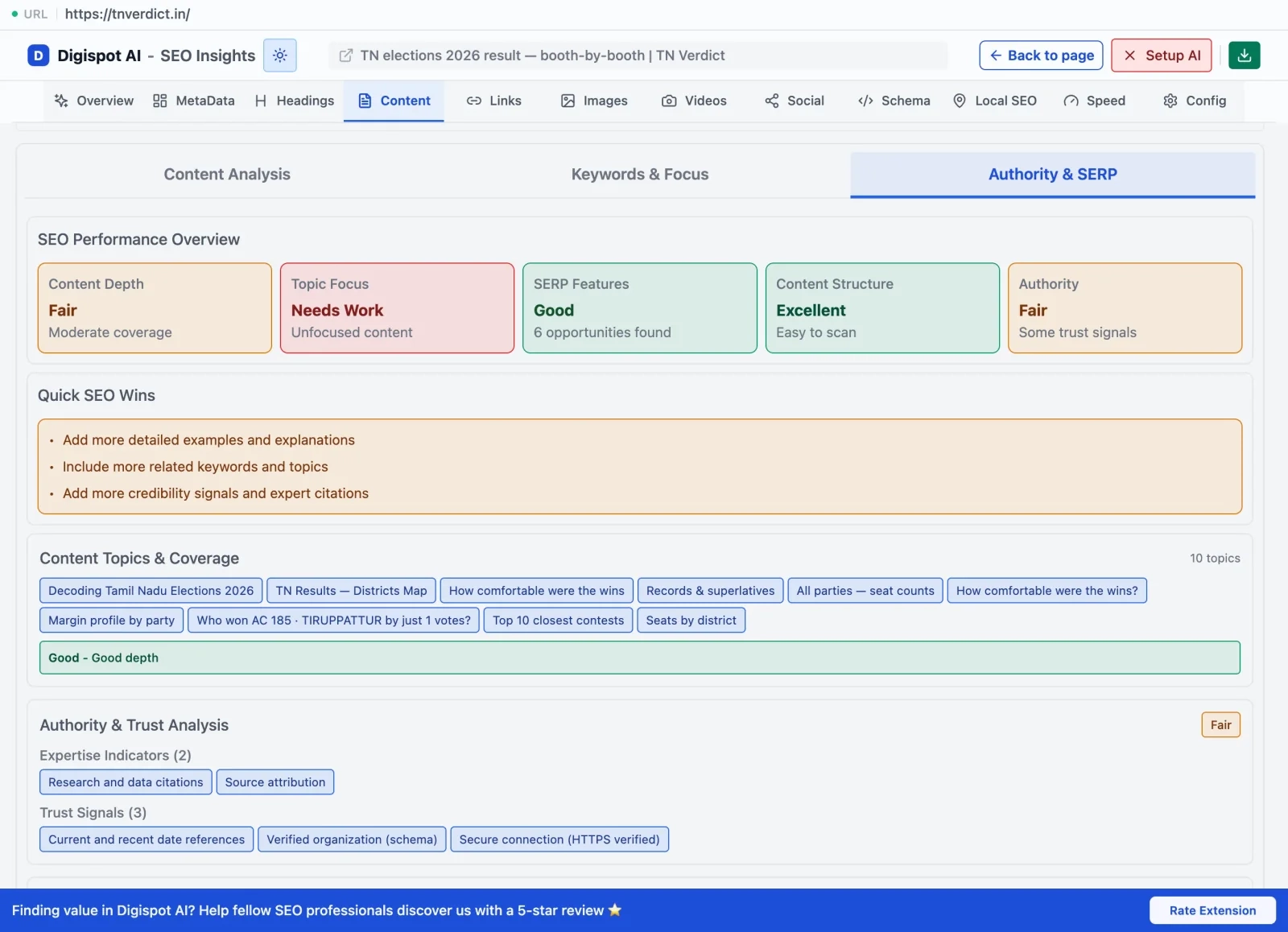
The Digispot AI Chrome extension puts an SEO consultant in your browser. It is designed for marketers, developers, and writers who need to audit pages on the fly—whether it’s your own site or a competitor's.
Real-World Use Case: Competitor Reconnaissance Imagine you land on a competitor's blog post that is outranking you. Click the extension:
- Check the Structure: Instantly see their Header hierarchy (H1, H2, H3). Are they covering sub-topics you missed?
- Analyze Metadata: Read their Title Tag and Meta Description. Are they targeting a slightly different angle or intent?
- Inspect Schema: Does the extension detect
FAQPageorArticleschema? If they have it and you don't, that’s an immediate action item. - Core Web Vitals: Is their page loading faster? The extension gives you a pass/fail on speed metrics instantly.
Key Features:
- Instant On-Page Audit: Checks meta tags, canonicals, and image attributes.
- Schema Visualization: Validates structured data implementation.
- AI Recommendations: Uses LLMs to suggest readability improvements.
Get instant SEO insights on any page with our free Chrome extension. It is the fastest way to spot check your on-page SEO best practices.
Essential Metrics to Monitor: Weekly vs. Monthly
Analytics tools provide endless data, but you need a routine to avoid paralysis. Here is a framework for what to track and when.
Weekly Pulse Check
- Organic Traffic Sessions: Is traffic stable? Look for sudden drops that indicate a technical break.
- Top Keyword Rankings: Check your top 10 revenue-driving keywords. Have they shifted?
- Crawl Errors (GSC): Check for new 404s or 500 errors. Fix these immediately.
- CTR Fluctuations: A sudden drop in CTR might mean a competitor has won a Featured Snippet above you.
Monthly Deep Dive
- New Backlinks: Who linked to you this month? Are they high quality?
- Keyword Expansion: Are you ranking for new keywords you haven't actively targeted? This is a sign to create new dedicated pages.
- Core Web Vitals: Has your site speed degraded after recent code deployments?
- Content Decay: Which formerly popular posts have lost 10%+ traffic? Schedule them for a refresh.
5 Common SEO Analytics Mistakes to Avoid
Even with the best tools, human error can lead to bad strategy. Avoid these common pitfalls.
1. Obsessing Over "Vanity" Keywords Ranking #1 for a high-volume keyword is useless if it doesn't convert. Don't ignore low-volume, high-intent keywords that actually drive sales.
2. Ignoring Mobile Data Google uses mobile-first indexing. If you only analyze your desktop site, you are looking at the wrong version of reality. Always audit the mobile version of your site first.
3. Failing to Segment Brand vs. Non-Brand Traffic If your traffic is up 20%, is it because your SEO is working, or because you ran a TV ad and people are searching your brand name? Always segment out branded search terms to see the true performance of your non-branded SEO efforts.
4. Reacting to Daily Fluctuations Rankings dance. It is normal to move from position 3 to 5 and back to 3 in a week. Do not panic and rewrite your page based on a single day's data. Look for trends over 2-3 weeks.
5. Neglecting Internal Links Analytics isn't just about external factors. Often, a page fails simply because it's "orphaned" or buried deep in your site. Use your audit tool to find pages with few internal links and boost them, then follow a deliberate internal linking strategy to funnel authority toward your priority pages. Read more about fixing these issues in our common SEO mistakes guide.
Achieving Business Outcomes with Smart SEO Analytics
The ultimate goal of SEO analytics isn't to make graphs go up and to the right; it's to drive business growth. Here is how the capabilities we discussed translate to the bottom line.
Improved Business Visibility
By continually auditing your site with a platform like Digispot AI, you ensure technical barriers never block your visibility.
- Credibility: High rankings signal trust. Users subconsciously believe the #1 result is the "best" company.
- Brand Awareness: Even if users don't click, seeing your brand name in the snippet repeatedly builds "share of mind."
Increase in Traffic and Business Leads
Smart analytics shift your focus from "more traffic" to "better traffic."
- Intent Matching: By analyzing search queries, you can align your content with user intent. If users search "best CRM software," they want a comparison, not a sales page. Giving them what they want reduces bounce rates and increases trust.
- Conversion Optimization: Integrating GA4 data allows you to see which landing pages have high traffic but low conversions. This signals a need to improve the Call-to-Action (CTA) or page design, directly impacting revenue.
Time and Cost Savings
Efficiency is the hidden profit center of SEO.
- Automation: Automated reporting saves your team hours of manual data entry every week.
- Prioritization: Instead of guessing what to fix, Digispot AI tells you, "Fixing these 5 metadata issues will yield higher returns than fixing these 50 image alt tags." This focused effort maximizes ROI.
- Ad Spend Reduction: As your organic visibility stabilizes, you can dial back PPC spend on expensive generic keywords, lowering your overall Customer Acquisition Cost (CAC).
How to Choose the Right SEO Analytics and Insights Tool
Selecting a platform is a strategic commitment. Here is a checklist to guide your decision:
- Data Accuracy & Freshness: Does the tool update rankings daily or weekly? In fast-moving industries, weekly data is too old.
- Breadth of Features: Does it cover the "Big 3": Auditing, Rank Tracking, and Backlink Analysis? Buying separate tools for each is expensive and inefficient.
- Integration Capabilities: If it doesn't connect to GSC and GA4, walk away. You need integrated data.
- Ease of Use: Is the UI intuitive? If it requires a PhD to navigate, your team won't use it.
- AEO Readiness: Does the tool account for AI search engines? As search evolves towards AI answers, legacy tools that only track "10 blue links" will become obsolete. Digispot AI is built specifically for this new era.
- Reporting: Can you generate white-labeled reports for clients or stakeholders automatically?
- Support & Education: Does the vendor provide guides, tutorials, and responsive support?
- Scalability: Will the pricing model punish you as you grow? Look for generous limits on pages crawled and keywords tracked.
Embracing the Future of SEO with Intelligent Analytics
The world of search is shifting beneath our feet. We are moving from a keyword-based economy to an entity-based, AI-driven ecosystem. In this environment, "guessing" is a liability.
SEO analytics and insights tools are the compass you need to navigate this complexity. They transform the opaque black box of search algorithms into a transparent, actionable roadmap. By providing deep visibility into technical health, competitor strategies, and user behavior, these tools empower you to make decisions that are not just safe, but strategic.
Whether you are performing a quick on-page analysis or a comprehensive site-wide audit, the principle remains the same: Data beats opinion.
Ready to stop guessing and start growing? Equip yourself with the right tools. Use the Digispot AI Chrome extension for daily checks, and leverage the full platform to architect a long-term strategy. Your customers are searching for you right now—make sure your data helps them find you.
Related deep-dives
Continue with these closely related guides:
- track ai search rankings — Track AI Search Rankings Monitoring: The New SEO Frontier
References
- Google Search Console
- About Google Analytics
- Structured data general guidelines | Google Search Central
- Core Web Vitals | Google Search Central
- Mobile-friendliness and search results | Google Search Central
- Search Engine Optimization (SEO) Starter Guide | Google Search Central
- Digispot AI - FREE On Page SEO Audit Tool
- Digispot AI - FREE Chrome Extension for SEO Insights
Audit any page in seconds
300+ SEO checks including Core Web Vitals, schema markup, meta tags, and AI readiness — trusted by 1000+ SEO experts and marketers.
Frequently Asked Questions
Here are some of our most commonly asked questions. If you need more help, feel free to reach out to us.
Written by
Maya Krishnan
Digital growth expert
Maya is a seasoned expert in web development, SEO, and digital strategy, dedicated to helping businesses achieve sustainable growth online. With a blend of technical expertise and strategic insight, she specializes in creating optimized web solutions, enhancing user experiences, and driving data-driven results. A trusted voice in the industry, Maya simplifies complex digital concepts through her writing, empowering readers with actionable strategies to thrive in the ever-evolving digital landscape.