Google Search Console SEO: E-commerce Power
Learn how Google Search Console revealed critical SEO issues for a billion-dollar ecommerce company, saving thousands in audit costs.
 Maya Krishnan
Ever wondered why some SEO agencies charge astronomical fees for website audits? Here's a secret they generally don't broadcast: many of the critical insights they provide are readily available in Google Search Console (GSC) — completely free of charge.
While premium tools have their place for competitive intelligence and backlink data, your own site's health data comes directly from the source: Google itself. This is the story of how we transformed a struggling e-commerce giant's SEO performance using primarily GSC and a dash of technical ingenuity.
A Billion-Dollar Company's SEO Struggles
We recently audited a near-billion-dollar valuation e-commerce company. They had millions of product pages, a massive inventory, and significant brand recognition. Yet, they were struggling with basic SEO fundamentals. Despite their massive scale, they were hampered by a small, disconnected SEO team and a lack of decisive leadership.
It serves as a stark reminder: in the digital world, size doesn't always equal sophistication.
The Silo Problem
The biggest hurdle wasn't the algorithm; it was organizational structure. Teams were operating in isolation and tossing tasks "over the wall." One team was building the UI, focusing purely on aesthetics. Another was coding the backend to handle massive transaction volumes. A separate group worked on generating programmatic sitemaps at scale every day. Meanwhile, marketing teams looked at Google Analytics and Google Search Console in a vacuum.
Sadly, there was no single person who understood how these pieces fit together. The developers didn't understand how their code affected crawling, and the marketers didn't understand technical constraints.
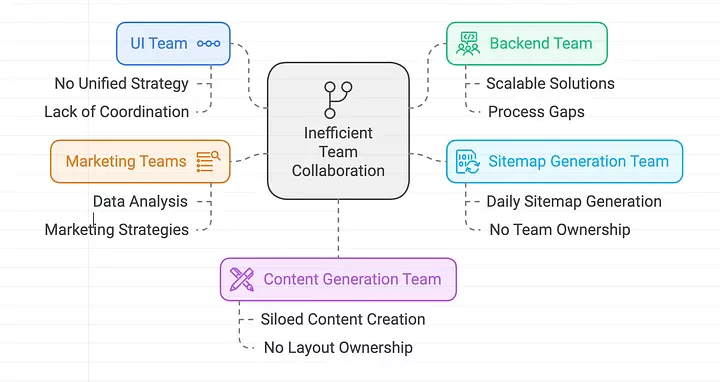
The company was spending thousands of dollars each month on inorganic methods to gain traffic, as well as on tools that operated in silos. This included heavy investments in user monitoring, web vitals tracking, and site speed performance tools. They hired SEO analysts on temporary contracts, but these contractors came from specific, narrow backgrounds.
One was a developer who only saw code. Another was a content writer who ignored technical debt. Another was a backlink builder who didn't care about on-page experience. Because they operated in silos, they could never provide a holistic view of the website. At the end of the year, they claimed success in their specific micro-tasks, but the ground reality—organic revenue and traffic—did not improve.
To understand how to bridge these gaps, it helps to review the basics of how Google Search works, ensuring every team member speaks the same language regarding crawling, indexing, and ranking.
The JavaScript Myth: Breaking Down False Narratives
One of the most shocking discoveries was the misinformation the company had received from previous "SEO experts." They were told that Google couldn't properly understand JavaScript-based websites — a myth that has been outdated for years.
While server-side rendering (SSR) is often preferred for speed and certainty, Google has become increasingly sophisticated in processing JavaScript. We proved this conclusively using a live test via GSC. By running the URL Inspection tool and viewing the "Crawled Page" (specifically the screenshot and HTML code), we demonstrated that Google was indeed rendering their content, albeit with some performance delays.
The issue wasn't that Google couldn't read the JavaScript; it was that the implementation was inefficient. A slow-loading website impacts your crawl budget and ranking potential. While they definitely needed to improve the experience for users and bots, they didn't need a complete platform rewrite.
Pro Tip: You can instantly check if your JavaScript content is visible to search engines. Get instant rendering insights on any page with our free Chrome extension.
They could solve other basics meanwhile. Our suggestion was to start with GSC and fix the low-hanging fruit that could be resolved within their current architecture.
Uncovering the Truth with Google Search Console
When we finally consolidated their data into a comprehensive audit, the findings were startling. GSC revealed technical fissures that were draining their organic potential.
The Canonical Catastrophe
Using GSC's Pages (formerly Coverage) report, we discovered a major issue: their sitemap generation had a critical bug creating duplicate canonical URLs.
For an e-commerce site, canonical tags are the roadmap for Google. They tell the search engine which version of a product page is the "master" version. Because of this bug, thousands of product variations (colors, sizes) were declaring themselves as the master version. This diluted their ranking signals. Instead of one strong page ranking well, they had ten weak pages competing against each other, confusing the indexer.
Bugs in Sitemap Generation
Our analysis pointed to a deep-seated bug in their sitemap generation formats. The worst part? One of their sitemap index URLs listed in robots.txt was itself broken and not in the correct XML format.
This meant Googlebot was hitting a dead end every time it tried to discover new products. For a site adding hundreds of items daily, this was catastrophic. If Google can't find your sitemap, it has to rely on internal links to find new pages, which is a much slower process.
Crawl Budget Hemorrhage
The GSC Crawl Stats report revealed a shocking truth: despite having millions of pages, only a fraction were being crawled effectively. Their crawl budget—the amount of attention Google devotes to a site—was being wasted on:
- Duplicate pages generated by the canonical URL bug.
- Dead-end 404 pages that were never cleaned up.
- Infinite loop pagination issues where the bot got stuck in endless "next page" sequences.
With millions of pages in their inventory, Google was not able to crawl more than a few thousand pages per day. At that rate, it would take years to index their entire catalog.
Lack of Sitemap Prioritization and Best Practices
The company was not following best practices around sitemap generation and management. Specifically, they were neglecting the <lastmod> tag.
Google relies heavily on the lastmod date to know if a page has changed since the last crawl. If this date isn't present or accurate, Google has to guess whether to recrawl a page. Combined with a lack of prioritization, this inefficiency compounded their crawl budget issues. To dive deeper into structuring e-commerce data, check out our complete e-commerce SEO guide.
Delisted Products and "Zombie" Pages
A common e-commerce plague is the handling of out-of-stock or discontinued items. The items which were delisted were not being removed from the sitemap. This caused two problems:
- Customer Frustration: Users landed on pages only to find the item gone.
- Crawl Waste: Google kept visiting these pages because the sitemap said they were valid.
Most of these delisted item pages were displaying a generic "Item Not Found" message but returning a 200 OK success response code. This is known as a "Soft 404." To Google, it looks like a valid page with thin content, which can hurt the site's overall quality score.
Understanding the Current State
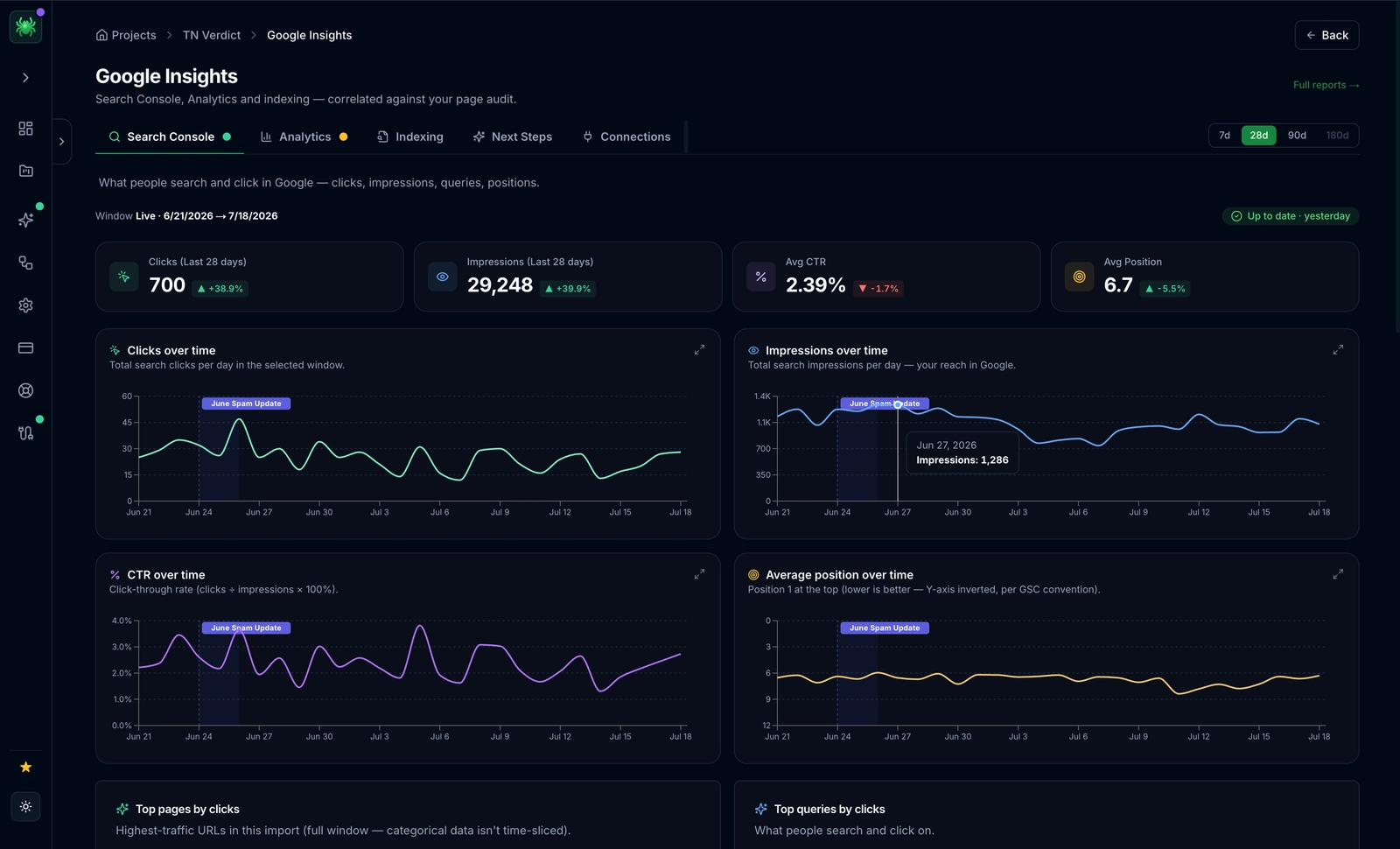
More than anything, visualizing their current traffic and detailing exactly what was working—and what wasn't—was an eye-opener for the team. They realized that 80% of their organic traffic was coming from just 15% of their pages, highlighting a massive opportunity for optimization across the rest of the catalog.
The Power of Free Tools
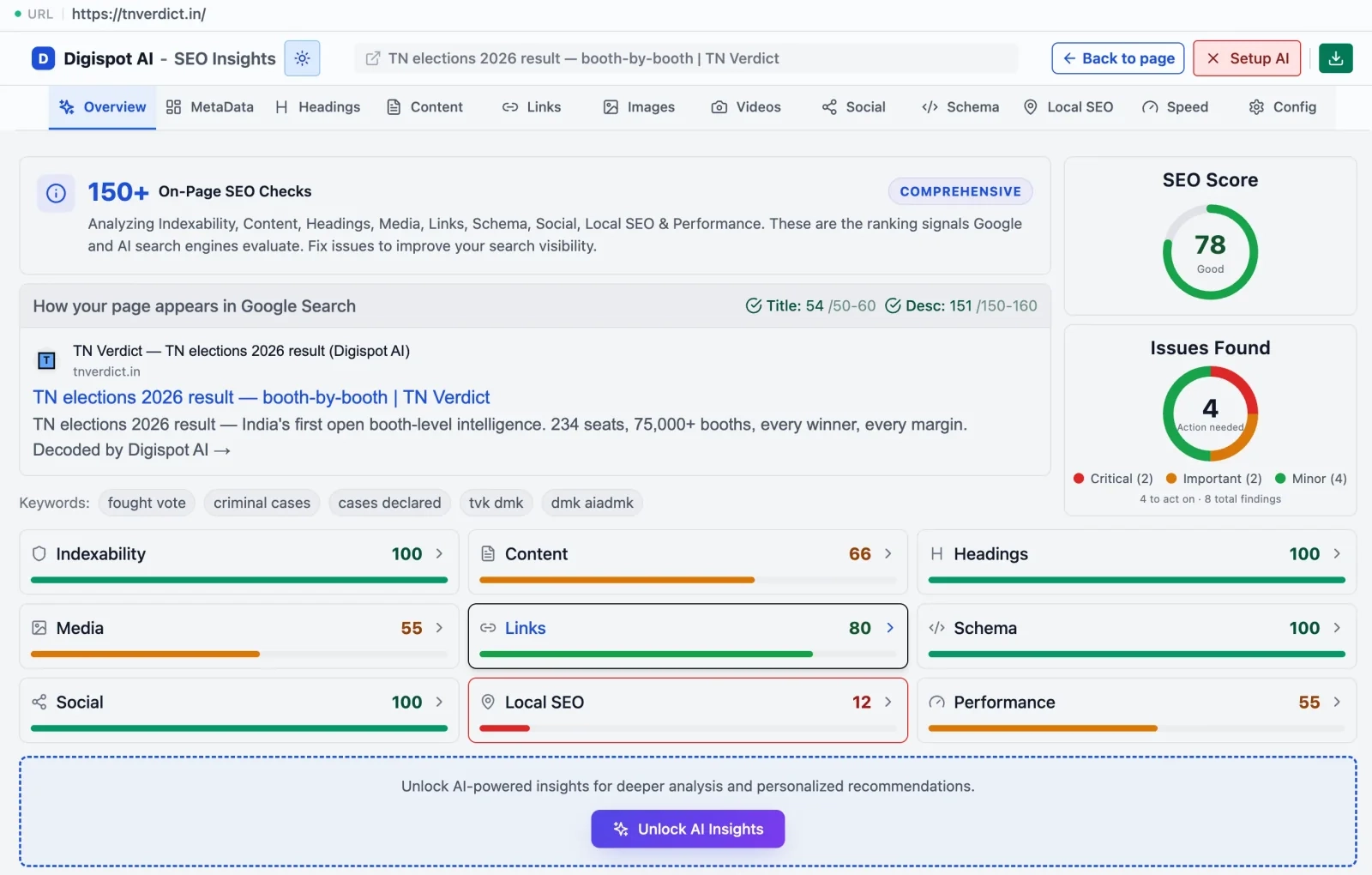
While specialized tools like Digispot AI helped identify a world of SEO issues by performing a thorough audit across 300+ factors, we wanted to be honest with the client. We aimed to create awareness around how GSC provided invaluable insights into:
- Real-time indexing status: Knowing exactly when a page enters the Google index.
- Search performance metrics: Actual click and impression data, not estimates.
- Core Web Vitals data: Real user experience metrics (CruX data).
- Mobile usability issues: Viewport and clickable element errors.
- Security problems: Hacked content or malware alerts.
- Manual actions: Notifications if a human reviewer at Google has penalized the site.
Actionable Insights That Drove Change
Our analysis led to several immediate improvements that required coordination between the dev and marketing silos:
- Fixed the Sitemap Generation Bug: We corrected the XML structure, ensuring only valid, indexable 200 OK URLs were included.
- Implemented Proper Canonical Tag Management: We established a strict logic for product variants, ensuring all "Blue/Medium" shirts pointed to the main product URL.
- Optimized Crawl Budget Allocation: By pruning dead pages (returning proper 404/410 codes) and adding accurate
<lastmod>dates to the sitemap, we increased effective crawling by 300%. - Enhanced Mobile Rendering: We identified specific CSS resources that were blocked in
robots.txt, preventing Google from rendering the mobile view correctly. (This is still a work in progress from the customer side). - Fixed Formatting Errors: We standardized the date formats and priority tags in the sitemap to meet Google's strict XML standards.
Digispot AI can help you identify and fix these issues automatically with AI-powered audits analyzing 300+ ranking factors, saving you the manual headache of checking XML lines one by one.
Practical GSC Insights That Drive Revenue
Understanding the technical side is crucial, but GSC is also a goldmine for revenue-generating insights. Here is how we applied data from the Performance Report to drive real growth.
1. Search Query Analysis Success
A home goods retailer discovered through GSC's Search Performance report that customers were searching for "pet-friendly sofas" and "cat scratch proof couch." However, their product descriptions only used generic terms like "durable fabric."
The Fix: We mapped these high-intent queries to their most durable product lines. The Result:
- Ranking improved from page 4 to page 1 for these specific terms.
- Click-through rate (CTR) increased by 312% because the title matched the user's intent.
- Generated $280K additional revenue in 3 months.
This is a classic example of search intent optimization—aligning your content with what users are actually typing.
2. Core Web Vitals Impact
A sports equipment retailer used GSC's Core Web Vitals report to identify page experience issues affecting their bottom line:
- LCP (Largest Contentful Paint): High-resolution product images were loading too slowly.
- INP (Interaction to Next Paint): Filter menus were laggy, frustrating users trying to select sizes.
- CLS (Cumulative Layout Shift): Dynamic ad banners were pushing the "Add to Cart" button down, causing mis-clicks.
Post-optimization results:
- 22% increase in conversion rate.
- 18% reduction in bounce rate.
- 31% improvement in pages per session.
Advanced GSC Techniques for E-commerce
For those ready to go beyond the basics, GSC offers advanced filtering that is particularly powerful for large inventories.
Using Regex for Product Filtering
E-commerce sites often struggle to separate brand traffic from generic product traffic. Using Regular Expressions (Regex) in the GSC Performance report allows for granular analysis.
- Query:
^(who|what|where|when|why|how)allows you to isolate informational queries to fuel your blog strategy. - Query:
sku-[0-9]+allows you to track performance for specific SKU patterns if your URLs are structured that way.
URL Inspection Tool Success Story
A luxury fashion retailer used GSC's URL Inspection tool to troubleshoot a mysterious drop in traffic for their "Summer Collection" page. They discovered:
- 404 errors on high-value product pages that had been accidentally unpublished.
- Redirect chains where old campaigns redirected to other redirects, wasting crawl budget.
- Mobile rendering issues where a pop-up modal was covering the main product image on mobile devices.
After fixes:
- Recovered $50K/month in lost revenue.
- Improved crawl efficiency by 45%.
- Reduced server load by 28% by eliminating redirect loops.
Measuring Success Through GSC Metrics
To prove ROI to stakeholders, you need to track the right KPIs. Don't just look at "Total Clicks."
Key Performance Indicators to Track:
-
Click-Through Rate (CTR) Improvements:
- Example: A fashion retailer improved product page CTR from 2.1% to 4.8% by testing clearer, benefit-driven meta descriptions.
- Impact: 128% increase in organic traffic value without ranking higher.
-
Average Position Changes:
- Case Study: An electronics store moved from avg. position 8.4 to 3.2 for "noise cancelling headphones."
- Result: 215% increase in organic conversions.
-
Index Coverage Optimization:
- Example: A home decor site resolved their "Discovered - currently not indexed" status issues, increasing valid pages from 40K to 120K.
- Impact: 167% growth in organic revenue simply by getting their inventory visible.
For a deeper dive into how to interpret these numbers, read our guide on SEO analytics and insights.
E-commerce SEO Quick Wins from GSC
If you are short on time, focus on these three high-impact areas first.
1. Rich Results Optimization
Use the Enhancements tab in GSC to monitor your structured data.
- Action: Implement Product schema markup (price, availability, reviews).
- Tool: Use the free Schema Markup Generator to create valid structured data in minutes.
- Real example: A beauty retailer saw an 89% CTR increase after their review stars started appearing in search results.
2. Search Query Mapping
Identify "Striking Distance" keywords. These are queries where you rank on Page 2 (Positions 11-20).
- Action: Add these exact keywords to your H2 headings and product descriptions.
- Example: A sporting goods store increased revenue by $180K after aligning product titles with these "striking distance" terms.
3. Mobile-First Optimization
Google uses the mobile version of your site for indexing and ranking.
- Action: Check the Page Experience report specifically for mobile. Fix "Content wider than screen" and "Clickable elements too close together" errors.
- Case study: A fashion retailer's mobile conversions went up 94% after GSC-guided fixes made the "Add to Cart" button easily clickable on smartphones.
The Big Picture: Why This Matters
This experience highlights a crucial truth in SEO: sometimes the most powerful insights don't come from expensive tools or consultants, but from properly utilizing the free tools Google provides. The challenge isn't access to information — it's knowing how to interpret and act on it.
Furthermore, in the era of AI Search (AEO), having a technically sound website is even more critical. AI engines like ChatGPT and Google's Gemini rely on clean structure and schema to parse your content. If your GSC shows crawling errors, it's virtually guaranteed that AI models are failing to read your site effectively too. Learn more about optimizing for this new landscape in our article on semantic search SEO.
Key Takeaways
- Don't be dazzled by expensive SEO audits — start with the raw data in GSC.
- Modern Google handles JavaScript effectively, but you must verify it using the URL Inspection tool. Take care of Core Web Vitals; a slow-loading website impacts crawl budget and ranking.
- Regular GSC monitoring is cheaper and more effective than reactive fixing. It prevents major SEO issues before they destroy revenue.
- Size and valuation don't guarantee SEO success. Even billion-dollar companies can fail at the basics if teams work in silos.
- Free tools often provide the most actionable insights because they come directly from the search engine itself.
Start Improving Your Traffic Today
For companies of any size, the lesson is clear: before investing in expensive SEO services, master the wealth of information available in Google Search Console. It's not about having the most expensive tools — it's about using the right tools effectively.
Remember, SEO success isn't about finding hidden secrets or paying for expensive audits. It's about understanding the fundamentals, regularly monitoring your site's health, and making data-driven decisions based on reliable information.
Start with the basics, trust but verify SEO advice, and remember that sometimes the best solutions are hiding in plain sight — like in your Google Search Console dashboard.
Ready to improve your search visibility? Try Digispot AI for comprehensive website audits and actionable recommendations that go beyond the basics, helping you dominate both traditional search and the new wave of AI answers.
Related deep-dives
Continue with these closely related guides:
- google search console seo — The Ultimate Google Search Console SEO Guide for 2025
References and Additional Resources
- Google Search Console
- URL canonicalization
- Mobile first indexing
- Page metadata
- Google's E-commerce SEO Guide
- Rich Results Testing Tool
- Mobile-Friendly Test
- Digispot AI - FREE Chrome Extension
- Digispot AI - FREE On Page SEO Audit Tool
- Digispot AI - FREE Schema Markup Visualizer
note: If you are looking for something beyond the Free GSC insights and interested to get a 360 degree analysis with entire website audited across 100+ factors that google uses in their process for crawling, indexing and ranking, then you can try out https://digispot.ai
Audit any page in seconds
300+ SEO checks including Core Web Vitals, schema markup, meta tags, and AI readiness — trusted by 1000+ SEO experts and marketers.
Frequently Asked Questions
Here are some of our most commonly asked questions. If you need more help, feel free to reach out to us.
Written by
Maya Krishnan
Digital growth expert
Maya is a seasoned expert in web development, SEO, and digital strategy, dedicated to helping businesses achieve sustainable growth online. With a blend of technical expertise and strategic insight, she specializes in creating optimized web solutions, enhancing user experiences, and driving data-driven results. A trusted voice in the industry, Maya simplifies complex digital concepts through her writing, empowering readers with actionable strategies to thrive in the ever-evolving digital landscape.