The Long Tail of Search: How to Target Long-Tail Keywords
How to target long-tail keywords: find them in Search Console, People Also Ask and communities, match intent, map one per page and track them with a simple regex.

Mastering long tail keywords is essential for acquiring targeted traffic, building topical depth, and reaching buyers when they are ready to act. By targeting granular search phrases, marketing teams and site owners can bypass competitive broad terms while capturing audience segments with high commercial intent. This guide breaks down the complete methodology for discovering, evaluating, clustering, and ranking long-tail queries across traditional search engines and AI search platforms.
Long-tail keywords (also written as long tailed keywords) are the phrases most sites already rank for without trying. For the wider process, start with our keyword research for beginners.
What Are Long-Tail Keywords in Modern SEO?
Understanding how query specificity shapes search volume distributions helps you prioritize resources toward high-converting search terms.
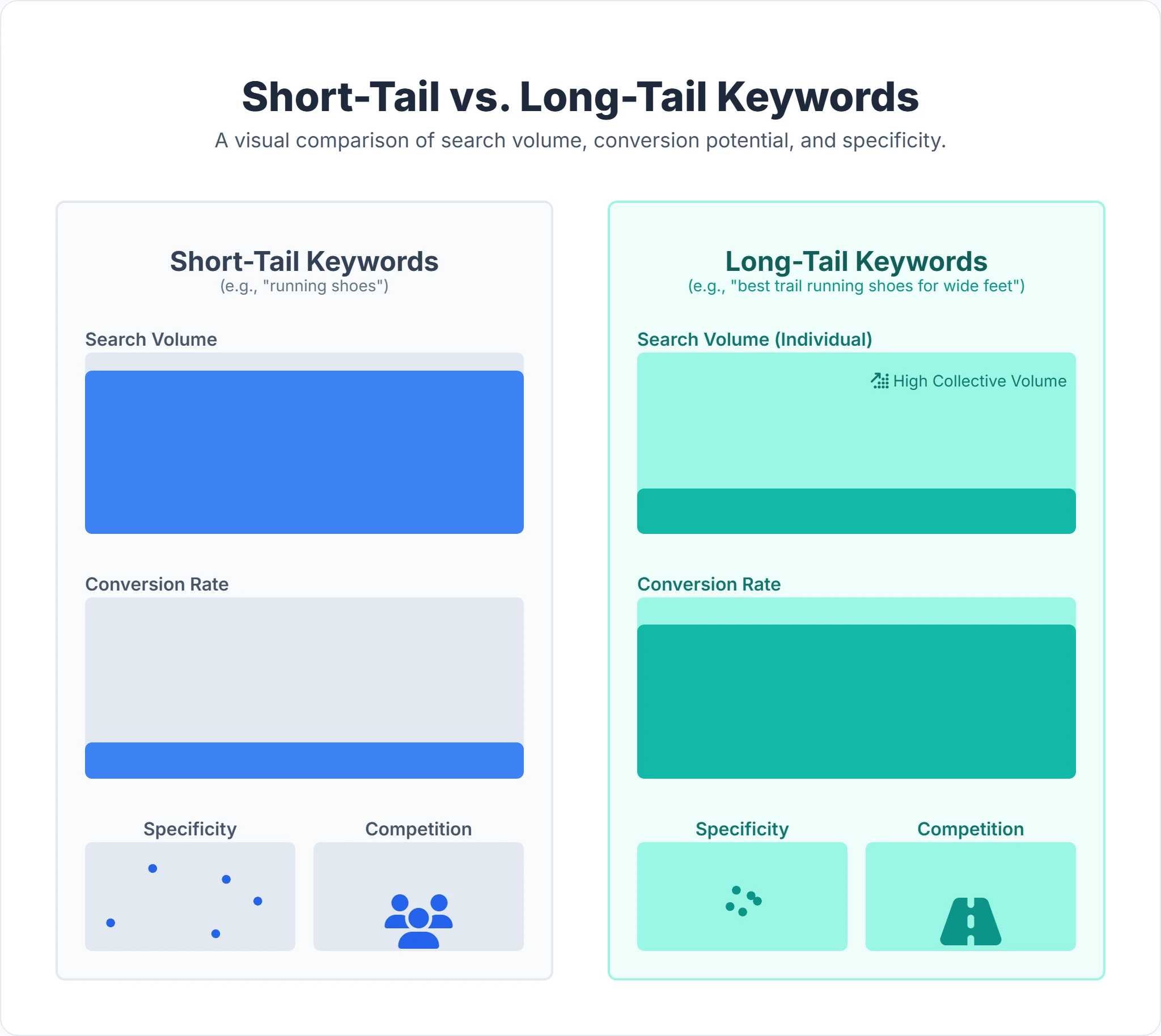
Long-tail keywords are highly specific search phrases—typically containing three or more words—that reflect precise user intent and explicit contextual needs. While individual search volume for any single tail term is generally modest, collectively these queries represent the vast majority of all web searches conducted across global search platforms.
Head, Body, and Tail Terms Compared
Search queries fall across a wide distribution curve defined by monthly volume, competition, and user intent.
Head terms consist of one or two broad words like "software" or "analytics." These phrases attract massive search volume but carry extreme competition and ambiguous user intent. A user searching for "analytics" could be looking for definitions, job descriptions, enterprise software, or open-source libraries.
Body terms sit in the middle of the curve, usually spanning two to three words such as "marketing analytics software." They narrow the topic focus, carrying moderate search volume alongside medium-to-high ranking competition.
Tail terms sit at the long end of the demand curve. Phrases like "automated google search console analytics reporting tool for agencies" represent precise requests. While the phrase itself receives fewer individual searches per month, the conversion probability rises significantly because the user's specific problem is clearly defined. For foundational concepts on categorizing search terms, read our guide on keyword research for beginners.
| Metric | Head Terms | Body Terms | Tail Terms |
|---|---|---|---|
| Typical Word Count | 1–2 words | 2–3 words | 3+ words |
| Search Volume | Very High | Moderate | Low to Moderate |
| Ranking Competition | Extreme | High | Low to Moderate |
| Conversion Intent | Broad / Ambiguous | Category Evaluation | Specific / Transactional |
| Content Alignment | Broad Category Pages | Pillar Pages / Hubs | Targeted Guides / Solutions |
Why Long-Tail Search Queries Drive Higher Conversions
Specific search terms yield superior conversion rates because they reflect a user who has already passed through the awareness phase of the buying journey. When a searcher enters a multi-word phrase containing specific product criteria, technical constraints, or explicit comparison points, they are evaluating immediate solutions.
Broad queries generate traffic from users researching background information. Specific phrases generate visits from qualified users seeking explicit features, pricing, implementation steps, or immediate deployment. Matching your content to these specific criteria ensures higher engagement rates and lower bounce rates.
Why You Should Target Long-Tail Keywords for High-Intent Growth
Targeting low-competition search phrases yields faster ranking acquisitions while laying the framework for citation across emerging artificial intelligence discovery platforms.
Accelerating Topical Authority
Building topical authority requires proving comprehensive expertise across every sub-topic within your industry domain. Newer domains and websites with modest backlink profiles often struggle to rank on the first page for competitive head terms. Attempting to rank exclusively for high-volume keywords frequently results in slow organic growth and wasted budget.
Publishing detailed content tailored to long-tail keywords allows a website to establish immediate search visibility. As search engines index and rank your pages across dozens of granular sub-topics, your domain gains systemic authority within that niche.
Over time, the combined search traffic, internal linking structure, and contextual relevance generated by a matrix of specific pages pass structural authority upward. This gradual accumulation of relevance helps your core pillar pages rank for higher-competition body and head terms. For a complete tactical workflow on evaluating terms across every funnel stage, see our comprehensive guide to keyword research for SEO.
Optimizing for Conversational AI and LLM Search Engines
Generative search platforms like ChatGPT, Claude, Perplexity, and Google Search Generative Experience rely on Large Language Models (LLMs) to construct detailed responses to user queries. Unlike traditional keyword matching engines, LLMs interpret natural language syntax and contextual intent.
Users interact with AI engines using full conversational sentences, detailed constraints, and complex multi-part questions. Content optimized around specific long-tail questions provides the precise direct answers, semantic clarity, and structured information that LLMs extract during retrieval-augmented generation (RAG).
When your content directly answers specific niche questions, AI models extract your paragraphs as trusted cited sources. Aligning your editorial workflow with explicit user questions optimizes your visibility across both standard search result pages (SERPs) and AI-driven answer engines.
How to Find Long-Tail Keywords Using Free and Data-Driven Methods
Discovering untapped search opportunities requires combining primary performance data, public search engine signals, and direct customer feedback logs.
Follow these practical steps to identify high-intent search queries:
- Extract queries from Google Search Console sitting between positions 8 and 20 that carry high impression counts.
- Mine search engine auto-suggest mechanisms, People Also Ask blocks, and related search parameters for semantic expansions.
- Review discussions on industry subreddits, Quora threads, and niche community forums for exact problem phrasing.
- Analyze internal customer support tickets, sales transcripts, and site search logs for unaddressed feature requests.
- Identify seasonal and emerging search variations by tracking real-time search trends.
Uncovering Striking-Distance Keywords in Google Search Console
Google Search Console (GSC) contains your site's exact historical search performance data. The Performance report exposes hundreds of long-tail terms for which your website already receives impressions, even if you have never intentionally optimized for them.
To locate these striking-distance opportunities, navigate to the Performance report and open the Queries tab. Set a filter for Average Position, then filter for positions greater than 7.9 and less than 20.1. Sort the resulting table by total impressions in descending order.
| Setting | Value |
|---|---|
| Report | Performance > Search Results |
| Metrics | Impressions, Clicks, Average Position |
| Query filter | Position > 7.9 and < 20.1 |
| Sort order | Impressions, descending |
Queries appearing in this range demonstrate that search engine algorithms already recognize your content's contextual relevance for the phrase. Because these terms sit on the bottom of page one or top of page two, minor on-page refinements—such as adding descriptive subheadings, expanding thin sections, or adding targeted internal links—can move these pages into top-ranking positions quickly.
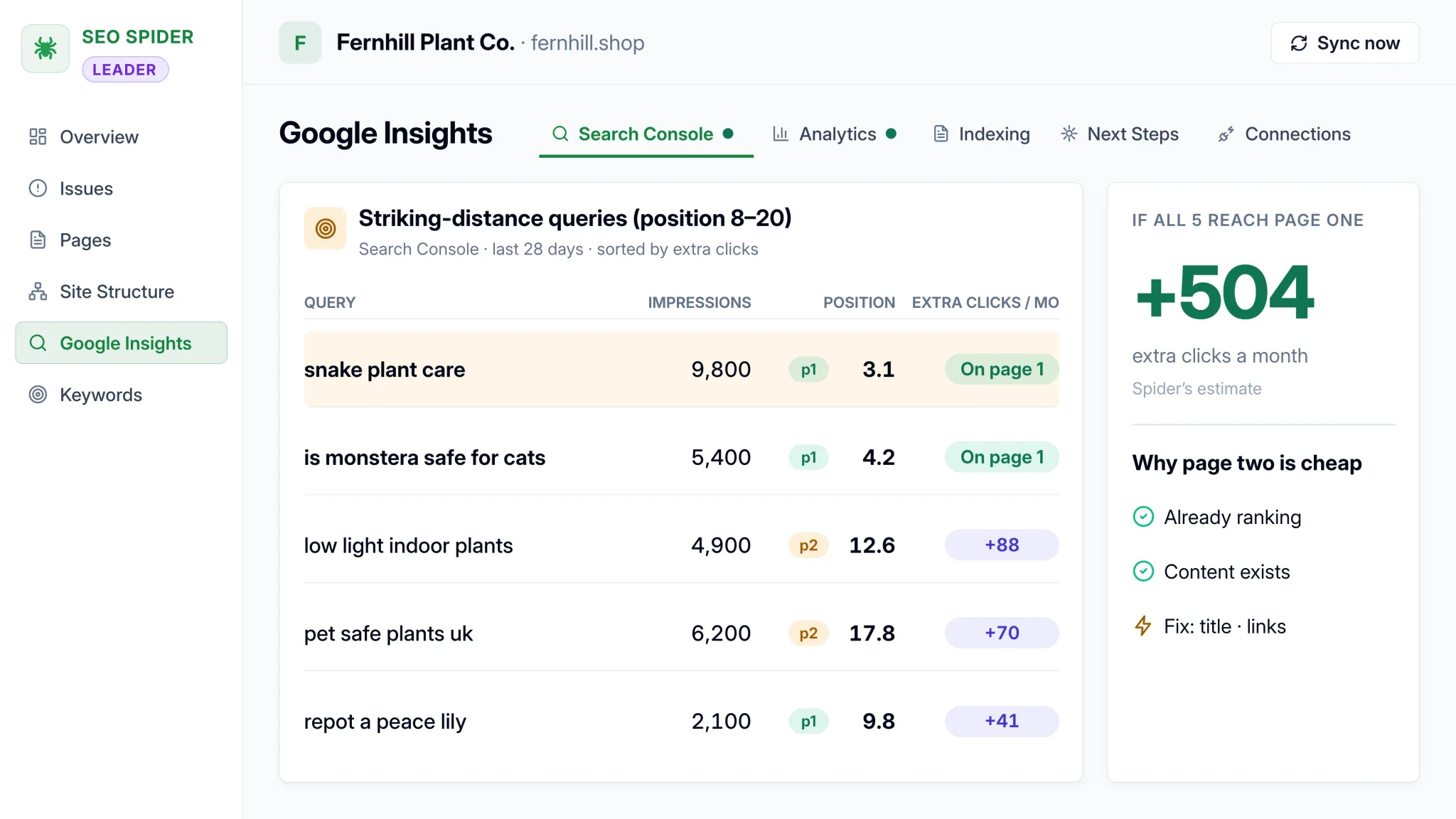
The Digispot AI SEO Spider does this inside its Google Insights screen. It lists striking-distance queries (positions 8 to 20) from Search Console, sorted by the extra clicks each could earn, and its Keyword Pulse gives free demand checks with related searches and country comparisons.
Mining Forums, Support Logs, and Customer Feedback
Keyword tools rely on aggregated historical search databases, which means newly emerging problems and raw phrasing are often missing from standard volume metrics. Real customer interactions provide a rich direct source for discovering natural language long-tail patterns.
Explore industry subreddits, specialized Discord servers, and niche community boards. Search for common pain points using advanced search operators like site:reddit.com/r/marketing "how do I automate". Take note of the exact phrases real users employ when describing their operational bottlenecks.
Search Engine Discovery Operators:
- site:reddit.com/r/[subreddit] "how to fix"
- site:quora.com "alternative to"
- site:community.[platform].com "error code"
Analyze your internal customer support ticket archives, sales conversation recordings, and site search query logs. When multiple prospective customers ask similar specific questions during sales calls, those exact phrasing patterns represent high-converting long-tail keyword candidates. To expand your discovery pipeline into real-time search movements, read our guide on how to find trending SEO keywords.
Can I Use Broken Link Building Strategies to Find Opportunities for Long-Tail Keywords?
Auditing competitor dead pages allows you to locate abandoned long-tail topics, analyze missing content gaps, and capture high-intent organic traffic.
Broken link building is traditionally viewed strictly as a link acquisition tactic. However, analyzing broken external links across competitor websites is an exceptional method for discovering proven, high-intent long-tail keywords that lack high-quality live resources.
Extracting Intent from Competitor 404 Anchor Text
When a prominent industry site deletes a resource or restructures its URL architecture without implementing 301 redirects, external links pointing to those pages break. These dead links create a footprint of what other websites were actively citing.
Use backlink analysis tools to crawl the domain of a major competitor and filter for dead outbound links or 404 landing pages with active inbound backlinks. Examine the incoming anchor text pointing toward those broken URLs.
- Run an outbound broken link audit on a competitor domain.
- Filter results to HTTP status 404 or 410.
- Check the backlinks and extract the descriptive anchor text phrases.
- Group the granular phrases into topic modules.
The anchor text used by third-party publishers often consists of descriptive long-tail phrases, such as "step by step guide to setup ga4 regex filters." These anchors reveal the precise technical concepts webmasters valued enough to link to. If dozens of sites linked to a resource using long-tail anchors, strong search demand and linkable asset potential exist for that specific sub-topic.
Crafting Long-Tail Content That Replaces Dead Resources
Once you extract the anchor text and topic structure of dead competitor resources, evaluate the intent behind those broken links. Frequently, dead assets were broad guides that contained one exceptionally valuable section or specialized formula.
Build a new, thoroughly updated asset that addresses the specific long-tail query with superior depth, modern screenshots, and actionable step-by-step instructions. Ensure your replacement content answers the exact technical nuance highlighted in the dead page's historical anchor text.
Reach out to webmasters who are currently linking to the dead competitor resource. Inform them politely that their outbound link leads to a broken 404 page, and present your newly published long-tail guide as a relevant, high-quality replacement. Because your replacement content specifically targets the precise anchor context they originally referenced, your outreach success rate improves dramatically.
How to Choose and Evaluate the Right Long-Tail Phrases
Prioritizing the most impactful search terms requires systematically screening candidates against intent fit, competition levels, search stability, and potential revenue value.
The 4-Point Long-Tail Evaluation Framework
Not every low-competition keyword is worth the operational cost of content creation. Evaluating target phrases through a structured criteria matrix prevents teams from wasting publishing bandwidth on low-value traffic.
| Criterion | Question to ask |
|---|---|
| 1. Intent alignment | Does the query match your product or service? |
| 2. Demand stability | Is search frequency consistent or rising? |
| 3. Competitor quality | Are the top ranking pages weak or generic? |
| 4. Commercial value | Does the traffic carry buyer intent? |
- Intent Alignment: Does the search query reflect a user problem that your business or software platform directly solves?
- Demand Stability: Does the keyword display recurring or rising search interest, or is it an isolated phrase with zero recurring queries?
- Competitor Quality: Are the currently ranking results dedicated, high-quality pages, or are search engines forced to display generic, outdated forum threads?
- Commercial Value: Would a visitor landing on this page plausibly convert into an active user, lead, or customer?
For detailed analysis on how to evaluate volume statistics without falling for misleading tool estimates, read our guide on keyword search volume.
Analyzing SERP Weakness and Competitor Content Quality
Before committing to a long-tail keyword target, inspect the top five organic results on the active Search Engine Results Page (SERP). Low keyword difficulty scores in software tools can be misleading; manual inspection of top-ranking assets provides absolute clarity.
Identify SERP structural weaknesses that signal clear ranking opportunities:
- Top-ranking results are broad overview pages that barely address the specific long-tail question.
- Search results consist of user-generated forum discussions, old Q&A threads, or unanswered support posts.
- The ranking pages contain broken image links, outdated code snippets, or incorrect technical instructions.
- None of the top results incorporate structured data, clear headings, or concise summary sections optimized for quick reading.
If top search results fail to give direct, immediate answers to the search phrase, a dedicated, well-formatted page can claim top rankings quickly.
Matching Search Intent Before Writing Content
Formatting your content to match explicit search intent parameters is mandatory for winning top SERP rankings and featured snippets.
Mapping Content Formats to User Intent
Search engine algorithms evaluate how well a web page satisfies user intent by monitoring user interaction signals, dwell time, and query satisfaction. User intent falls into four primary classifications:
| Intent | What the user wants | Best formats |
|---|---|---|
| Informational | Learn or understand a concept | Detailed guides, definitions, how-to articles, tutorials |
| Commercial investigation | Compare options before buying | Comparison tables, product reviews, feature breakdowns |
| Transactional | Purchase or sign up now | Product pages, pricing pages, free trial landing pages |
| Navigational | Reach a specific brand or login | Homepage, login page, account dashboard |
Analyze the dominant content formats present on the first page of search results for your chosen long-tail keyword. If all top-ranking results are step-by-step technical guides, publishing a promotional product sales landing page will fail to rank. Match your content layout strictly to the structural expectations demonstrated by the existing search results.
Structuring Direct Answers for Featured Snippets
Featured snippets and AI summaries appear at the top of many long-tail search results to give users immediate answers. Capturing these prominent positions requires structuring specific sections of your page for instant automated extraction.
Position an explicit definition or answer block immediately below your subheadings. Keep this summary paragraph between 40 and 60 words, using clean, objective language.
- Heading (H2 or H3): the question phrase.
- Paragraph: a 40-60 word objective answer that defines the key terms.
- Bullet list or table: supporting details or execution steps.
When targeting list-based or procedural intent (such as "how to configure GSC regex filters"), place a concise numbered list directly following the introductory summary block. Structured tables and clean ordered lists provide ideal inputs for search crawlers indexing snippet candidate content.
Organizing Long-Tail Queries: Grouping, Mapping, and Preventing Cannibalization
Building a scalable content architecture requires clustering semantically linked long-tail variants onto shared pillar resources to protect site architecture integrity.
Clustering Semantic Variants into Single Content Hubs
Creating an individual web page for every micro-variation of a long-tail search phrase bloats website structure and dilutes domain authority. Modern search engines evaluate semantic topic context, meaning a single well-structured page can rank for dozens—or even hundreds—of closely related search variants.
Keyword clustering involves taking a list of long-tail candidate queries and grouping phrases that share identical user intent onto a target URL. For example, queries like "how to track long tail keywords in gsc," "google search console long tail filter," and "gsc regex for multi word queries" should be consolidated onto one technical analytics guide. To implement advanced topical grouping methods, explore our complete framework for keyword clustering for SEO.
Preventing Keyword Cannibalization Across Deep Pages
Keyword cannibalization occurs when multiple deep pages on your site target identical or overlapping search queries. This forces search engine algorithms to choose between competing pages on your domain, which splits page authority, dilutes internal link strength, and causes rankings to fluctuate wildly between position 10 and 40.
- Identify overlapping pages: audit URLs that target the same intent.
- Select a primary page: pick the one with the strongest authority and backlinks.
- Consolidate content: merge the valuable sections into the primary page.
- Implement redirects: 301 redirect the secondary URLs to the primary page.
- Update internal links: point every internal anchor to the primary URL.
Regularly audit your content inventory to ensure every published page maintains a unique target intent profile. If two existing articles target overlapping long-tail variants, consolidate their content into a single master guide and 301 redirect the secondary URL. For step-by-step instructions on diagnosing and fixing overlapping content issues, consult our guide on how to fix keyword cannibalization.
On-Page SEO Checklist for Long-Tail Content Optimization
Optimizing pages for long-tail search terms requires precise title tags, clear heading hierarchies, descriptive schema markup, and natural internal link placement.
Executing proper on-page optimization ensures search crawlers correctly parse your page structure:
- Position the target phrase or core long-tail variation naturally near the start of the title tag and main H1 heading.
- Maintain title tag lengths between 50 and 60 characters (under 580 pixels) to prevent search result truncation.
- Organize sections using hierarchical H2, H3, and H4 headings that address specific secondary questions.
- Implement clean, descriptive URL slugs containing primary topical keywords separated by hyphens.
- Add relevant JSON-LD structured data (such as Article or TechArticle schema) to clarify page entities.
- Insert contextual internal links pointing toward pillar content and related contextual guides using descriptive anchor text.
Heading Hierarchy and Title Optimization
Organizing your document structure with accurate HTML heading tags helps search engines contextualize page sections. Your H1 tag must clearly reflect the main topic of the page. Subheadings (H2, H3) should incorporate natural long-tail phrases and related user queries discovered during research.
- H1: Complete Guide to Long-Tail Keyword Optimization
- H2: How to Find Long-Tail Keywords in Search Console
- H3: Filtering GSC Data with Custom Regex Patterns
- H2: Structuring Content for Featured Snippets
- H3: Formatting 50-Word Direct Answer Blocks
- H2: How to Find Long-Tail Keywords in Search Console
Avoid stuffing subheadings with repetitive target keywords. Focus on writing descriptive subheadings that summarize the immediate section content. Naturally incorporating semantic variations within your headings improves search engine understanding while preserving readability.
Structured Data and Internal Link Placement
Structured data provides explicit contextual hints to search engine crawlers regarding your content's underlying entity attributes. Utilizing JSON-LD markup formats like Article, TechArticle, or SoftwareApplication helps search bots parse content relationships efficiently.
{
  "@context": "https://schema.org",
  "@type": "TechArticle",
  "headline": "How to Target Long-Tail Keywords: Finding & Ranking Low-Competition Terms",
  "description": "Learn how to discover low-competition long-tail keywords, cluster search intent, and optimize pages for traditional SERPs and AI search engines.",
  "author": {
    "@type": "Person",
    "name": "Maya Krishnan"
  },
  "publisher": {
    "@type": "Organization",
    "name": "Digispot AI",
    "url": "https://digispot.ai"
  }
}
Internal links pass authority and provide navigation paths across your content ecosystem. Connect specific long-tail pages to relevant broad topic pillars using descriptive anchor text. Avoid generic anchors like "click here" or "read more." Instead, use contextually rich anchors that signal the exact subject matter of the destination page.
How to Track and Measure Long-Tail SEO Performance
Accurately measuring long-tail campaign success requires filtering Search Console data with regex, tracking query expansion, and measuring landing page conversions in GA4.
Filtering Long-Tail Queries in GSC with Regex
Standard Google Search Console reporting screens lump all query data into a single unsorted list. Utilizing custom regular expressions (regex) allows you to isolate and track multi-word long-tail performance metrics over time.
Navigate to the Google Search Console Performance report, click + New, select Query, and choose Custom (regex) from the dropdown menu.
GSC Regex Filters for Query Length Isolation:

1. Match queries with 4 or more words:
   ^(\S+\s+){3,}\S+$

2. Match queries with 5 or more words:
   ^(\S+\s+){4,}\S+$

3. Match natural question queries (who, what, why, how, can):
   ^(who|what|where|when|why|how|can|is|are|does|do)\b
Applying the multi-word regex filter (^(\S+\s+){3,}\S+$) removes broad head terms from your report. This allows you to evaluate long-tail performance metrics independently:
- Total clicks generated exclusively from granular search queries.
- Impression growth across multi-word queries month over month.
- Average click-through rate (CTR) trends for long-tail query clusters.
Tracking Conversion Rates and Query Expansion in GA4
Long-tail SEO success is measured by total organic conversion volume and query portfolio expansion, not just standalone head term rankings. As your topical authority expands, your target pages will begin ranking for long-tail queries you never explicitly targeted.
In Google Analytics 4 (GA4), build a custom exploration report to evaluate user engagement across specific long-tail landing pages.
- Dimensions: landing page and page path
- Metrics: active users, engagement rate, key events, event rate
- Filter: landing page matching your target long-tail URL paths
When you track thousands of long-tail keywords, a rank tracker gets expensive and noisy. Search Console already reports every query that earns impressions, so use the regex filters above for the long tail and keep daily rank tracking for a short list of priority terms. In the Digispot AI Cloud app, SERP Intelligence tracks daily ranks for the keywords you choose, and Search Analytics shows Search Console and GA4 data side by side.
Compare the conversion rates of visitors arriving on specific, high-intent long-tail landing pages against visitors landing on generic broad overview pages. Visitors entering through detailed, intent-matched content consistently register higher engagement rates and key event conversion frequencies.
Common Mistakes to Avoid
Preventing strategic execution errors protects your website from thin content penalties, keyword cannibalization, and wasted content production budgets.
Watch out for these strategic errors during execution:
- Creating separate, thin pages for minor singular versus plural query variations instead of clustering them.
- Targeting low-competition long-tail keywords that carry zero business relevance or potential conversion value.
- Neglecting periodic content updates for striking-distance pages sitting stuck between positions 8 and 20.
- Stuffing long-tail keyword phrases awkwardly into body text, ruining content readability for human visitors.
- Failing to match the primary content format (guide, tool, comparison) dictated by current top SERP results.
Thin Content and Over-Segmentation Risks
Publishing hundreds of 300-word articles to target tiny phrasing variations creates a fragmented site structure. Search engines view extensive networks of thin, near-duplicate pages as low-quality content, which can trigger site-wide quality downgrades.
Instead of over-segmenting your content, consolidate related queries into comprehensive pillar pages. Ensure every published URL offers substantial depth, original insights, unique visual assets, and thorough answers to user sub-questions.
Ignoring Periodic Content Refresh Cycles
Publishing long-tail content is not a one-time effort. Search engine algorithms continuously re-evaluate content freshness, accuracy, and user satisfaction signals. Pages that initially rank in top positions can decline over time as competitors update their assets.
Monitor your Search Console performance metrics monthly to catch striking-distance opportunities. When a page sits between positions 8 and 20 for key long-tail terms, execute a content refresh:
- Update outdated figures, statistics, and year references.
- Add clear answers to newly emerging user sub-questions.
- Improve formatting with fresh visual diagrams, bulleted summaries, or comparison tables.
- Add new internal links from recently published articles to pass page authority.
Find and Track Long-Tail Keywords with Digispot AI
Long-tail work repeats: research, intent clustering, on-page fixes and tracking. Managing it by hand across thousands of multi-word queries gets heavy for in-house teams and agencies alike.
Use the Spider's Google Insights for striking-distance queries, its keyword coverage map to see which keywords have a page and which do not, and Keyword Research in the Cloud app for volume, difficulty and trends. One Digispot AI plan covers the Spider, the Cloud app, the WordPress plugin and the free Chrome extension, so agencies can run every client site on the same tools.
More in the Keyword Research guide
Start with the Keyword Research: The Complete Guide for 2026.
Audit any page in seconds
200+ SEO checks including Core Web Vitals, schema markup, meta tags, and AI readiness — trusted by 1,250+ SEO experts and marketers.
Frequently Asked Questions
Here are some of our most commonly asked questions. If you need more help, feel free to reach out to us.

Maya Krishnan is an SEO and AEO specialist at Digispot AI. She helps agencies and businesses across industries and countries grow organic traffic from Google and AI search, and knows the major SEO platforms well, from desktop crawlers to all-in-one suites. She checks and approves every article published under her name.
More from Maya Krishnan