Digital Marketing & SEO: Complete Beginner Guide 2026
Complete guide to digital marketing channels and strategies. Learn SEO, PPC, social media, email marketing, and how each drives business growth online.
 Maya Krishnan
Marketing isn't just about selling anymore—it's about building relationships, creating value, and meeting your customers exactly where they look for answers. And where are they looking? Online.
With over 5 billion people using the internet daily, digital marketing has shifted from an optional strategy to a requirement for business survival. Whether you run a local coffee shop or a global SaaS platform, your digital footprint defines your brand's credibility.
Consider your own habits: when was the last time you bought a significant product without Googling it first? Whether checking reviews, comparing prices, or scrolling through Instagram for inspiration, the digital world dictates decision-making. Businesses that fail to adapt to this reality risk invisibility.
This guide cuts through the noise. We will break down exactly how modern digital marketing works, moving beyond buzzwords to actionable strategies you can implement immediately.
Key Takeaways
- Treat your channels as one ecosystem. Social drives traffic to your website, your website captures emails, and email nurtures leads back to your products—the handoffs matter more than any single channel.
- Build assets before renting attention. Invest in SEO, content, and your email list first; layer on paid ads once your foundation can convert the traffic you send it.
- Go deep on one or two channels, not shallow on five. Beginners win by being genuinely good at SEO plus one social platform rather than spreading themselves thin.
- Optimize for AI answers, not just blue links. Structure content around clear questions and concise answers so engines like ChatGPT and Google AI Overviews can cite you.
- Measure what moves revenue. Track conversion rate, organic traffic, and engagement that leads to action—ignore vanity metrics like raw likes.
What will you learn in this guide?
- Understanding core digital marketing channels and their specific benefits
- A step-by-step roadmap to launching your digital marketing journey
- Practical tips for implementing strategies that actually drive revenue
- Cost-effective methods tailored for small businesses and startups
- Essential metrics to track so you stop wasting budget on things that don't work
Understanding Digital Marketing: A Modern Business Essential
Digital marketing encompasses all marketing efforts that use an electronic device or the internet. It leverages channels such as search engines, social media, email, and other websites to connect with current and prospective customers.
However, viewing it simply as "online advertising" misses the point. Effective digital marketing is data-driven communication. Unlike traditional billboards or radio spots, digital channels allow you to track every click, view, and conversion. This granular data lets you refine your strategy in real-time, ensuring your budget focuses on high-performing tactics.
💡 Pro Tip: Digital marketing isn't just about promoting products; it's about creating meaningful connections. If you solve a problem for your audience through free content, they are far more likely to trust you with their wallet later.
The Digital Marketing Ecosystem: A Comprehensive Overview
To succeed, you must view these channels as an interconnected ecosystem, not isolated silos. Your social media should drive traffic to your website; your website should capture emails; your emails should nurture leads back to your products.
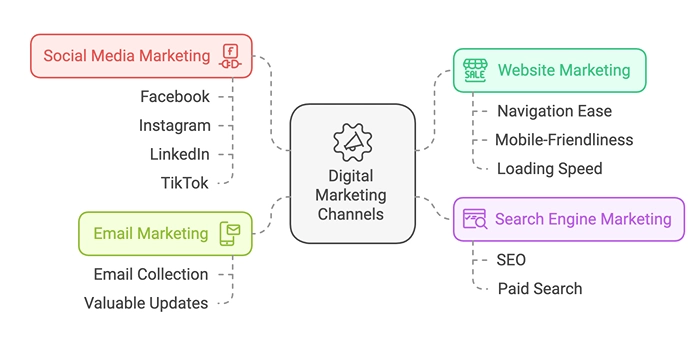
1. Website Marketing and SEO
Your website is your 24/7 salesperson, brand ambassador, and customer service representative. It is the only digital asset you fully own—social media algorithms can change, but your website remains under your control.
With 75% of consumers judging a company's credibility based on website design, you never get a second chance to make that first impression. A poor user experience (UX) drives potential customers straight to your competitors.
Essential Website Elements
- Responsive design: Your site must adapt fluidly to mobile, tablet, and desktop screens.
- Core Web Vitals: Google prioritizes sites with fast loading speeds (under 3 seconds) and visual stability.
- Clear navigation: Users should find what they need in three clicks or less.
- Compelling CTAs: Tell visitors exactly what to do next (e.g., "Get a Quote," "Download Guide").
- SSL Security: A secure site (HTTPS) is non-negotiable for trust and rankings.
For a deeper dive into technical requirements, read our guide on on-page SEO best practices.
Success Story: Wix, a leading website platform, saw remarkable results through strategic SEO implementation. By integrating advanced SEO tools and Google Search Console, their users experienced an average 15% increase in traffic and a 24% boost in revenue for e-commerce sites. Even more impressive, over 2 million Wix sites benefited from these optimizations.
Source: Google Search Central Case Studies
Try the free On-Page SEO Analysis tool to audit any URL instantly and see how your site measures up against modern standards.
2. Search Engine Marketing (SEM)
SEM covers the strategies used to gain visibility on search engine results pages (SERPs). It includes both organic efforts (SEO) and paid strategies (PPC).
Organic Search (SEO)
SEO is the art and science of persuading search engines like Google (and now AI engines like ChatGPT) to recommend your content as the best answer to a user's question. It is a long-term investment that compounds over time.
- Keyword Research: Identifying the specific phrases your customers type into search bars. If you are just getting started, our keyword research guide for beginners walks through finding low-competition terms with real search demand.
- Content Creation: Writing authoritative articles that satisfy user intent.
- Technical SEO: Ensuring bots can crawl and index your site without errors.
- Link Building: Earning votes of confidence (backlinks) from other reputable sites.
To ensure you aren't missing critical technical elements, review our SEO audit checklist for 2026.
Paid Search Advertising (PPC)
While SEO builds a foundation, paid search offers immediate visibility. With an average return of $2 for every $1 spent, platforms like Google Ads act as a faucet—you can turn traffic on or off instantly. This is ideal for launching new products or pushing seasonal promotions.
Key elements include:
- Targeted Bidding: Paying only when users search for high-intent keywords (e.g., "buy running shoes near me").
- Ad Copy Optimization: Writing headlines that demand clicks.
- Landing Page Alignment: Ensuring the page users land on matches the promise made in the ad.
3. Social Media Marketing Strategy
With 4.9 billion social media users worldwide, your customers are scrolling right now. However, "being on social media" isn't enough. You need a strategy that acknowledges the nuances of each platform.
We are seeing a shift toward "Social Search." Younger demographics often use TikTok or Instagram as their primary search engine for local businesses and product reviews. Your content must be discoverable, not just engaging.
Platform-Specific Strategies
Understanding the psychology of the user on each platform is crucial for conversion.
| Platform | Best For | Content Type |
|---|---|---|
| Community & Local Business | Groups, Events, Long-form video | |
| Visual Brands (Fashion, Food) | High-res photos, Stories, Reels | |
| B2B & Professional Services | Case studies, Industry insights | |
| TikTok | Gen Z & Viral Awareness | Raw, authentic short-form video |
| E-commerce & Planning | Visual inspiration boards, Infographics |
4. Email Marketing Excellence
Email marketing remains the undisputed king of ROI, generating $36 for every $1 spent. Why? because it is a direct line to your customer's pocket, free from the interference of algorithmic changes.
The era of "spray and pray" blasts is over. Modern email marketing relies on segmentation. This means organizing your list based on behavior (e.g., "customers who bought X," "leads who downloaded Y").
Key Components
- Lead Magnets: offering value (like a checklist or discount) in exchange for an email address.
- Automation Workflows: Setting up "set it and forget it" sequences, such as Welcome Series or Abandoned Cart reminders.
- Personalization: Going beyond "Hi [Name]" to recommend products based on past purchases.
Case Study: Bluewire Media transformed their email marketing by offering a simple but valuable lead magnet—their "Email Marketing Templates" PDF. This strategy resulted in a 16x increase in subscribers and a 68% conversion rate on their landing page. They proved that helpful content beats aggressive selling every time.
Source: Neil Patel's Email Marketing Case Studies
Strategic Implementation Guide
Building a successful digital marketing strategy is like constructing a building. You cannot install the roof (paid ads) until you have a solid foundation (website) and strong walls (content).
1. Building Your Digital Marketing Foundation
Before you spend a dollar on ads, ensure your digital presence is ready to receive traffic. Sending paid traffic to a broken website is burning money. If you are launching lean, our SEO guide for startups shows how to earn early visibility without a big budget.
Start with these essential steps:
-
Website Development
- Select a hosting provider that guarantees uptime.
- Implement a mobile-first design philosophy.
- Schema Markup: Help search engines understand your content. Use the free Schema Markup Generator to create valid structured data in minutes.
-
Content Strategy
- Develop "Topic Clusters" to build authority in your niche.
- Create a content calendar to maintain consistency.
- Optimize every piece of content for specific keywords and user intent.
-
Analytics Setup
- Install Google Analytics 4 (GA4) immediately.
- Set up Google Search Console to monitor organic health.
- Define what a "conversion" looks like (form fill, purchase, call).
2. Advanced Marketing Techniques
Once the basics are humming, you can layer on sophisticated tactics to scale your growth.
Marketing Automation
Automation removes repetitive tasks, allowing you to scale personal interactions.
- Lead Scoring: Assign points to leads based on their activity (e.g., +10 points for visiting the pricing page). This helps sales teams focus on hot leads.
- Chatbots: Use AI to answer common questions 24/7, capturing leads while you sleep.
Content Marketing 2.0
- Podcasting: Audio creates an intimate connection with listeners that text cannot match. Publish episodes as show notes on your site so search engines and AI answer engines can index the transcript—turning a single conversation into a permanent, discoverable asset.
- Video Production: From YouTube tutorials to product demos, video is prioritized by almost every algorithm today. Keep the first three seconds hook-driven, add captions for silent autoplay, and embed clips inside relevant blog posts to lift time-on-page.
- Repurposing: Turn one blog post into a video script, three LinkedIn posts, and an infographic. This "create once, distribute everywhere" approach compounds reach without compounding your workload.
- Answer-First Formatting: Lead sections with the direct answer, then explain. As users increasingly ask questions of AI assistants, content written this way is far more likely to be quoted—see our Answer Engine Optimization guide for the exact structure.
Performance Measurement and Analytics
You cannot improve what you do not measure. In digital marketing, data is your compass. However, drowning in data is as dangerous as having none. You must focus on KPIs (Key Performance Indicators) that impact your bottom line.
Key Metrics to Track
-
Website Performance
- Page Load Time: Slow sites lose money.
- Conversion Rate: The percentage of visitors who take action.
- Bounce Rate: High bounce rates often indicate irrelevant content or bad UX. Check our guide on common SEO mistakes to fix this.
-
SEO Metrics
- Organic Traffic: Are you growing without paying for ads?
- Keyword Rankings: Are you appearing for terms that drive sales?
- Domain Authority: A measure of your site's reputation relative to competitors.
-
Social Media Metrics
- Engagement Rate: Likes are vanity; comments and shares represent true interest.
- Click-Through Rate (CTR): How effective is your content at driving traffic?
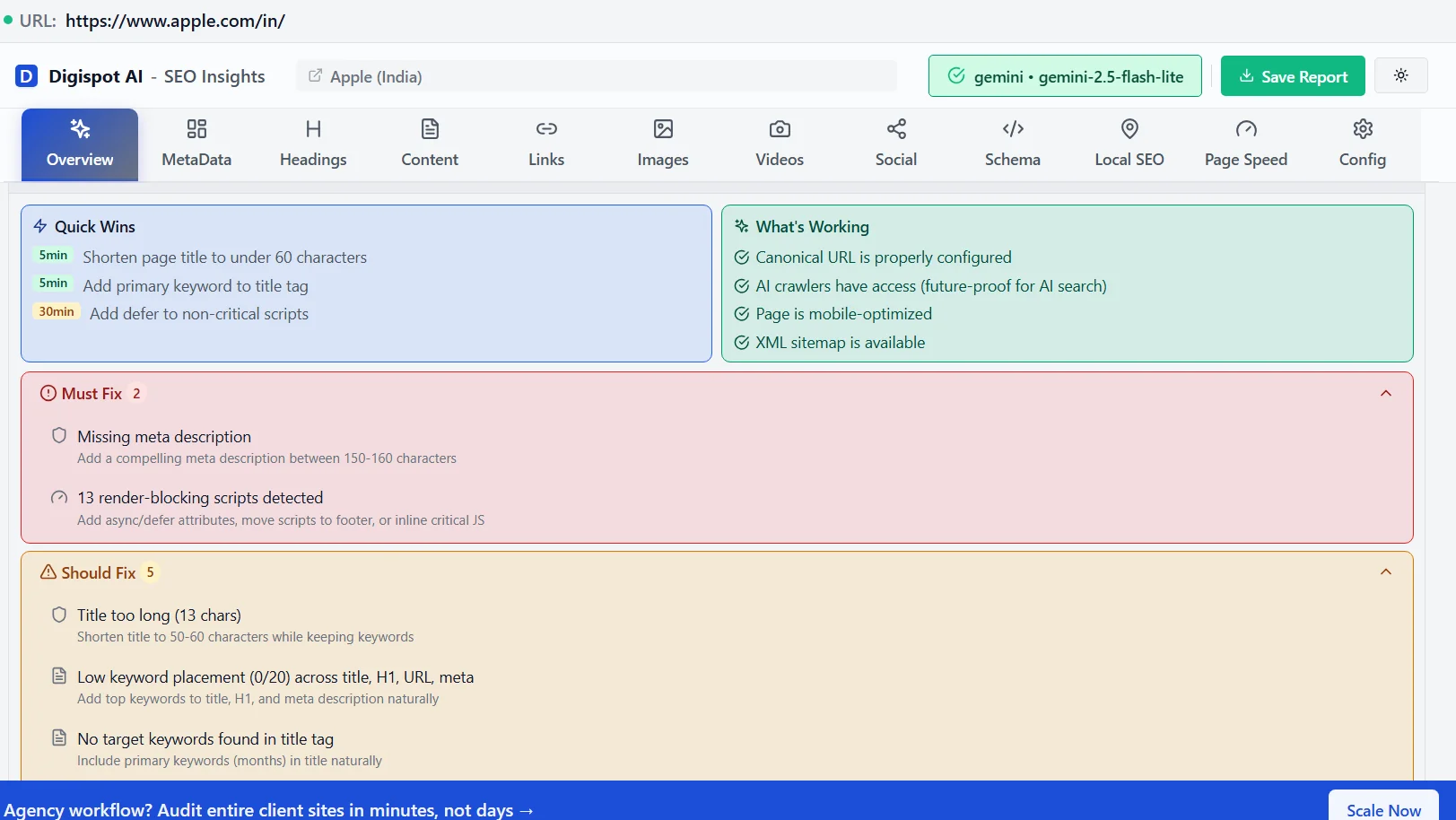
Digispot AI can help you identify and fix these issues automatically with AI-powered audits analyzing 300+ ranking factors, saving you hours of manual data crunching.
Investment and ROI Considerations
How much should you spend? This is the most common question from business owners. While there is no "one size fits all" answer, industry benchmarks provide a starting point.
Budget Allocation Guide
Think of your budget in two buckets: Assets (SEO, Content, Email list) which grow in value over time, and Expenses (Ads) which stop working the moment you stop paying.
| Channel | Recommended % | Starting Budget (Small Biz) |
|---|---|---|
| Website (Maintenance/CRO) | 20-30% | $500-1000 |
| SEO & Content | 25-35% | $300-800 |
| Social Media | 15-25% | $200-500 |
| Email Tools | 10-20% | $100-300 |
Expert Tips for Success
After analyzing thousands of websites, we have identified the factors that separate high-growth businesses from stagnant ones.
-
Focus on Mobile First Google practices "Mobile-First Indexing," meaning it ranks your site based on its mobile version, not the desktop version. Test your site on an actual phone, not just a resized browser window.
-
Prioritize E-E-A-T Experience, Expertise, Authoritativeness, and Trustworthiness are crucial for ranking. Google wants to know who is behind the content. Ensure your "About Us" page is robust and your authors have visible credentials. Learn more about E-E-A-T guidelines here.
-
Engage, Don't Broadcast Social media is a two-way street. Reply to every comment. Ask questions. The algorithm rewards accounts that keep users on the platform through active conversation.
Future Trends in Digital Marketing
The landscape shifts rapidly. According to Forbes, 76% of consumers have changed their shopping habits in the past year alone.
Stay ahead by watching these trends:
- AEO (Answer Engine Optimization): With tools like ChatGPT and Perplexity, users are getting direct answers rather than a list of links. Optimizing your content for these AI models is the next frontier of SEO.
- Voice Search: With over 1 billion voice searches per month, targeting conversational keywords (e.g., "Where is the best pizza near me?" vs "pizza restaurant") is critical. Our voice search SEO optimization guide covers how to structure content for spoken queries.
- Video Dominance: Short-form video (Reels, TikTok) is seeing 88% year-over-year growth. If you aren't using video, you are invisible to a massive segment of the market.
- Privacy-First Marketing: As third-party cookies disappear, building your own database (First-Party Data) via email lists is more important than ever.
Getting Started: Your 60-Day Action Plan
The journey starts with a single step. We have broken down the first two months into manageable phases so you don't get overwhelmed.
| Timeline | Focus Area | Key Actions | Expected Outcomes |
|---|---|---|---|
| Week 1-2 Foundation | Digital Presence Setup | • Audit & fix website speed | • Professional infrastructure |
| Week 3-4 Content | Content Strategy | • Build 3-month content calendar | • Content backlog ready |
| Month 2 Growth | Campaign Launch | • Publish content weekly | • Growing organic traffic |
Get instant SEO insights on any page with our free Chrome extension.
💡 Pro Tip: Don't try to master every channel at once. It is better to be excellent at one channel (like SEO or Instagram) than mediocre at five. Quality beats volume every time.
Frequently Asked Questions
-
How much should I spend on digital marketing? Start with 7-10% of your revenue for established businesses. If you are a startup, focus on time investment in content creation and SEO before spending heavily on ads.
-
How long until I see results? SEO is a marathon, typically taking 3-6 months for significant movement. Paid advertising (PPC) is a sprint and can generate leads within 24 hours. A balanced strategy uses both.
-
Do I need to be on all social platforms? No. In fact, spreading yourself too thin hurts performance. Focus strictly on the platforms where your specific target audience spends their time.
Start Improving Your Digital Presence Today
Digital marketing is not a magic switch; it is a process of consistent improvement. By building a strong foundation, creating content that actually helps your audience, and measuring your results, you will see compound growth over time.
Don't let the technical details overwhelm you. Start with your website, ensure it's healthy, and expand from there.
Ready to improve your search visibility? Try Digispot AI for comprehensive website audits and actionable recommendations that take the guesswork out of growth.
Additional Resources
- Google Digital Marketing Course
- HubSpot Academy
- Moz SEO Learning Center
- Social Media Examiner
- Digispot AI - FREE Chrome Extension
- Digispot AI - FREE On Page SEO Audit Tool
- Digispot AI - FREE Schema Markup Visualizer
Related deep-dives
Continue with these closely related guides:
- to get seo — How to Get an SEO Job: Career Guide & Skills
Audit any page in seconds
300+ SEO checks including Core Web Vitals, schema markup, meta tags, and AI readiness — trusted by 1000+ SEO experts and marketers.
Frequently Asked Questions
Here are some of our most commonly asked questions. If you need more help, feel free to reach out to us.
Written by
Maya Krishnan
Digital growth expert
Maya is a seasoned expert in web development, SEO, and digital strategy, dedicated to helping businesses achieve sustainable growth online. With a blend of technical expertise and strategic insight, she specializes in creating optimized web solutions, enhancing user experiences, and driving data-driven results. A trusted voice in the industry, Maya simplifies complex digital concepts through her writing, empowering readers with actionable strategies to thrive in the ever-evolving digital landscape.