Google August 2026 Spam Update: What You Need to Know
Google released the August 2026 spam update on August 18, rolling out globally in all languages. Learn what changed, how to diagnose a drop, and what to fix.
 Maya Krishnan
Google has released its August 2026 spam update, the latest improvement to the automated systems it uses to detect and neutralize search spam.
According to the Google Search Status Dashboard, the incident began at 09:27 PDT on 18 August 2026, with the release logged one minute later:
Released the August 2026 spam update, which applies globally and to all languages. The rollout may take a few days to complete.
The incident is filed under Ranking, which means measurable position changes are expected while it rolls out.
This is not a core update. It targets spam detection specifically, not the broader relevance and quality signals a core update adjusts — a distinction that matters a great deal when you start diagnosing a drop.
Key Takeaways
- Confirm the cause before acting. Check the Manual Actions report first — a clean report means you are dealing with an algorithmic reassessment, not a penalty, and there is no reconsideration request to file.
- Wait for the rollout to complete. Don't make strategic changes on the first 24 to 48 hours of movement; editing mid-rollout destroys your ability to attribute what changed.
- Segment the loss, don't total it. Drill from queries to URLs to directories to content types — spam-related drops concentrate in one section, while an even, site-wide decline usually points elsewhere.
- Use brand vs. non-brand as your key diagnostic. Stable brand traffic with a fall in non-brand traffic is consistent with a spam reassessment; if both fell together, look at tracking, technical health, or seasonality first.
- Fix the violation, not the symptom. For link spam in particular, cleaning up manipulative links restores compliance but does not buy back rankings that were never legitimately earned.
What a Google spam update actually is
Google's systems evaluate pages continuously for behavior that violates its spam policies. That evaluation never stops. What Google announces as a spam update is a larger, notable improvement to those systems — significant enough that site owners deserve a heads-up.
A central component here is SpamBrain, Google's AI-based spam-prevention system. Introduced in 2018, it detects spam at crawl time and has since been extended to identify both sites that buy links and sites that exist to pass outgoing links. As spam techniques evolve, Google retrains and improves these systems to catch them.
The practical implication: spam updates are getting better at pattern recognition, not just rule matching. Tactics that evaded detection in previous cycles are not permanently safe.
Spam update vs. core update vs. manual action
Confusing these three is the single most common reason site owners fix the wrong thing. They are not the same event and they do not call for the same response.
| Spam update | Core update | Manual action | |
|---|---|---|---|
| What it targets | Violations of Google's spam policies | Broad relevance and quality assessment | A specific site, reviewed by a human |
| Notification | None — announced publicly, not per-site | None | Appears in Search Console → Manual Actions |
| Typical fix | Remove the violating practice | Improve genuine content quality | Fix the issue, then submit a reconsideration request |
| Recovery | At a later system refresh | At a later core update | After the reconsideration request is approved |
If your Manual Actions report is clean, you are dealing with an algorithmic reassessment. There is no reconsideration request to file and no appeal to submit — the path back runs through fixing what the systems are now flagging.
What to do if your rankings dropped
Don't panic, and don't start changing everything at once.
The rollout is still in progress. Fluctuations during a rollout do not necessarily indicate a permanent problem, and changes you ship mid-rollout make attribution nearly impossible afterwards. You lose your ability to tell what the update did from what your edits did.
If your site sees a meaningful decline, Google's guidance is to review the Search Essentials spam policies and determine whether anything on your site could violate them.
Areas worth reviewing:
- Scaled content abuse — pages generated in bulk primarily to rank, whether written by AI, humans, or a mix
- Keyword stuffing — unnatural repetition of terms
- Cloaking — showing search engines different content than users see
- Doorway pages — near-duplicate pages targeting query or location variants that all funnel to the same destination
- Hidden text or links — content positioned or styled to be invisible to users
- Sneaky redirects — sending users somewhere other than what the search result promised
- Link spam — paid links, exchanges, automated links, low-value guest posting at scale
- Expired domain abuse — buying an aged domain to repurpose its authority for unrelated content
- Site reputation abuse — third-party content published on a trusted domain to exploit its ranking signals
A ranking drop does not automatically mean your site was penalized. Algorithmic systems can simply reassess the signals associated with a site as spam detection improves. The credit gets withdrawn; nobody flagged you.
The link spam exception matters
Google draws an important distinction for link-related spam that changes what recovery looks like.
If Google's systems determine that spammy links were artificially contributing to your rankings, Google may remove the ranking benefit those links provided. Removing the links afterwards does not restore the positions you previously held.
Put plainly:
If the ranking benefit came from manipulative links, losing that benefit is the expected outcome, not a penalty to be reversed.
Cleaning up those links brings the site into compliance and protects it from further action. It does not buy back an advantage that was never legitimately earned. Teams that budget for a "recovery" after a link cleanup are usually budgeting for something that will not arrive — the realistic goal is a stable baseline built on links you would have earned anyway. Our guide to improving your backlink profile covers what that baseline looks like in practice.
Don't confuse this with ordinary ranking volatility
Not every ranking movement in this window is caused by the August spam update.
Google's systems change continuously, and unannounced adjustments run alongside announced ones. Look for patterns, not single-day readings.
Compare across a meaningful window:
- Organic clicks and impressions
- Average position, by query
- Query-level winners and losers
- Landing page performance
- Indexed page counts
- Crawl activity
- Manual actions and security issues
- Any major technical changes you shipped
- Backlink profile changes
- Traffic by country and device
- Brand vs. non-brand traffic
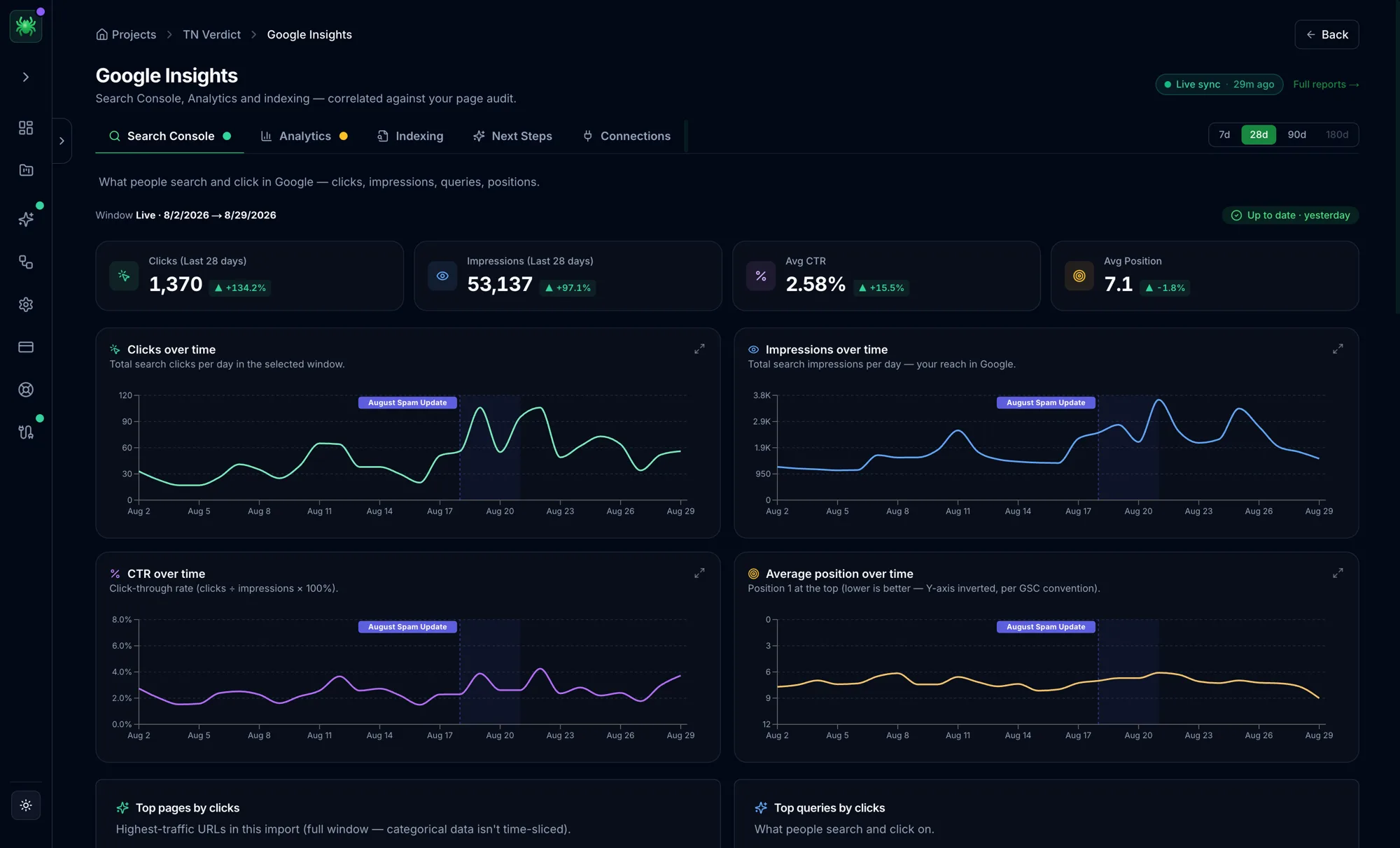
That last one is the most diagnostic split available to you. Brand queries are largely insulated from spam systems — people searching your name still find you. If brand traffic held steady while non-brand traffic fell, the loss is in discovery, and that is consistent with an algorithmic reassessment. If both fell together, look at tracking, technical health, or seasonality before blaming the update.
Then align the timing of any decline against the 18 August rollout. A drop that started on 12 August is not this update.
A structured response, in order
The right reaction is not to rewrite hundreds of pages or disavow every backlink. It is a structured audit.
1. Identify exactly what changed
Don't stop at total organic traffic. Drill down through:
Queries → URLs → Directories → Content types
Spam-related losses tend to concentrate. If one directory, one template, or one content type absorbed most of the decline, you have found your scope. If the loss is evenly spread across an entire site, the cause is more likely something else. Segment your Search Console data with a 28-day comparison window, and set the comparison boundary at 18 August.
2. Review Google's spam policies against your own practices
Read the policies with your own site open beside them. Pay particular attention to content produced at scale, aggressive automation, expired domains, doorway-style pages, and manipulative link building.
Be honest about programmatic content in particular. Generating pages at scale is not a violation on its own — generating pages at scale primarily to rank, with no genuine value per page, is exactly what scaled content abuse describes. The dividing line is per-page value: a programmatic SEO template that assembles genuinely distinct, useful data for each URL is fine, while the same template spinning near-identical text across thousands of location or keyword variants is the pattern spam systems now flag. The same test applies to how the content was written — Google judges output, not method, so AI-assisted content is only a problem when it produces thin, undifferentiated pages that would not exist for any reason other than to capture search traffic.
3. Audit your content footprint
One question cuts through most debates:
Would this page exist if Google Search didn't exist?
If the answer is no, investigate further. That is not proof of a violation, but it reliably points at the pages worth examining first.
Pages should serve a real reader need rather than capture a query variant. Our E-E-A-T guide covers what genuine value looks like in the signals Google can actually assess, and the complete SEO audit checklist walks the full site-level review.
4. Review your link profile
Look for patterns involving:
- Paid links
- Link networks and PBNs
- Automated or programmatic links
- Large-scale guest posting
- Irrelevant backlinks from unrelated niches
- Sitewide footer or sidebar links
- Anchor text manipulation
Don't assume every low-quality backlink is a problem. Any site with real authority accumulates junk links it never asked for, and Google's systems are built to ignore them. The goal is finding manipulative patterns you created, not chasing every unattractive link into a disavow file. Over-aggressive disavowing does real damage.
The distinction that matters is intent and scale. A handful of spammy directory listings you never submitted to are noise Google discards. A recurring pattern — the same exact-match anchor text across dozens of unrelated domains, a burst of links acquired in a single week, or a footprint tracing back to a network you paid — is a signal you built and can be neutralized. When you do find genuinely manipulative links you control, the disavow tool is a last resort after attempting removal at the source, and it should target the pattern, not every individual URL. Our guide to removing toxic backlinks safely walks the removal-versus-disavow decision in detail, and a step-by-step backlink audit shows how to surface those patterns in the first place.
5. Wait for the rollout to finish
This one matters most right now.
The August 2026 spam update is still rolling out. Avoid making major strategic decisions on the first 24 to 48 hours of movement. Watch the Search Status Dashboard for the completion notice, monitor as the rollout progresses, and look for changes that sustain rather than spike.
Use the waiting period productively: gather baselines, segment your data, and build the diagnosis. Then act once you know what you are acting on.
Build a defensible baseline before the next update
The most useful thing you can do during a rollout is know your own site well enough to spot what actually changed. That means a documented crawl, a known-good technical baseline, and a clear map of which pages earn their traffic.
Digispot AI runs deep instrumented audits using real browser rendering across 300+ SEO and AEO checks, connects directly to Google Search Console and GA4, and tracks issue-level deltas between crawls — so when rankings move, you can separate what you changed from what Google changed.
The bigger lesson
Google's spam systems are increasingly automated and AI-driven. That trend has a clear implication:
SEO strategies built primarily around exploiting search engine loopholes are becoming less durable.
The systems detecting manipulation are improving faster than the techniques evading them, and every spam update narrows the gap further. The durable approach is building sites that are genuinely useful, technically accessible, trusted, and valuable to real readers.
The August 2026 spam update is another reminder that SEO isn't only about finding ranking signals. It's about whether your entire site holds up against Google's increasingly sophisticated ability to tell real value from search manipulation.
The update has started. The rollout is ongoing. Don't react to noise — diagnose the pattern.
Related deep-dives
- Complete SEO Audit Checklist — the full site-level review process
- What is E-E-A-T in SEO — building the trust signals spam systems reward
- How to Improve Your Website's Backlink Profile — cleaning up and earning links properly
- Google Search Console Guide for SEO — segmenting the data you need to diagnose a drop
- How Google Search Works — crawling, indexing, and ranking fundamentals
- 10 Common SEO Mistakes to Fix — the execution errors that compound during updates
- What is Technical SEO — the foundation that keeps sites resilient
References
- Google Search Status Dashboard: status.search.google.com
- Google Search Essentials spam policies: Google Search Central
- Google ranking updates overview: Google Search Central
- Debugging traffic drops: Google Search Central
- Manual Actions report: Search Console Help
- Link spam and the disavow tool: Search Console Help
Audit any page in seconds
300+ SEO checks including Core Web Vitals, schema markup, meta tags, and AI readiness — trusted by 1000+ SEO experts and marketers.
Frequently Asked Questions
Here are some of our most commonly asked questions. If you need more help, feel free to reach out to us.
Written by
Maya Krishnan
Digital growth expert
Maya is a seasoned expert in web development, SEO, and digital strategy, dedicated to helping businesses achieve sustainable growth online. With a blend of technical expertise and strategic insight, she specializes in creating optimized web solutions, enhancing user experiences, and driving data-driven results. A trusted voice in the industry, Maya simplifies complex digital concepts through her writing, empowering readers with actionable strategies to thrive in the ever-evolving digital landscape.